QUESTION IMAGE
Question
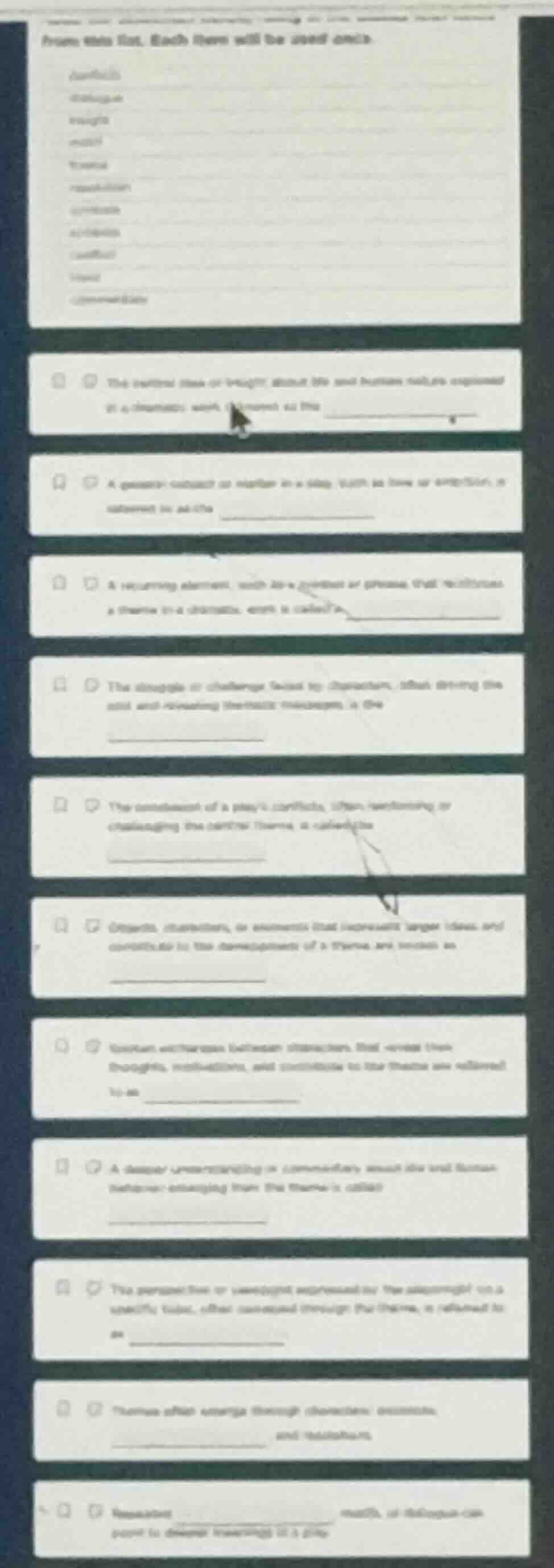
from the list. each item will be used once.
(words list: conflict, dialogue, insight, motif, theme, resolution, synthesis, dynamics, contrast, irony, commentary)
- the central idea or thought about life and human nature explored in a dramatic work, known as the ______
- a general outlook or attitude in a story (such as love or ambition), is conveyed in the ______
- a recurring element, such as a situation or phrase, that reinforces a theme in a dramatic work is called a ______
- the struggle or challenge faced by characters, often driving the plot and revealing thematic meanings, is the ______
- the conclusion of a play’s conflicts, often reaffirming or challenging the central theme, is called the ______
- objects, situations, or events that represent larger ideas and contribute to the development of a theme are known as ______
- short, witty remarks between characters that reveal their thoughts, intentions, and contribute to the theme are delivered by an ______
- a deeper understanding or commentary about life and human behavior emerging from the theme is called ______
- the perspective or viewpoint expressed on the subject of a specific idea, often conveyed through the theme, is reflected in an ______
- themes often emerge through characters’ decisions, ______, and relationships.
- repeating ______ motifs, or dialogue can help to develop meaning in a play
Brief Explanations
Each term is matched to its standard literary definition, using each list item once:
- The core belief about life in a literary work is its central thematic idea.
- A broad topic like love is the overarching subject of a play.
- A repeating element that reinforces a theme is a recurring device.
- The struggle driving plot is the central conflict of a narrative.
- The resolution of conflicts is the play's conclusion.
- Objects/characters representing larger ideas are symbols.
- Character speech exchanges are dialogue.
- A deeper meaning beyond the theme is the work's subtext.
- The author's viewpoint on a topic is their perspective.
- Themes emerge through actions, dialogue, and motifs.
- Repeating symbols, motifs, or dialogue reveal deeper meaning.

Snap & solve any problem in the app
Get step-by-step solutions on Sovi AI
Photo-based solutions with guided steps
Explore more problems and detailed explanations
- The central idea or insight about life and human nature explored in a dramatic work is known as the theme
- A general subject or matter in a play, such as love or ambition, is referred to as its topic
- A recurring element, such as a symbol or phrase, that reinforces a theme in a dramatic work is called a motif
- The struggle or challenge faced by characters, often driving the plot and reinforcing thematic messages is the conflict
- The conclusion of a play's conflicts, often reaffirming or challenging the central theme, is called the resolution
- Objects, characters, or events that represent larger ideas and contribute to the development of a theme are known as symbols
- Spoken exchanges between characters, that reveal their thoughts, motivations, and contribute to the theme are referred to as dialogue
- A deeper understanding or commentary about life and human nature, emerging from the theme is called subtext
- The perspective or viewpoint expressed by the playwright on a specific topic, often conveyed through the theme, is referred to as a perspective
- Themes often emerge through characters' decisions, dialogue, and situations.
- Repeating symbolic motifs, or dialogue can point to deeper meanings in a play.