QUESTION IMAGE
Question
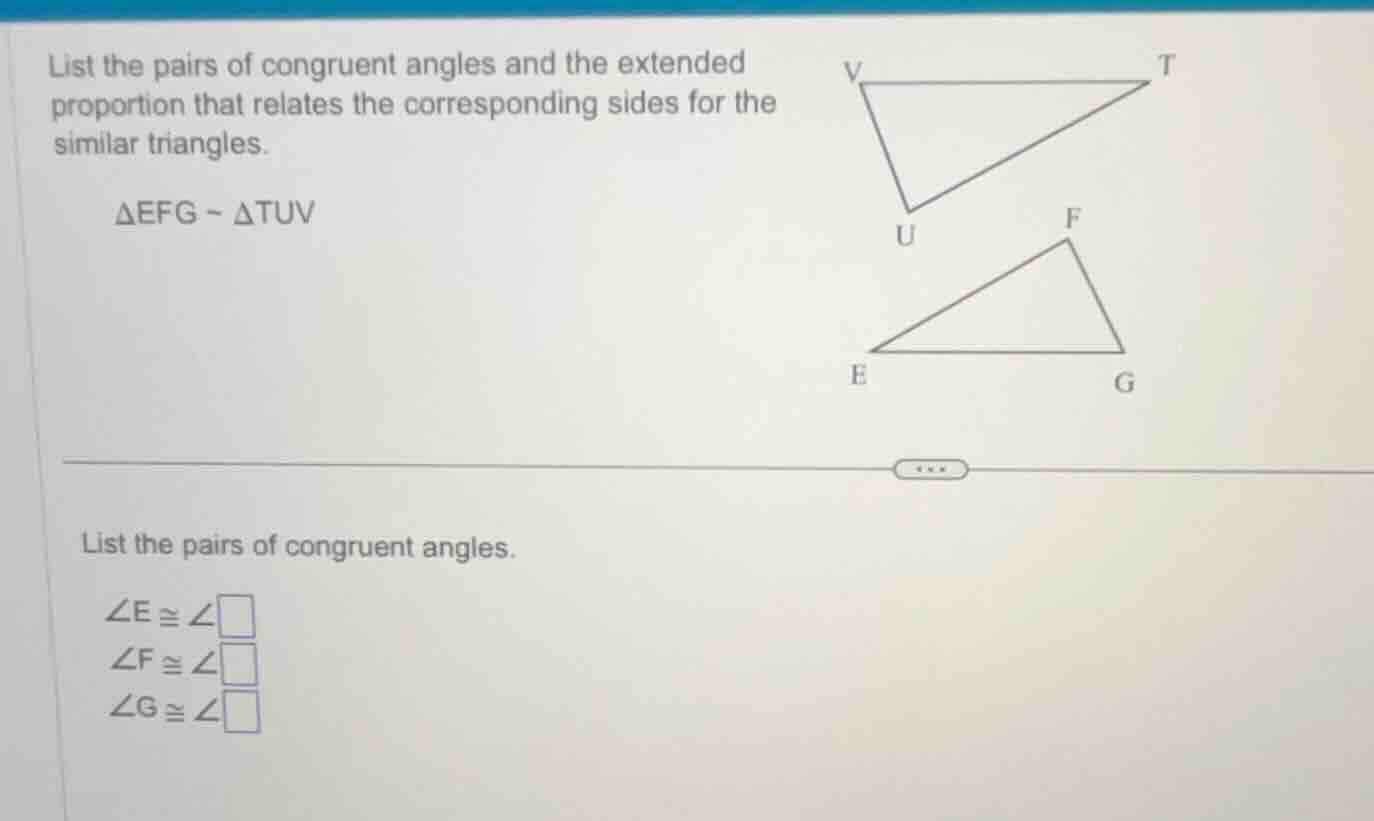
list the pairs of congruent angles and the extended proportion that relates the corresponding sides for the similar triangles.
△efg ~ △tuv
list the pairs of congruent angles.
∠e ≅ ∠□
∠f ≅ ∠□
∠g ≅ ∠□
Step1: Recall Similar Triangle Angle Correspondence
In similar triangles, corresponding angles are congruent. The order of the vertices in the similarity statement (ΔEFG ~ ΔTUV) gives the correspondence: E corresponds to T, F corresponds to U, G corresponds to V. Wait, no—wait, ΔEFG ~ ΔTUV means E ↔ T, F ↔ U, G ↔ V? Wait, no, let's check again. Wait, the notation ΔEFG ~ ΔTUV means that vertex E corresponds to T, F corresponds to U, G corresponds to V? Wait, no, maybe I mixed up. Wait, the similarity statement is ΔEFG ~ ΔTUV, so the order is E→T, F→U, G→V? Wait, no, let's think: when we write ΔABC ~ ΔDEF, then ∠A ≅ ∠D, ∠B ≅ ∠E, ∠C ≅ ∠F. So applying that, ΔEFG ~ ΔTUV: so E corresponds to T, F corresponds to U, G corresponds to V? Wait, no, wait the triangles: ΔEFG has vertices E, F, G; ΔTUV has T, U, V. So the correspondence is E ↔ T, F ↔ U, G ↔ V? Wait, but let's check the angles. Wait, maybe I made a mistake. Wait, let's look at the triangle labels. ΔEFG ~ ΔTUV: so angle E (at vertex E) corresponds to angle T (at vertex T), angle F (at F) corresponds to angle U (at U), angle G (at G) corresponds to angle V (at V). Wait, no, maybe the other way? Wait, no, the similarity statement is ΔEFG ~ ΔTUV, so the order is E-T, F-U, G-V. So ∠E ≅ ∠T, ∠F ≅ ∠U, ∠G ≅ ∠V. Wait, but let's confirm. Let's see the triangles: ΔEFG and ΔTUV. So E corresponds to T, F to U, G to V. So ∠E (in EFG) is congruent to ∠T (in TUV), ∠F ≅ ∠U, ∠G ≅ ∠V.
Step2: Fill in the Angles
So for ∠E ≅ ∠?, since E corresponds to T, so ∠E ≅ ∠T.
For ∠F ≅ ∠?, F corresponds to U, so ∠F ≅ ∠U.
For ∠G ≅ ∠?, G corresponds to V, so ∠G ≅ ∠V.

Snap & solve any problem in the app
Get step-by-step solutions on Sovi AI
Photo-based solutions with guided steps
Explore more problems and detailed explanations
∠E ≅ ∠T
∠F ≅ ∠U
∠G ≅ ∠V