QUESTION IMAGE
Question
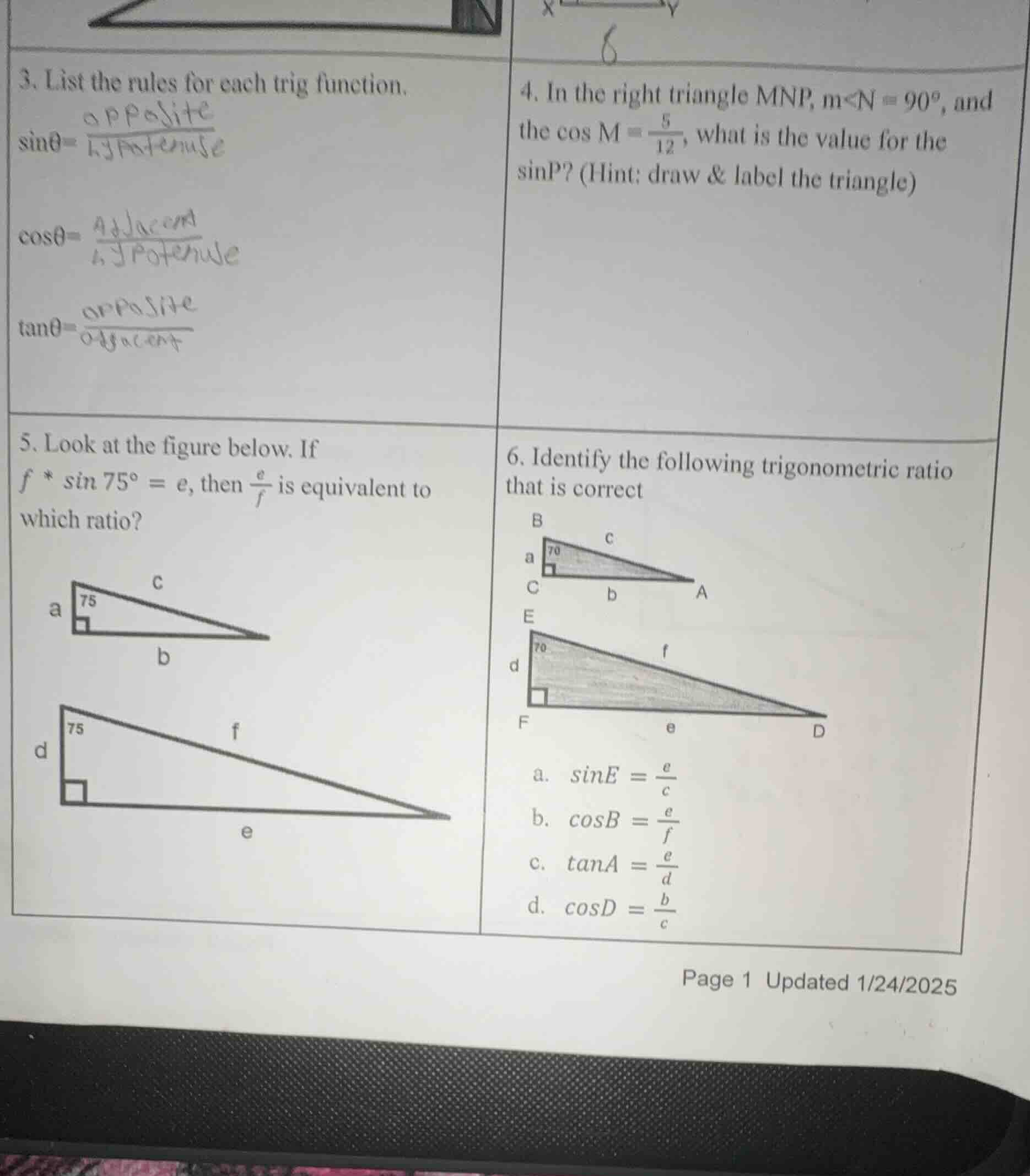
- list the rules for each trig function.
\\(\sin\theta=\frac{\text{opposite}}{\text{hypotenuse}}\\)
\\(\cos\theta=\frac{\text{adjacent}}{\text{hypotenuse}}\\)
\\(\tan\theta=\frac{\text{opposite}}{\text{adjacent}}\\)
- in the right triangle mnp, \\(m\angle n = 90^\circ\\), and the \\(\cos m = \frac{5}{12}\\), what is the value for the \\(\sin p\\)? (hint: draw & label the triangle)
- look at the figure below. if \\(f * \sin 75^\circ = e\\), then \\(\frac{e}{f}\\) is equivalent to which ratio?
- identify the following trigonometric ratio that is correct
a. \\(\sin e = \frac{a}{c}\\)
b. \\(\cos b = \frac{e}{f}\\)
c. \\(\tan a = \frac{e}{d}\\)
d. \\(\cos d = \frac{b}{c}\\)
Question 4 Solution:
Step1: Analyze the right triangle
In right triangle \( MNP \) with \( \angle N = 90^\circ \), \( \cos M=\frac{5}{12} \). By the definition of cosine, \( \cos M=\frac{\text{adjacent to } M}{\text{hypotenuse}} \). So, adjacent side to \( M \) (which is \( MN \)) is \( 5 \), and hypotenuse \( MP \) is \( 12 \).
Step2: Identify angles and sides for \( \sin P \)
In a right triangle, \( \angle M + \angle P=90^\circ \). For \( \sin P \), \( \sin P=\frac{\text{opposite to } P}{\text{hypotenuse}} \). The side opposite to \( P \) is \( MN \) (since \( \angle P \) and \( \angle M \) are complementary, the opposite side of \( P \) is the adjacent side of \( M \)).
Step3: Calculate \( \sin P \)
Since opposite side to \( P \) is \( 5 \) and hypotenuse is \( 12 \), \( \sin P = \frac{5}{12} \). Wait, no, wait. Wait, let's re - check. Wait, in right triangle \( MNP \), \( \angle N = 90^\circ \), so sides: \( MN \) (adjacent to \( M \)), \( NP \) (opposite to \( M \)), \( MP \) (hypotenuse). \( \cos M=\frac{MN}{MP}=\frac{5}{12} \), so \( MN = 5 \), \( MP = 12 \). Now, \( \angle P \): the side opposite to \( P \) is \( MN \), and hypotenuse is \( MP \). Wait, no, \( \angle P \): in triangle \( MNP \), angles sum to \( 180^\circ \), \( \angle N = 90^\circ \), so \( \angle M+\angle P = 90^\circ \). So \( \sin P=\cos M \) (because \( \sin(90^\circ - \theta)=\cos\theta \)). Since \( \cos M=\frac{5}{12} \), then \( \sin P=\frac{5}{12} \)? Wait, no, wait, maybe I mixed up the sides. Wait, let's draw the triangle: vertices \( M \), \( N \), \( P \), right - angled at \( N \). So \( MN \) and \( NP \) are legs, \( MP \) is hypotenuse. \( \angle M \) is at vertex \( M \), so the sides: adjacent to \( M \) is \( MN \), opposite to \( M \) is \( NP \), hypotenuse \( MP \). \( \cos M=\frac{MN}{MP}=\frac{5}{12} \), so \( MN = 5 \), \( MP = 12 \). Now, \( \angle P \) is at vertex \( P \), so the side opposite to \( P \) is \( MN \), and hypotenuse is \( MP \). So \( \sin P=\frac{\text{opposite to } P}{\text{hypotenuse}}=\frac{MN}{MP}=\frac{5}{12} \). Wait, but that seems too easy. Wait, no, wait, maybe I made a mistake. Wait, \( \sin P=\frac{NP}{MP} \)? No, no. Wait, \( \angle P \): the side opposite to \( P \) is \( MN \), because \( \angle P \) is at \( P \), so the side opposite is \( MN \) (from \( P \) to \( M \)'s adjacent side). Wait, let's use the co - function identity: \( \sin P=\sin(90^\circ - M)=\cos M \). Since \( \cos M = \frac{5}{12} \), then \( \sin P=\frac{5}{12} \).
Step1: Start with the given equation
We are given \( f\times\sin75^{\circ}=e \). We need to find \( \frac{e}{f} \).
Step2: Solve for \( \frac{e}{f} \)
Divide both sides of the equation \( f\times\sin75^{\circ}=e \) by \( f \) (assuming \( f
eq0 \)). We get \( \frac{e}{f}=\sin75^{\circ} \).
Let's analyze each option:
- Option a: In triangle \( ABC \), right - angled at \( C \), \( \sin E \) (wait, no, triangle \( ABC \): right - angled at \( C \), angle at \( B \) is \( 70^\circ \). \( \sin B=\frac{\text{opposite to } B}{\text{hypotenuse}}=\frac{AC}{AB}=\frac{b}{c} \), not \( \frac{a}{c} \). So option a is wrong.
- Option b: In triangle \( EFD \), right - angled at \( F \), angle at \( E \) is \( 70^\circ \). In triangle \( ABC \), angle at \( B \) is \( 70^\circ \). \( \cos B=\frac{\text{adjacent to } B}{\text{hypotenuse}}=\frac{BC}{AB}=\frac{a}{c} \), not \( \frac{e}{f} \). Wait, no, let's look at triangle \( EFD \): \( \cos E=\frac{\text{adjacent to } E}{\text{hypotenuse}}=\frac{EF}{ED}=\frac{e}{f} \). And since \( \angle B = \angle E = 70^\circ \), \( \cos B=\cos E=\frac{e}{f} \). So option b is correct.
- Option c: In triangle \( ABC \), \( \tan A=\frac{\text{opposite to } A}{\text{adjacent to } A}=\frac{BC}{AC}=\frac{a}{b} \), not \( \frac{e}{d} \). So option c is wrong.
- Option d: In triangle \( ABC \), \( \cos D \): wait, \( D \) is in triangle \( EFD \). \( \cos D=\frac{\text{adjacent to } D}{\text{hypotenuse}}=\frac{FD}{ED}=\frac{e}{f} \), not \( \frac{b}{c} \). So option d is wrong.

Snap & solve any problem in the app
Get step-by-step solutions on Sovi AI
Photo-based solutions with guided steps
Explore more problems and detailed explanations
\(\frac{5}{12}\)