QUESTION IMAGE
Question
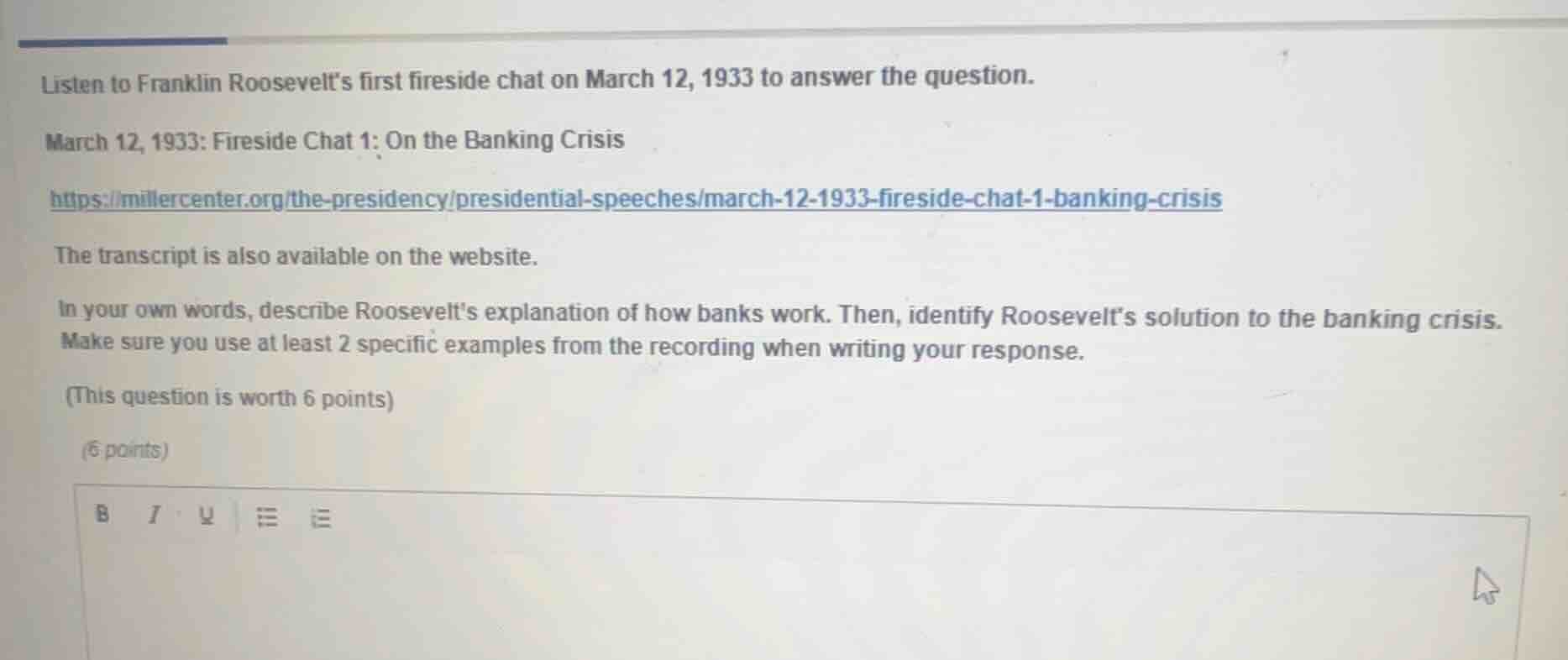
listen to franklin roosevelt’s first fireside chat on march 12, 1933 to answer the question.
march 12, 1933: fireside chat 1: on the banking crisis
h ttps://millercenter.org/the-presidency/presidential-speeches/march-12-1933-fireside-chat-1-banking-crisis
the transcript is also available on the website.
in your own words, describe roosevelt’s explanation of how banks work. then, identify roosevelt’s solution to the banking crisis. make sure you use at least 2 specific examples from the recording when writing your response.
(this question is worth 6 points)
(6 points)
Brief Explanations
- Roosevelt's explanation of banks: He framed banks as intermediaries that hold deposits from savers, then lend most of that money to other people (for things like homes, businesses) rather than keeping all cash on hand. He used the example of a farmer who deposits money after selling a crop; that money is lent to a neighbor to buy farm equipment, so the original depositor's cash is not all stored in the bank vault. He also noted that when too many people demand all their cash at once (a bank run), banks cannot meet these demands because most funds are loaned out, causing the bank to fail.
- Roosevelt's solution: He announced a temporary "bank holiday" where all banks closed for four days to stop ongoing runs. After this, only banks that were verified as financially sound by government inspectors would be allowed to reopen. A specific example is that smaller, local banks that passed inspection would reopen first, followed by larger city banks, to rebuild public trust incrementally. He also mentioned the creation of federal insurance (what would become the FDIC) implicitly, by stating the government would guarantee deposits to prevent future panics.

Snap & solve any problem in the app
Get step-by-step solutions on Sovi AI
Photo-based solutions with guided steps
Explore more problems and detailed explanations
- Roosevelt's explanation of how banks work: Roosevelt explained that banks do not keep all depositors' cash in vaults. Instead, they take most of the money people deposit and lend it out to others (such as farmers buying equipment or people purchasing homes) to stimulate economic activity. He used the example of a farmer who deposits crop sale proceeds; that money is not held in the bank but is lent to a neighbor, so only a small portion of deposits is kept as on-hand cash. When mass bank runs occurred, banks could not give everyone their money back because most funds were loaned out, leading to bank failures.
- Roosevelt's solution to the banking crisis: His core solution was a nationwide "bank holiday" that closed all U.S. banks for four days to halt the ongoing panic and bank runs. After the holiday, only banks that passed government inspections to prove they were financially stable would be allowed to reopen. A specific example is that smaller, community banks that were solvent would reopen first, followed by larger urban banks, to gradually rebuild public confidence. He also assured listeners that the government would back legitimate banks, laying the groundwork for federal deposit insurance to prevent future panics.