QUESTION IMAGE
Question
look at this set of ordered pairs:
(-20, 8)
(14, 8)
(9, -15)
(14, -15)
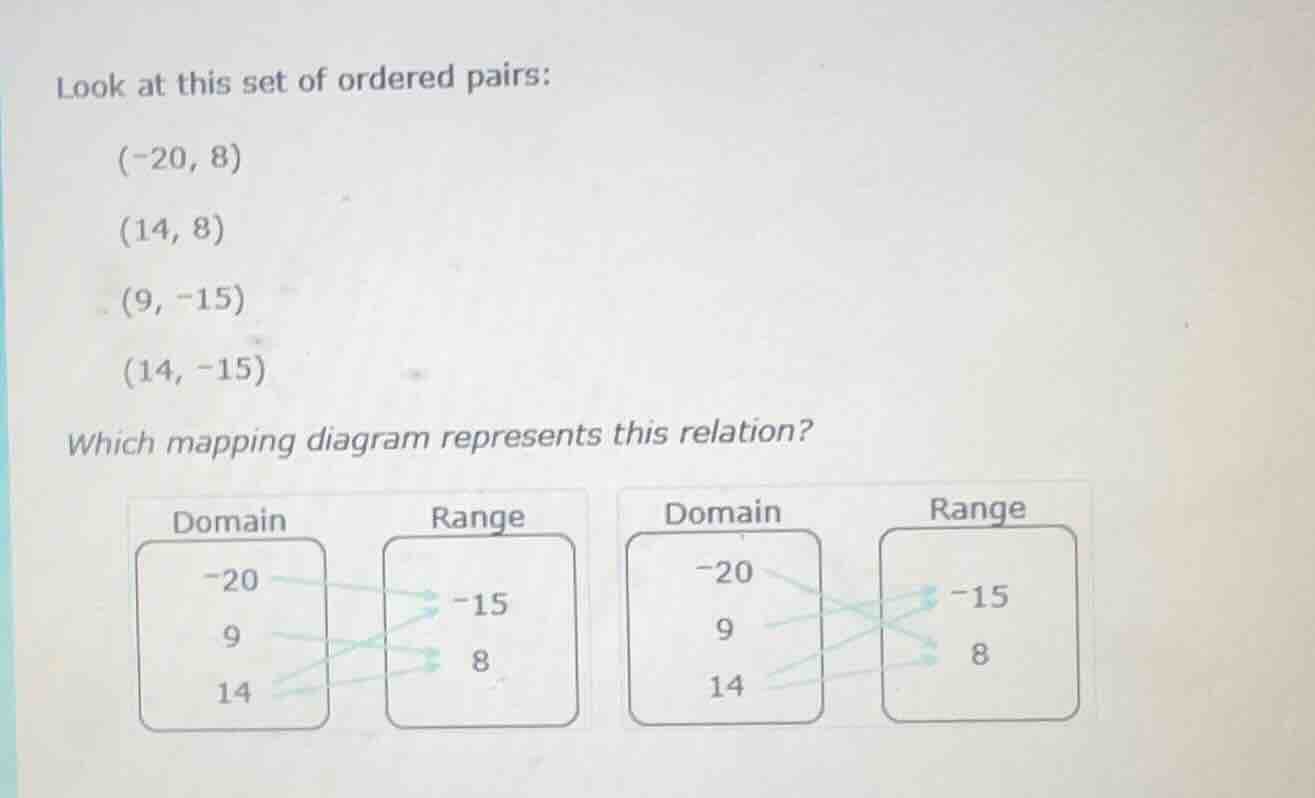
which mapping diagram represents this relation?
Step1: Identify Domain and Range
The domain is the set of all x - values from the ordered pairs: \(\{-20, 14, 9\}\) (we list each unique x - value). The range is the set of all y - values from the ordered pairs: \(\{8, - 15\}\) (we list each unique y - value).
Step2: Analyze Mappings
- For the ordered pair \((-20, 8)\), we map \(-20\) to \(8\).
- For the ordered pair \((14, 8)\), we map \(14\) to \(8\).
- For the ordered pair \((9, - 15)\), we map \(9\) to \(-15\).
- For the ordered pair \((14, - 15)\), we map \(14\) to \(-15\).
Now let's check the mapping diagrams:
- In the first diagram:
- \(-20\) is mapped to \(-15\) (which is wrong, should be mapped to \(8\)).
- \(9\) is mapped to \(8\) (which is wrong, should be mapped to \(-15\)).
- \(14\) is mapped to both \(-15\) and \(8\) (correct for \(14\), but the other mappings are wrong).
- In the second diagram:
- \(-20\) is mapped to \(8\) (correct).
- \(9\) is mapped to \(-15\) (correct).
- \(14\) is mapped to both \(8\) and \(-15\) (correct, since \(14\) is paired with both \(8\) and \(-15\) in the ordered pairs).

Snap & solve any problem in the app
Get step-by-step solutions on Sovi AI
Photo-based solutions with guided steps
Explore more problems and detailed explanations
The second mapping diagram (the one where \(-20\) maps to \(8\), \(9\) maps to \(-15\), and \(14\) maps to both \(8\) and \(-15\))