QUESTION IMAGE
Question
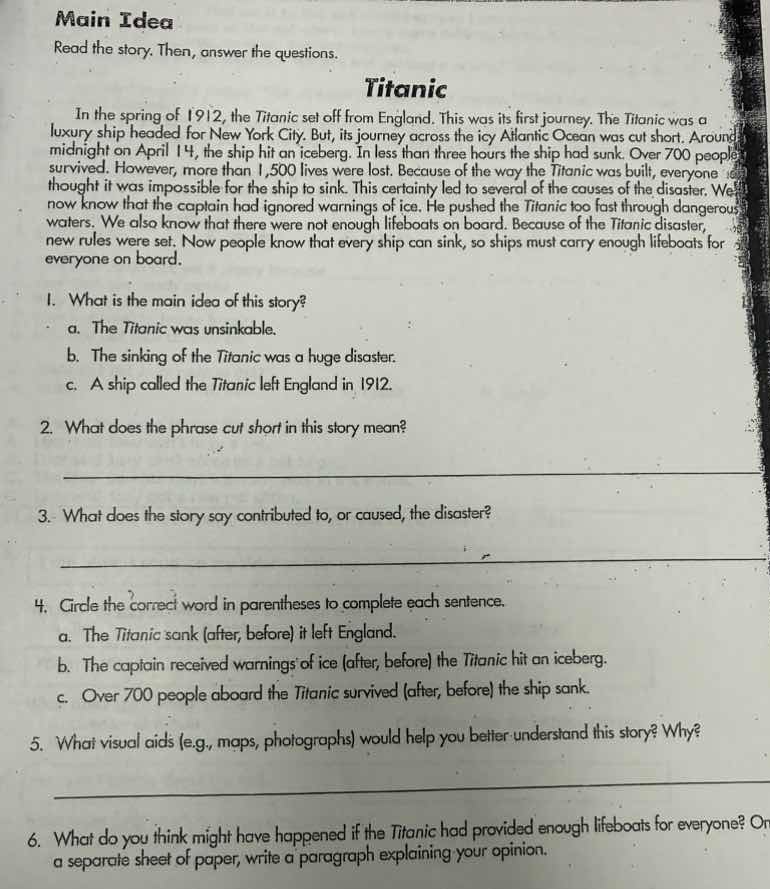
main idea
read the story, then, answer the questions.
titanic
in the spring of 1912, the titanic set off from england. this was its first journey. the titanic was a luxury ship headed for new york city. but, its journey across the icy atlantic ocean was cut short. around midnight on april 14, the ship hit an iceberg. in less than three hours the ship had sunk. over 700 people survived. however, more than 1,500 lives were lost. because of the way the titanic was built, everyone thought it was impossible for the ship to sink. this certainly led to several of the causes of the disaster. we now know that the captain had ignored warnings of ice. he pushed the titanic too fast through dangerous waters. we also know that there were not enough lifeboats on board. because of the titanic disaster, new rules were set. now people know that every ship can sink, so ships must carry enough lifeboats for everyone on board.
- what is the main idea of this story?
a. the titanic was unsinkable.
b. the sinking of the titanic was a huge disaster.
c. a ship called the titanic left england in 1912.
- what does the phrase cut short in this story mean?
_____________________________________________________________________
- what does the story say contributed to, or caused, the disaster?
_____________________________________________________________________
- circle the correct word in parentheses to complete each sentence.
a. the titanic sank (after, before) it left england.
b. the captain received warnings of ice (after, before) the titanic hit an iceberg.
c. over 700 people aboard the titanic survived (after, before) the ship sank.
- what visual aids (e.g., maps, photographs) would help you better understand this story? why?
_____________________________________________________________________
- what do you think might have happened if the titanic had provided enough lifeboats for everyone? on a separate sheet of paper, write a paragraph explaining your opinion.
- For question 1, the story focuses on the Titanic's sinking, the large loss of life, and its aftermath, so the main idea is that the sinking was a huge disaster.
- For question 2, the phrase "cut short" refers to the Titanic's journey ending earlier than planned because it hit an iceberg and sank.
- For question 3, the story lists three contributing factors: the ship was thought unsinkable, the captain ignored ice warnings and sailed too fast in dangerous waters, and there were not enough lifeboats.
- For question 4, we use the timeline from the story: the ship sank after leaving England, the captain got ice warnings before hitting the iceberg, and people survived after the ship sank.
- For question 5, visual aids like a map of the Titanic's route shows where the disaster happened, a diagram of the ship helps understand its layout/lifeboat placement, and photos of the Titanic or icebergs give context to the event.
- For question 6, if there were enough lifeboats, most passengers and crew could have evacuated safely, reducing casualties, though some might still have died from cold water exposure.

Snap & solve any problem in the app
Get step-by-step solutions on Sovi AI
Photo-based solutions with guided steps
Explore more problems and detailed explanations
- b. The sinking of the Titanic was a huge disaster.
- It means the Titanic's journey ended abruptly earlier than intended.
- - Everyone thought the ship was unsinkable, leading to overconfidence.
- The captain ignored ice warnings and sailed too fast in icy waters.
- There were not enough lifeboats on the ship.
- a. after
b. before
c. after
- Example 1: A map of the Titanic's route. It would show the location of the iceberg collision and the ship's path, helping visualize where the disaster occurred.
Example 2: A diagram of the Titanic's deck layout. It would show how few lifeboats there were relative to the number of passengers, clarifying why so many died.
- If the Titanic had enough lifeboats for everyone, the vast majority of the 2,200+ passengers and crew would likely have survived the initial sinking. While some people might still have perished from hypothermia if they fell into the frigid Atlantic waters before reaching a lifeboat, the massive loss of over 1,500 lives would have been avoided. Lifeboats could have systematically evacuated people from the sinking ship, and nearby rescue vessels like the Carpathia could have picked up those in the lifeboats with far fewer fatalities. This would have changed the legacy of the Titanic from a symbol of catastrophic failure to a cautionary tale about preparedness, rather than one of massive loss of life.