QUESTION IMAGE
Question
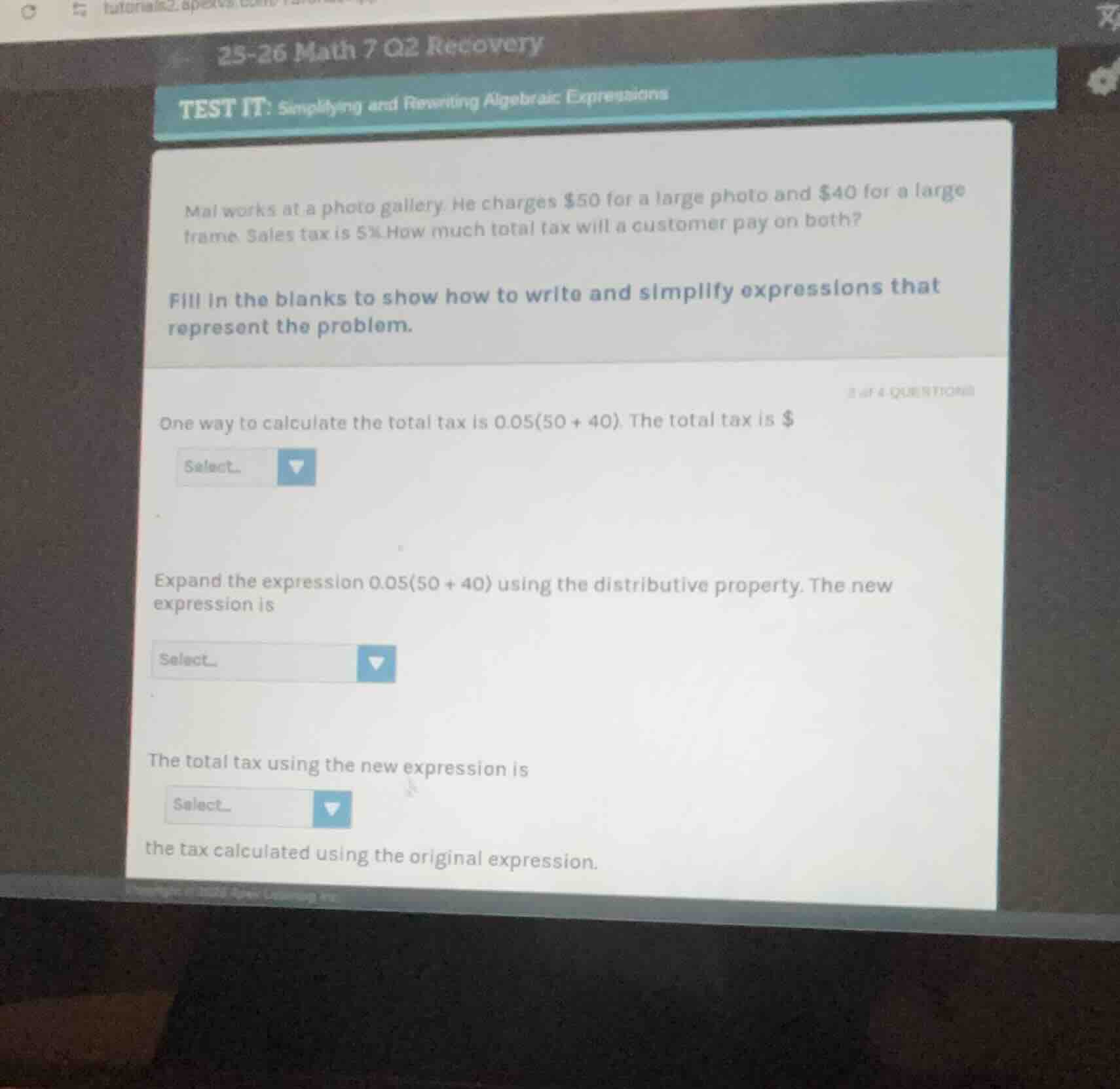
mal works at a photo gallery. he charges $50 for a large photo and $40 for a large frame. sales tax is 5%. how much total tax will a customer pay on both? fill in the blanks to show how to write and simplify expressions that represent the problem. 3 of 4 questions one way to calculate the total tax is 0.05(50 + 40). the total tax is $ select... expand the expression 0.05(50 + 40) using the distributive property. the new expression is select... the total tax using the new expression is select... the tax calculated using the original expression.
First Blank (Total Tax Amount)
Step1: Calculate inside the parentheses
First, add the cost of the photo and the frame: \( 50 + 40 = 90 \)
Step2: Multiply by the tax rate
Then, multiply the sum by the tax rate (0.05): \( 0.05 \times 90 = 4.5 \)
Step1: Apply the distributive property
The distributive property states that \( a(b + c) = ab + ac \). Here, \( a = 0.05 \), \( b = 50 \), and \( c = 40 \). So, \( 0.05(50 + 40) = 0.05 \times 50 + 0.05 \times 40 \)
Step2: Simplify each term (optional for expression)
Calculating each term: \( 0.05 \times 50 = 2.5 \) and \( 0.05 \times 40 = 2 \), but the expanded expression is \( 0.05 \times 50 + 0.05 \times 40 \) (or simplified as \( 2.5 + 2 \), but the expanded form from distribution is \( 0.05(50) + 0.05(40) \))
Step1: Recall the distributive property
The distributive property ensures that \( a(b + c) = ab + ac \), so both expressions (original and expanded) should give the same result. We calculated the total tax as \( 4.5 \) using the original expression, and using the expanded expression: \( 2.5 + 2 = 4.5 \), which is the same.
Step2: Determine the relationship
Since both methods give the same tax amount, the total tax using the new expression is equal to the tax calculated using the original expression.

Snap & solve any problem in the app
Get step-by-step solutions on Sovi AI
Photo-based solutions with guided steps
Explore more problems and detailed explanations
\( 4.5 \)