QUESTION IMAGE
Question
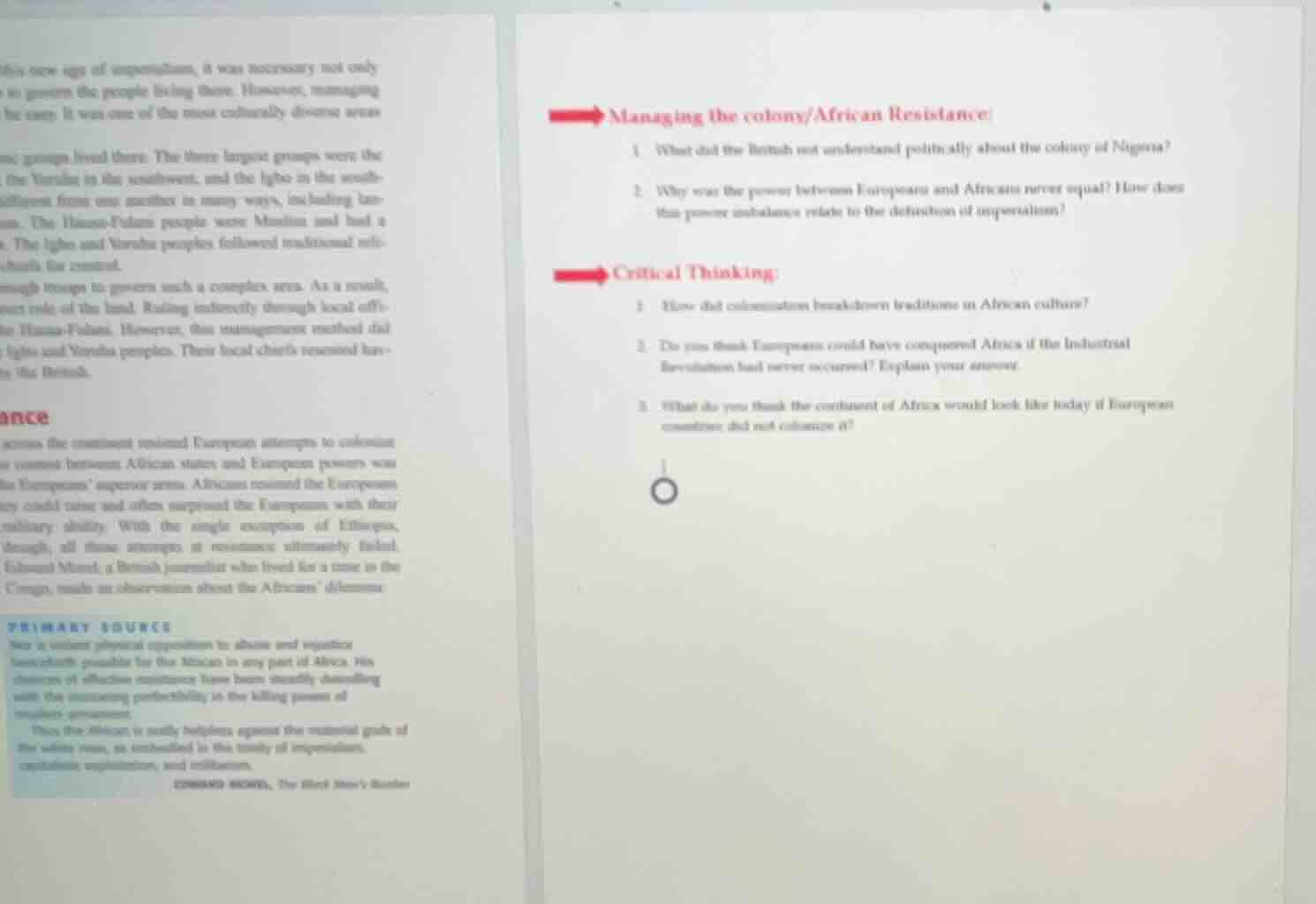
managing the colony/african resistance
1 what did the british not understand politically about the colony of nigeria?
2 why was the power between europeans and africans never equal? how does this power imbalance relate to the definition of imperialism?
critical thinking
1 how did colonization breakdown traditions in african culture?
2 do you think europeans could have conquered africa if the industrial revolution had never occurred? explain your answer.
3 what do you think the continent of africa would look like today if european countries did not colonize it?
Brief Explanations
- The British failed to grasp that Nigeria was not a single unified political entity, but a collection of distinct, self-governing ethnic groups (like the Hausa-Fulani, Yoruba, and Igbo) with their own political systems, laws, and loyalties, rather than a centralized nation.
- Europeans held superior military technology (like machine guns, artillery, and steam-powered transport) developed during the Industrial Revolution, along with economic and organizational advantages. This imbalance is core to imperialism, as imperialism relies on a stronger power extending political, economic, and cultural control over a weaker territory or people through this inherent power gap.
- Colonization broke down African cultural traditions by imposing European legal systems, religions, and educational structures that undermined local customs; forcing labor systems that disrupted family and community structures; redrawing political borders that split ethnic groups and destroyed traditional governance; and devaluing African cultural practices to legitimize European rule.
- Europeans likely could not have conquered Africa without the Industrial Revolution. The revolution provided the advanced weapons, steamships, and railways that allowed them to traverse and control African territories, as well as the economic motives (access to raw materials, new markets) that drove expansion. Without these technological and economic tools, European powers would have lacked the means to overcome large-scale African resistance and control vast inland areas.
- Without European colonization, Africa would likely consist of nations shaped by pre-colonial ethnic and political boundaries, with more continuity of traditional governance systems. Economies would have developed based on indigenous trade networks and resources, rather than being structured to extract wealth for European powers. Cultural traditions, languages, and religious practices would have evolved without the forced imposition of European norms, and there would be less of the artificial ethnic tension created by arbitrary colonial border divisions.

Snap & solve any problem in the app
Get step-by-step solutions on Sovi AI
Photo-based solutions with guided steps
Explore more problems and detailed explanations
- The British did not understand that Nigeria was a collection of distinct, self-governing ethnic groups with separate political systems, not a single unified political entity.
- Power was unequal because Europeans had vastly superior military technology, economic resources, and organizational capacity from the Industrial Revolution. This imbalance is the foundation of imperialism, as imperialism is defined by a stronger power exerting control over a weaker, less developed territory/people through such disparities.
- Colonization broke down African cultural traditions by imposing European legal, religious, and educational systems that displaced local customs; disrupting family and community structures through forced labor; redrawing borders that split ethnic groups and destroyed traditional governance; and devaluing African cultural practices to legitimize foreign rule.
- No, Europeans likely could not have conquered Africa without the Industrial Revolution. The revolution provided the advanced weapons, transportation (steamships, railways), and economic infrastructure that allowed them to penetrate and control African territories, which they would have lacked without this technological and economic shift, making large-scale conquest unfeasible against organized African resistance.
- Without European colonization, Africa would likely have nations defined by pre-colonial ethnic and political boundaries, with preserved traditional governance systems. Its economies would be rooted in indigenous trade and resource use rather than extractive European models, cultural traditions would evolve without forced European influence, and there would be far less artificial ethnic conflict from arbitrary colonial border divisions.