QUESTION IMAGE
Question
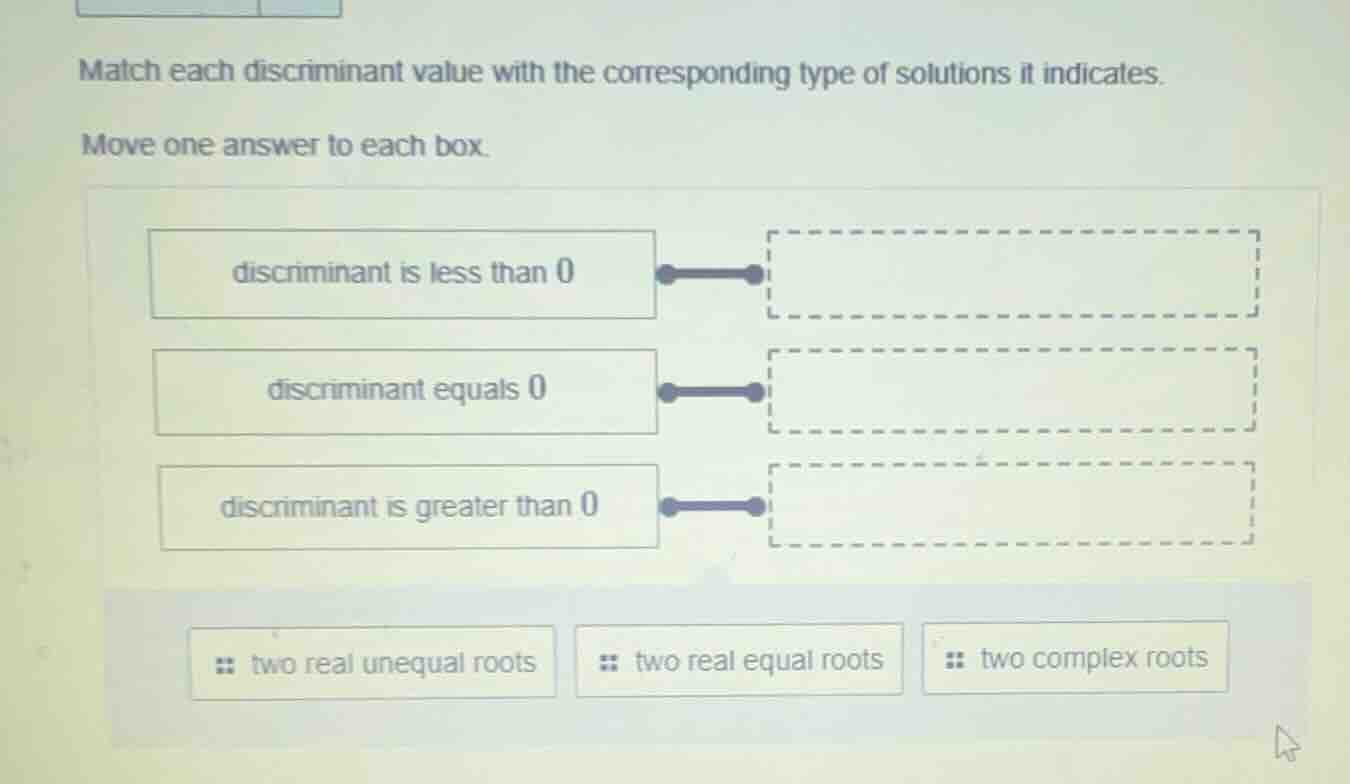
match each discriminant value with the corresponding type of solutions it indicates. move one answer to each box. discriminant is less than 0 discriminant equals 0 discriminant is greater than 0 two real unequal roots two real equal roots two complex roots
Brief Explanations
For a quadratic equation $ax^2+bx+c=0$, the discriminant is $\Delta = b^2-4ac$.
- When $\Delta < 0$, the square root of a negative number results in complex numbers, so there are two complex roots.
- When $\Delta = 0$, the quadratic formula gives a single repeated real solution, so there are two real equal roots.
- When $\Delta > 0$, the quadratic formula yields two distinct real values, so there are two real unequal roots.

Snap & solve any problem in the app
Get step-by-step solutions on Sovi AI
Photo-based solutions with guided steps
Explore more problems and detailed explanations
- discriminant is less than 0 → two complex roots
- discriminant equals 0 → two real equal roots
- discriminant is greater than 0 → two real unequal roots