QUESTION IMAGE
Question
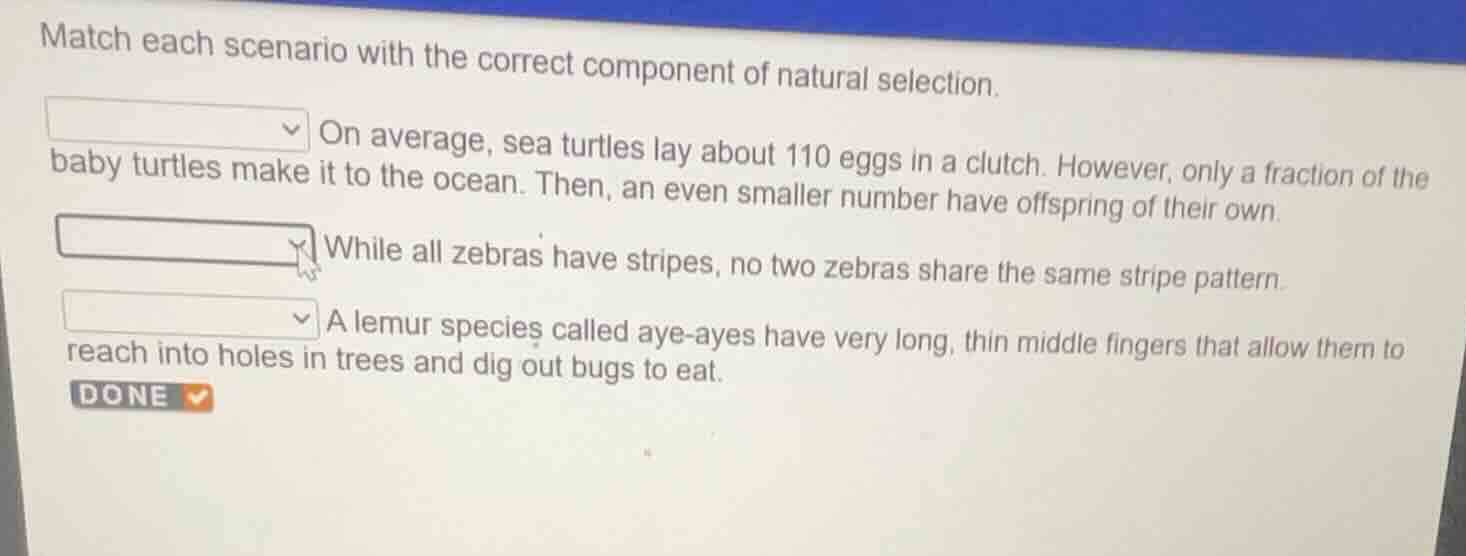
match each scenario with the correct component of natural selection.
on average, sea turtles lay about 110 eggs in a clutch. however, only a fraction of the baby turtles make it to the ocean. then, an even smaller number have offspring of their own.
while all zebras have stripes, no two zebras share the same stripe pattern.
a lemur species called aye - ayes have very long, thin middle fingers that allow them to reach into holes in trees and dig out bugs to eat.
done
Brief Explanations
- For the sea turtle scenario: This describes that more offspring are produced than can survive to reproduce, which aligns with overproduction (a core component of natural selection).
- For the zebra scenario: This shows that individuals in a population have unique traits, which is variation (differences among members of a population, a necessary condition for natural selection).
- For the aye-aye scenario: This trait (long thin middle finger) helps the organism survive and obtain food, which is adaptation (a heritable trait that improves an organism's fitness in its environment).

Snap & solve any problem in the app
Get step-by-step solutions on Sovi AI
Photo-based solutions with guided steps
Explore more problems and detailed explanations
- On average, sea turtles lay about 110 eggs in a clutch. However, only a fraction of the baby turtles make it to the ocean. Then, an even smaller number have offspring of their own. → Overproduction
- While all zebras have stripes, no two zebras share the same stripe pattern. → Variation
- A lemur species called aye-ayes have very long, thin middle fingers that allow them to reach into holes in trees and dig out bugs to eat. → Adaptation