QUESTION IMAGE
Question
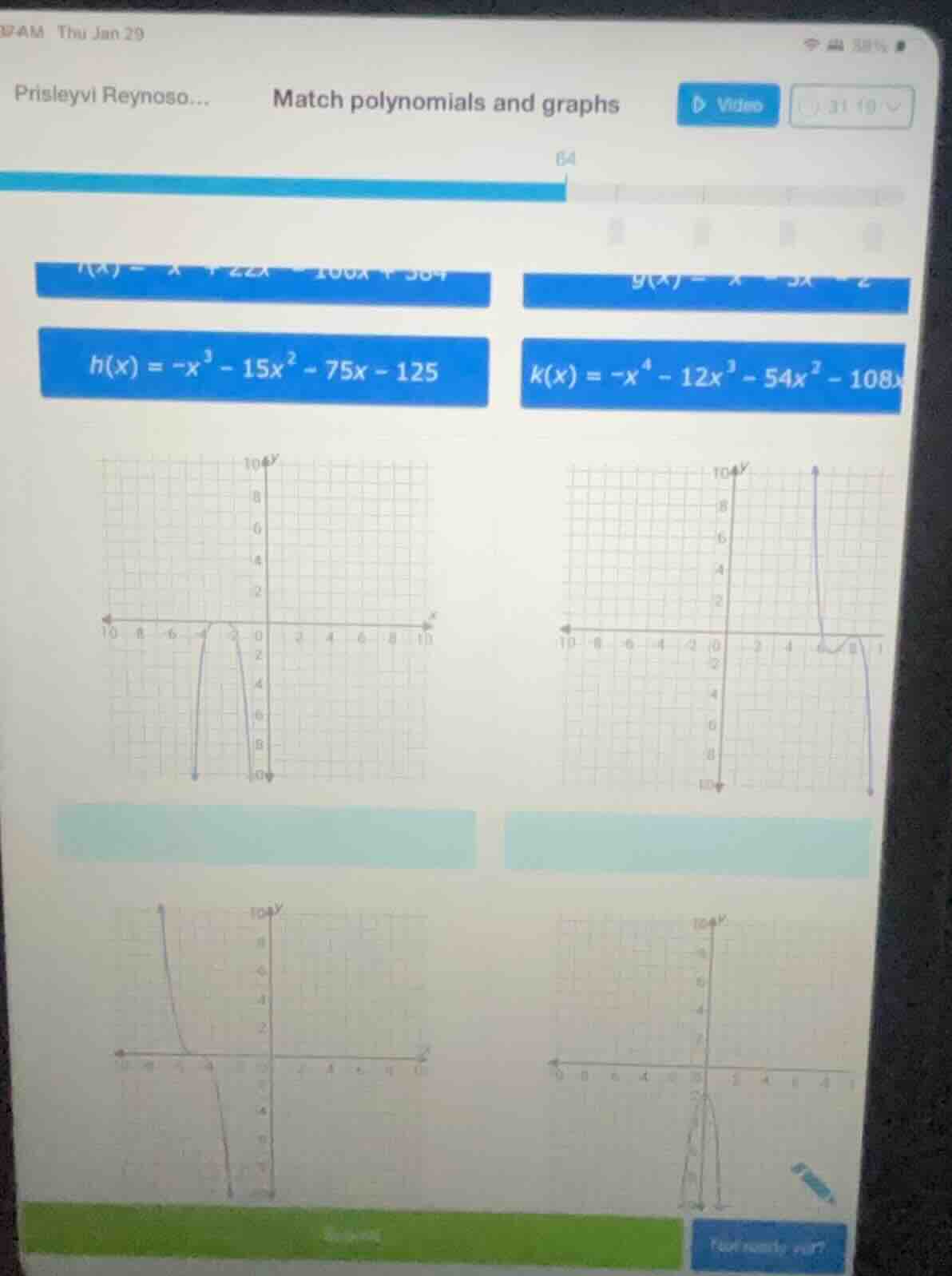
match polynomials and graphs
( h(x) = -x^3 - 15x^2 - 75x - 125 )
( k(x) = -x^4 - 12x^3 - 54x^2 - 108x )
To solve the problem of matching the polynomial \( h(x) = -x^3 - 15x^2 - 75x - 125 \) to its graph, we analyze the polynomial:
Step 1: Factor the Polynomial
First, we factor \( h(x) \). Notice that \( h(x) \) can be rewritten by factoring out the negative sign and then recognizing a perfect cube:
\[
\]
Step 2: Analyze the End Behavior
For a cubic function \( y = ax^3 + bx^2 + cx + d \), the end behavior is determined by the leading coefficient \( a \) and the degree (3, which is odd). Here, the leading coefficient of \( h(x) \) (after factoring) is \( -1 \) (since \( h(x) = - (x + 5)^3 \)).
- When the degree is odd and the leading coefficient is negative:
- As \( x \to +\infty \), \( y \to -\infty \) (because \( x^3 \) dominates, and with a negative coefficient, it goes to negative infinity).
- As \( x \to -\infty \), \( y \to +\infty \) (because \( (-x)^3 = -x^3 \), and with a negative coefficient, \( -(-x^3) = x^3 \), so it goes to positive infinity).
Step 3: Analyze the Root (x-intercept)
The root of \( h(x) \) is found by setting \( h(x) = 0 \):
\[
- (x + 5)^3 = 0 \implies (x + 5)^3 = 0 \implies x = -5
\]
This is a repeated root (multiplicity 3), so the graph touches and turns around at \( x = -5 \) (but since the multiplicity is odd, it actually crosses the axis, but with a "flatter" appearance due to the higher multiplicity). Wait, actually, for a cubic with a triple root, the graph has a point of inflection at the root. However, the key here is the end behavior and the root.
Step 4: Match to the Graph
Looking at the graphs, we need one with end behavior: as \( x \to +\infty \), \( y \to -\infty \) and as \( x \to -\infty \), \( y \to +\infty \) (which is characteristic of a cubic with a negative leading coefficient). Additionally, the root at \( x = -5 \).
Among the given graphs, the graph with the following features:
- End behavior: down on the right (as \( x \to +\infty \), \( y \to -\infty \)) and up on the left (as \( x \to -\infty \), \( y \to +\infty \)).
- A root at \( x = -5 \).
This matches the graph that has a single real root (with multiplicity 3) at \( x = -5 \) and the correct end behavior for a cubic with a negative leading coefficient.
So, the polynomial \( h(x) = -x^3 - 15x^2 - 75x - 125 \) (which factors to \( - (x + 5)^3 \)) matches the graph with end behavior up on the left, down on the right, and a root at \( x = -5 \).

Snap & solve any problem in the app
Get step-by-step solutions on Sovi AI
Photo-based solutions with guided steps
Explore more problems and detailed explanations
To solve the problem of matching the polynomial \( h(x) = -x^3 - 15x^2 - 75x - 125 \) to its graph, we analyze the polynomial:
Step 1: Factor the Polynomial
First, we factor \( h(x) \). Notice that \( h(x) \) can be rewritten by factoring out the negative sign and then recognizing a perfect cube:
\[
\]
Step 2: Analyze the End Behavior
For a cubic function \( y = ax^3 + bx^2 + cx + d \), the end behavior is determined by the leading coefficient \( a \) and the degree (3, which is odd). Here, the leading coefficient of \( h(x) \) (after factoring) is \( -1 \) (since \( h(x) = - (x + 5)^3 \)).
- When the degree is odd and the leading coefficient is negative:
- As \( x \to +\infty \), \( y \to -\infty \) (because \( x^3 \) dominates, and with a negative coefficient, it goes to negative infinity).
- As \( x \to -\infty \), \( y \to +\infty \) (because \( (-x)^3 = -x^3 \), and with a negative coefficient, \( -(-x^3) = x^3 \), so it goes to positive infinity).
Step 3: Analyze the Root (x-intercept)
The root of \( h(x) \) is found by setting \( h(x) = 0 \):
\[
- (x + 5)^3 = 0 \implies (x + 5)^3 = 0 \implies x = -5
\]
This is a repeated root (multiplicity 3), so the graph touches and turns around at \( x = -5 \) (but since the multiplicity is odd, it actually crosses the axis, but with a "flatter" appearance due to the higher multiplicity). Wait, actually, for a cubic with a triple root, the graph has a point of inflection at the root. However, the key here is the end behavior and the root.
Step 4: Match to the Graph
Looking at the graphs, we need one with end behavior: as \( x \to +\infty \), \( y \to -\infty \) and as \( x \to -\infty \), \( y \to +\infty \) (which is characteristic of a cubic with a negative leading coefficient). Additionally, the root at \( x = -5 \).
Among the given graphs, the graph with the following features:
- End behavior: down on the right (as \( x \to +\infty \), \( y \to -\infty \)) and up on the left (as \( x \to -\infty \), \( y \to +\infty \)).
- A root at \( x = -5 \).
This matches the graph that has a single real root (with multiplicity 3) at \( x = -5 \) and the correct end behavior for a cubic with a negative leading coefficient.
So, the polynomial \( h(x) = -x^3 - 15x^2 - 75x - 125 \) (which factors to \( - (x + 5)^3 \)) matches the graph with end behavior up on the left, down on the right, and a root at \( x = -5 \).