QUESTION IMAGE
Question
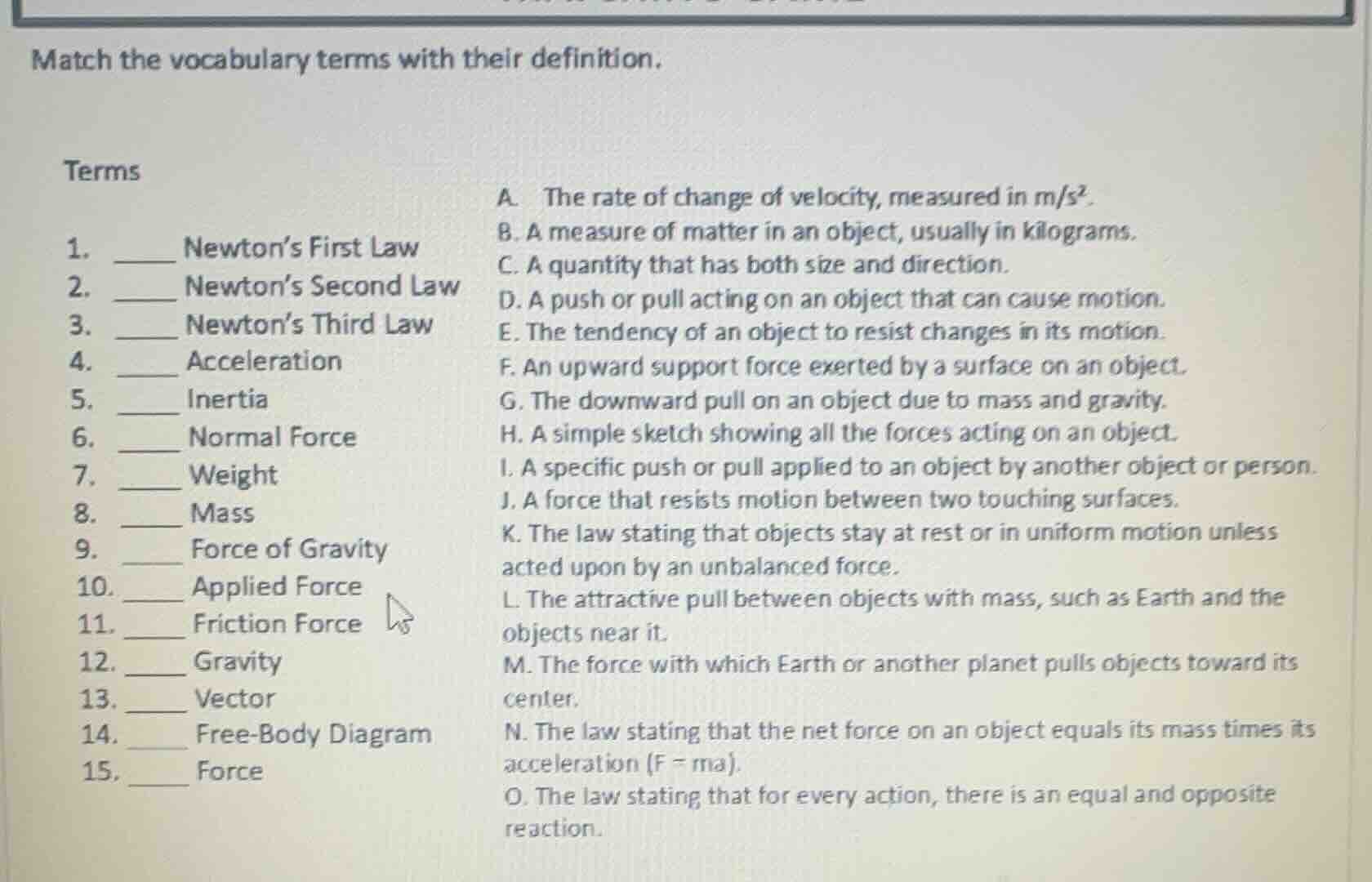
match the vocabulary terms with their definition.
terms
- ____ newton’s first law
- ____ newton’s second law
- ____ newton’s third law
- ____ acceleration
- ____ inertia
- ____ normal force
- ____ weight
- ____ mass
- ____ force of gravity
- ____ applied force
- ____ friction force
- ____ gravity
- ____ vector
- ____ free - body diagram
- ____ force
a. the rate of change of velocity, measured in m/s².
b. a measure of matter in an object, usually in kilograms.
c. a quantity that has both size and direction.
d. a push or pull acting on an object that can cause motion.
e. the tendency of an object to resist changes in its motion.
f. an upward support force exerted by a surface on an object.
g. the downward pull on an object due to mass and gravity.
h. a simple sketch showing all the forces acting on an object.
i. a specific push or pull applied to an object by another object or person.
j. a force that resists motion between two touching surfaces.
k. the law stating that objects stay at rest or in uniform motion unless acted upon by an unbalanced force.
l. the attractive pull between objects with mass, such as earth and the objects near it.
m. the force with which earth or another planet pulls objects toward its center.
n. the law stating that the net force on an object equals its mass times its acceleration (f = ma).
o. the law stating that for every action, there is an equal and opposite reaction.
- Newton’s First Law: K (objects stay at rest/uniform motion unless unbalanced force).
- Newton’s Second Law: N (net force = mass × acceleration, F = ma).
- Newton’s Third Law: O (action - reaction).
- Acceleration: A (rate of change of velocity).
- Inertia: E (resist change in motion).
- Normal Force: F (upward support force from surface).
- Weight: M (pull of Earth/planet towards center).
- Mass: B (measure of matter in object).
- Force of Gravity: G (downward pull due to mass and gravity).
- Applied Force: I (specific push/pull by another object/person).
- Friction Force: J (resists motion between touching surfaces).
- Gravity: L (attractive pull between objects with mass).
- Vector: C (has size and direction).
- Free - Body Diagram: H (sketch of all forces on object).
- Force: D (push or pull causing motion).

Snap & solve any problem in the app
Get step-by-step solutions on Sovi AI
Photo-based solutions with guided steps
Explore more problems and detailed explanations
- K. The law stating that objects stay at rest or in uniform motion unless acted upon by an unbalanced force.
- N. The law stating that the net force on an object equals its mass times its acceleration (F = ma).
- O. The law stating that for every action, there is an equal and opposite reaction.
- A. The rate of change of velocity, measured in m/s².
- E. The tendency of an object to resist changes in its motion.
- F. An upward support force exerted by a surface on an object.
- M. The force with which Earth or another planet pulls objects toward its center.
- B. A measure of matter in an object, usually in kilograms.
- G. The downward pull on an object due to mass and gravity.
- I. A specific push or pull applied to an object by another object or person.
- J. A force that resists motion between two touching surfaces.
- L. The attractive pull between objects with mass, such as Earth and the objects near it.
- C. A quantity that has both size and direction.
- H. A simple sketch showing all the forces acting on an object.
- D. A push or pull acting on an object that can cause motion.