QUESTION IMAGE
Question
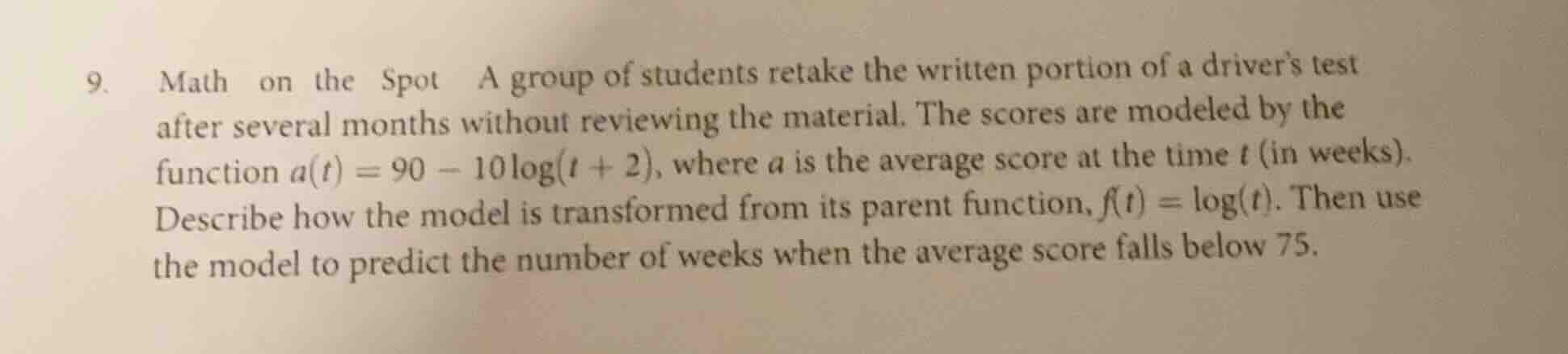
- math on the spot a group of students retake the written portion of a drivers test after several months without reviewing the material. the scores are modeled by the function ( a(t) = 90 - 10log(t + 2) ), where ( a ) is the average score at the time ( t ) (in weeks). describe how the model is transformed from its parent function, ( f(t) = log(t) ). then use the model to predict the number of weeks when the average score falls below 75.
Part 1: Transformation of the Parent Function
The parent function is \( f(t)=\log(t) \). Let's analyze the transformations to get \( a(t) = 90-10\log(t + 2) \):
- Horizontal Shift: The argument of the logarithm is \( t + 2 \), which means the graph of \( \log(t) \) is shifted 2 units to the left.
- Vertical Stretch: The logarithm is multiplied by 10, which vertically stretches the graph by a factor of 10.
- Reflection over the t - axis: The negative sign in front of \( 10\log(t + 2) \) reflects the graph of \( 10\log(t + 2) \) over the \( t \) - axis.
- Vertical Shift: The entire function is added to 90, which means the graph is shifted 90 units up.
Part 2: Predicting the Number of Weeks when the Average Score Falls Below 75
We want to find \( t \) when \( a(t)<75 \). Given \( a(t)=90 - 10\log(t + 2) \), we set up the inequality:
Step 1: Set up the inequality
\( 90-10\log(t + 2)<75 \)
Step 2: Isolate the logarithmic term
Subtract 90 from both sides:
\( - 10\log(t + 2)<75 - 90 \)
\( - 10\log(t + 2)<-15 \)
Step 3: Divide both sides by - 10 (and reverse the inequality sign)
When we divide an inequality by a negative number, the direction of the inequality sign changes. So we have:
\( \log(t + 2)>\frac{-15}{-10} \)
\( \log(t + 2)>1.5 \)
Step 4: Convert from logarithmic to exponential form
Assuming the logarithm is base 10 (since it is not specified, we use the common logarithm with base 10), if \( \log_{10}(x)=y \), then \( x = 10^{y} \). So from \( \log(t + 2)>1.5 \), we get:
\( t + 2>10^{1.5} \)
Step 5: Calculate \( 10^{1.5} \)
We know that \( 10^{1.5}=10^{\frac{3}{2}}=\sqrt{10^{3}}=\sqrt{1000}\approx31.62 \)
Step 6: Solve for \( t \)
Subtract 2 from both sides:
\( t>31.62 - 2 \)
\( t>29.62 \)
Since \( t \) represents the number of weeks, and we are looking for when the score falls below 75, we can say that after approximately 30 weeks (we round up because at \( t = 29.62 \) the score is equal to 75, and we want when it falls below), the average score will be below 75.
Final Answer for the number of weeks:
After approximately \( \boldsymbol{30} \) weeks (we can also present the exact form \( t>10^{1.5}-2\approx29.62 \), so we can say \( t\approx30 \) weeks when rounded up to the nearest whole number) the average score falls below 75.
For the transformation part, the function \( a(t) \) is obtained from \( f(t)=\log(t) \) by a horizontal shift left by 2 units, a vertical stretch by a factor of 10, a reflection over the \( t \) - axis, and a vertical shift up by 90 units.

Snap & solve any problem in the app
Get step-by-step solutions on Sovi AI
Photo-based solutions with guided steps
Explore more problems and detailed explanations
Part 1: Transformation of the Parent Function
The parent function is \( f(t)=\log(t) \). Let's analyze the transformations to get \( a(t) = 90-10\log(t + 2) \):
- Horizontal Shift: The argument of the logarithm is \( t + 2 \), which means the graph of \( \log(t) \) is shifted 2 units to the left.
- Vertical Stretch: The logarithm is multiplied by 10, which vertically stretches the graph by a factor of 10.
- Reflection over the t - axis: The negative sign in front of \( 10\log(t + 2) \) reflects the graph of \( 10\log(t + 2) \) over the \( t \) - axis.
- Vertical Shift: The entire function is added to 90, which means the graph is shifted 90 units up.
Part 2: Predicting the Number of Weeks when the Average Score Falls Below 75
We want to find \( t \) when \( a(t)<75 \). Given \( a(t)=90 - 10\log(t + 2) \), we set up the inequality:
Step 1: Set up the inequality
\( 90-10\log(t + 2)<75 \)
Step 2: Isolate the logarithmic term
Subtract 90 from both sides:
\( - 10\log(t + 2)<75 - 90 \)
\( - 10\log(t + 2)<-15 \)
Step 3: Divide both sides by - 10 (and reverse the inequality sign)
When we divide an inequality by a negative number, the direction of the inequality sign changes. So we have:
\( \log(t + 2)>\frac{-15}{-10} \)
\( \log(t + 2)>1.5 \)
Step 4: Convert from logarithmic to exponential form
Assuming the logarithm is base 10 (since it is not specified, we use the common logarithm with base 10), if \( \log_{10}(x)=y \), then \( x = 10^{y} \). So from \( \log(t + 2)>1.5 \), we get:
\( t + 2>10^{1.5} \)
Step 5: Calculate \( 10^{1.5} \)
We know that \( 10^{1.5}=10^{\frac{3}{2}}=\sqrt{10^{3}}=\sqrt{1000}\approx31.62 \)
Step 6: Solve for \( t \)
Subtract 2 from both sides:
\( t>31.62 - 2 \)
\( t>29.62 \)
Since \( t \) represents the number of weeks, and we are looking for when the score falls below 75, we can say that after approximately 30 weeks (we round up because at \( t = 29.62 \) the score is equal to 75, and we want when it falls below), the average score will be below 75.
Final Answer for the number of weeks:
After approximately \( \boldsymbol{30} \) weeks (we can also present the exact form \( t>10^{1.5}-2\approx29.62 \), so we can say \( t\approx30 \) weeks when rounded up to the nearest whole number) the average score falls below 75.
For the transformation part, the function \( a(t) \) is obtained from \( f(t)=\log(t) \) by a horizontal shift left by 2 units, a vertical stretch by a factor of 10, a reflection over the \( t \) - axis, and a vertical shift up by 90 units.