QUESTION IMAGE
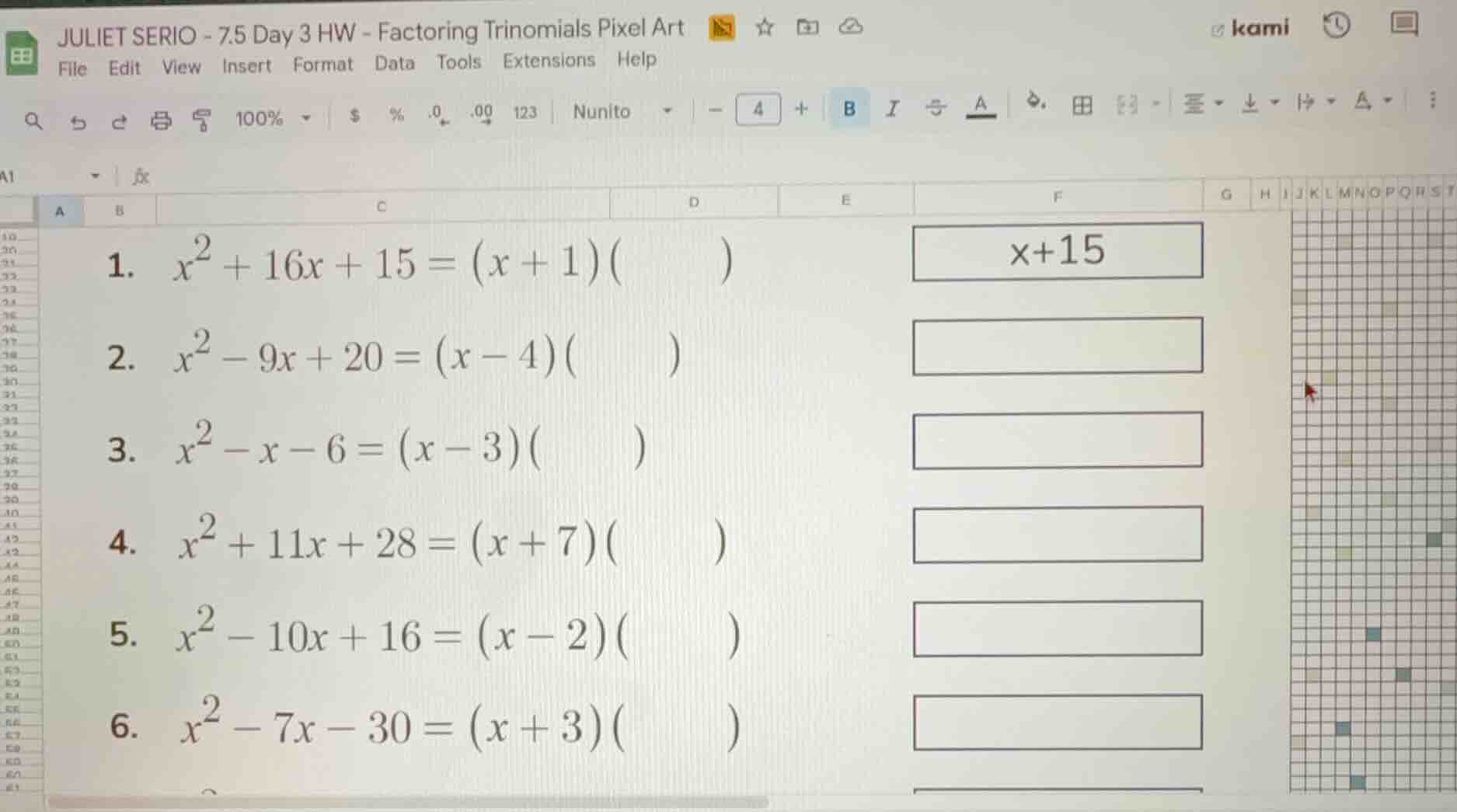
Question
- $x^2 + 16x + 15 = (x + 1)(quad)$
- $x^2 - 9x + 20 = (x - 4)(quad)$
- $x^2 - x - 6 = (x - 3)(quad)$
- $x^2 + 11x + 28 = (x + 7)(quad)$
- $x^2 - 10x + 16 = (x - 2)(quad)$
- $x^2 - 7x - 30 = (x + 3)(quad)$
Problem 2:
Step1: Recall factoring trinomial rule
For a trinomial \(x^2 + bx + c=(x + m)(x + n)\), \(m + n=b\) and \(m\times n = c\). Here, the trinomial is \(x^2-9x + 20\) and one factor is \((x - 4)\). Let the other factor be \((x + n)\). Then \((x-4)(x + n)=x^2+(n - 4)x-4n\). Comparing with \(x^2-9x + 20\), we have \(n-4=-9\) and \(-4n = 20\).
Step2: Solve for n
From \(n-4=-9\), add 4 to both sides: \(n=-9 + 4=-5\). Check with \(-4n = 20\): \(-4\times(-5)=20\), which is correct. So the factor is \(x-5\).
Step1: Use factoring trinomial rule
For \(x^2-x - 6=(x - 3)(x + n)\). Expand \((x - 3)(x + n)=x^2+(n - 3)x-3n\). Compare with \(x^2-x - 6\), so \(n-3=-1\) and \(-3n=-6\).
Step2: Solve for n
From \(n-3=-1\), add 3 to both sides: \(n=-1 + 3 = 2\). Check \(-3n=-6\): \(-3\times2=-6\), correct. So the factor is \(x + 2\).
Step1: Apply factoring trinomial rule
For \(x^2+11x + 28=(x + 7)(x + n)\). Expand \((x + 7)(x + n)=x^2+(n + 7)x+7n\). Compare with \(x^2+11x + 28\), so \(n + 7 = 11\) and \(7n = 28\).
Step2: Solve for n
From \(n + 7 = 11\), subtract 7: \(n=11 - 7 = 4\). Check \(7n = 28\): \(7\times4 = 28\), correct. So the factor is \(x + 4\).

Snap & solve any problem in the app
Get step-by-step solutions on Sovi AI
Photo-based solutions with guided steps
Explore more problems and detailed explanations
\(x - 5\)