QUESTION IMAGE
Question
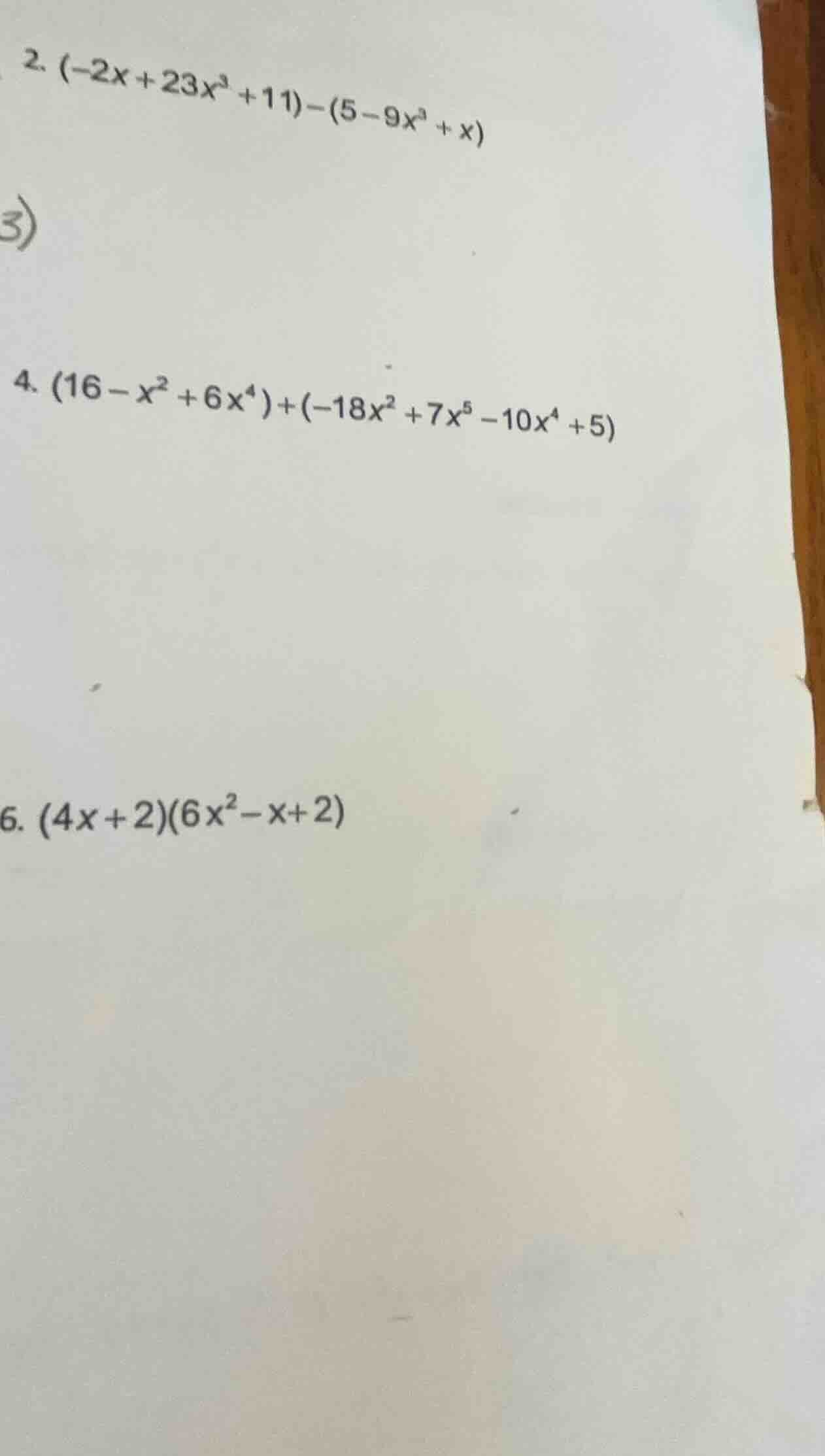
- $(-2x + 23x^3 + 11) - (5 - 9x^3 + x)$
- $(16 - x^2 + 6x^4) + (-18x^2 + 7x^5 - 10x^4 + 5)$
- $(4x + 2)(6x^2 - x + 2)$
Response
Problem 2: $(-2x + 23x^3 + 11) - (5 - 9x^3 + x)$
Step 1: Distribute the negative sign
We need to distribute the negative sign to each term inside the second parentheses. So we get:
$ -2x + 23x^3 + 11 - 5 + 9x^3 - x $
Step 2: Combine like terms
- For the $x^3$ terms: $23x^3 + 9x^3 = 32x^3$
- For the $x$ terms: $-2x - x = -3x$
- For the constant terms: $11 - 5 = 6$
Putting it all together, we have:
$ 32x^3 - 3x + 6 $
Step 1: Remove the parentheses
Since we are adding the two polynomials, we can simply remove the parentheses:
$ 16 - x^2 + 6x^4 - 18x^2 + 7x^5 - 10x^4 + 5 $
Step 2: Combine like terms
- For the $x^5$ term: $7x^5$ (only one term)
- For the $x^4$ terms: $6x^4 - 10x^4 = -4x^4$
- For the $x^2$ terms: $-x^2 - 18x^2 = -19x^2$
- For the constant terms: $16 + 5 = 21$
Putting it all together, we have:
$ 7x^5 - 4x^4 - 19x^2 + 21 $
Step 1: Use the distributive property (FOIL for trinomials)
We distribute each term in the first parentheses to each term in the second parentheses:
- $4x \cdot 6x^2 = 24x^3$
- $4x \cdot (-x) = -4x^2$
- $4x \cdot 2 = 8x$
- $2 \cdot 6x^2 = 12x^2$
- $2 \cdot (-x) = -2x$
- $2 \cdot 2 = 4$
Step 2: Combine like terms
- For the $x^3$ term: $24x^3$ (only one term)
- For the $x^2$ terms: $-4x^2 + 12x^2 = 8x^2$
- For the $x$ terms: $8x - 2x = 6x$
- For the constant term: $4$ (only one term)
Putting it all together, we have:
$ 24x^3 + 8x^2 + 6x + 4 $

Snap & solve any problem in the app
Get step-by-step solutions on Sovi AI
Photo-based solutions with guided steps
Explore more problems and detailed explanations
$ 32x^3 - 3x + 6 $