QUESTION IMAGE
Question
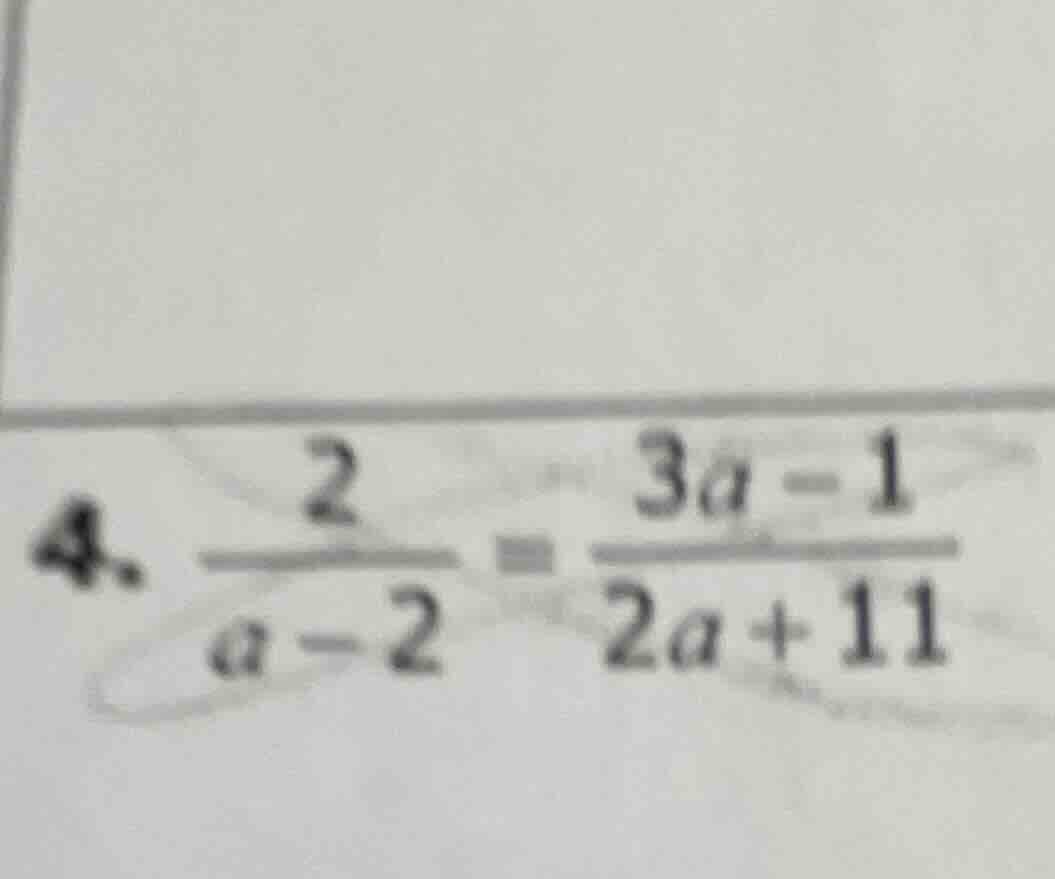
- \\(\frac{2}{a - 2} = \frac{3a - 1}{2a + 11}\\)
Step1: Cross - multiply to eliminate fractions
Cross - multiplying gives $2(2a + 11)=(3a - 1)(a - 2)$.
Step2: Expand both sides
Expanding the left side: $2\times2a+2\times11 = 4a + 22$.
Expanding the right side: $3a\times a-3a\times2-1\times a + 1\times2=3a^{2}-6a - a+2 = 3a^{2}-7a + 2$.
So we have the equation $4a + 22=3a^{2}-7a + 2$.
Step3: Rearrange into standard quadratic form
Subtract $4a + 22$ from both sides: $0 = 3a^{2}-7a + 2-(4a + 22)$.
Simplify the right side: $3a^{2}-7a + 2-4a - 22=3a^{2}-11a - 20$.
So the quadratic equation is $3a^{2}-11a - 20 = 0$.
Step4: Solve the quadratic equation
We can factor the quadratic or use the quadratic formula. Let's use the quadratic formula $a=\frac{-b\pm\sqrt{b^{2}-4ac}}{2a}$ (here the quadratic is in the form $Ax^{2}+Bx + C = 0$, so $A = 3$, $B=-11$, $C=-20$).
First, calculate the discriminant $\Delta=B^{2}-4AC=(-11)^{2}-4\times3\times(-20)=121 + 240 = 361$.
Then $a=\frac{-(-11)\pm\sqrt{361}}{2\times3}=\frac{11\pm19}{6}$.
We have two solutions:
$a_1=\frac{11 + 19}{6}=\frac{30}{6}=5$ and $a_2=\frac{11-19}{6}=\frac{-8}{6}=-\frac{4}{3}$.
Step5: Check for extraneous solutions
We need to check if these solutions make the original denominators zero.
For the original equation $\frac{2}{a - 2}=\frac{3a - 1}{2a+11}$, the denominators are $a - 2$ and $2a + 11$.
When $a = 5$: $a-2=5 - 2 = 3
eq0$ and $2a+11=2\times5 + 11=10 + 11 = 21
eq0$.
When $a=-\frac{4}{3}$: $a - 2=-\frac{4}{3}-2=-\frac{4 + 6}{3}=-\frac{10}{3}
eq0$ and $2a+11=2\times(-\frac{4}{3})+11=-\frac{8}{3}+\frac{33}{3}=\frac{25}{3}
eq0$.

Snap & solve any problem in the app
Get step-by-step solutions on Sovi AI
Photo-based solutions with guided steps
Explore more problems and detailed explanations
$a = 5$ or $a=-\frac{4}{3}$