QUESTION IMAGE
Question
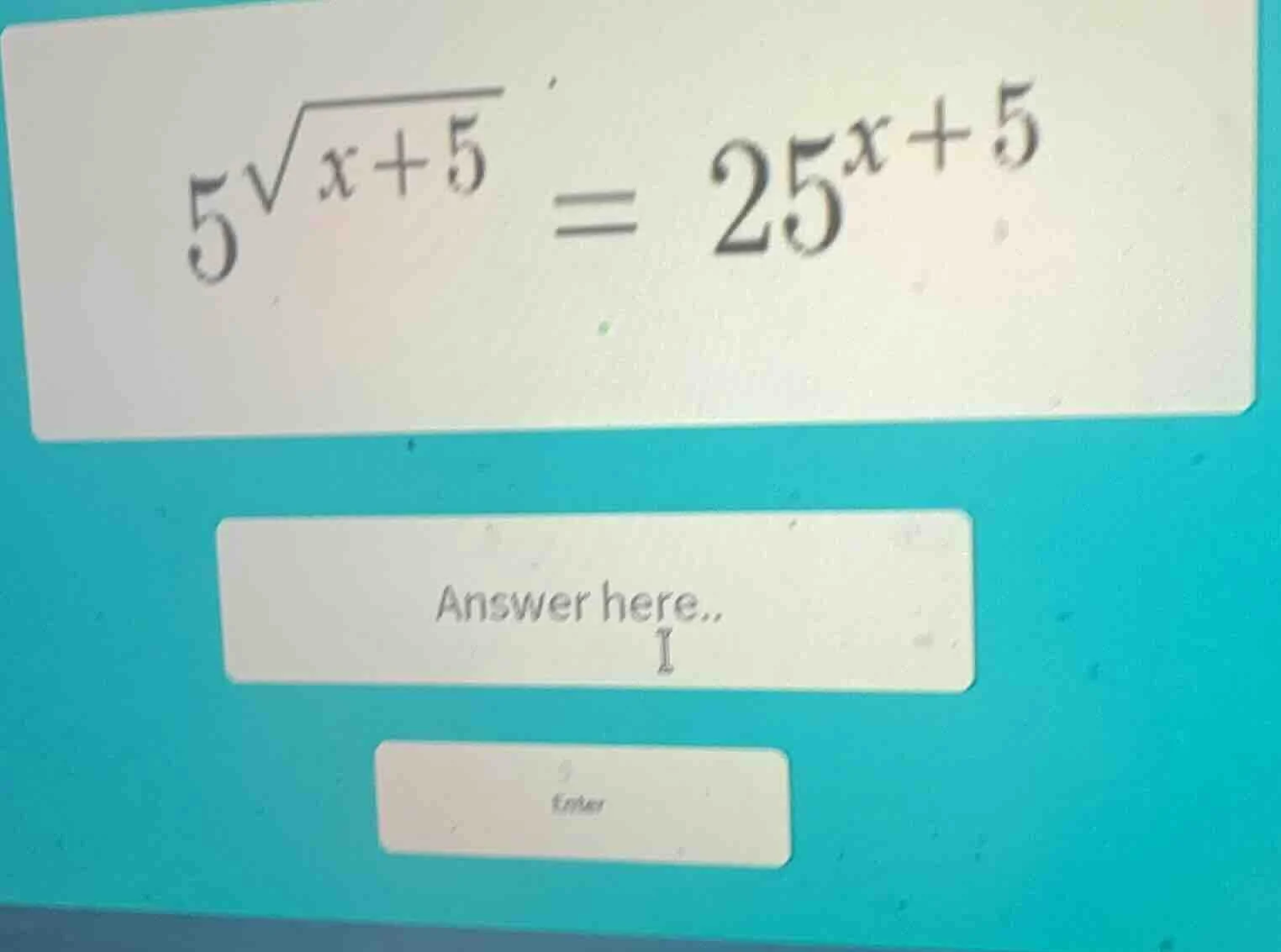
$5^{sqrt{x + 5}} = 25^{x + 5}$
Step1: Rewrite 25 as 5²
We know that \(25 = 5^2\), so the right - hand side of the equation \(25^{x + 5}\) can be rewritten as \((5^2)^{x+5}\).
According to the power - of - a - power rule \((a^m)^n=a^{mn}\), we have \((5^2)^{x + 5}=5^{2(x + 5)}\).
The original equation \(5^{\sqrt{x + 5}}=25^{x + 5}\) becomes \(5^{\sqrt{x + 5}}=5^{2(x + 5)}\).
Step2: Set exponents equal
Since the bases are the same (both are 5) and the exponential function \(y = a^x\) (\(a>0,a
eq1\)) is one - to - one, if \(a^m=a^n\), then \(m = n\).
So we can set the exponents equal to each other: \(\sqrt{x + 5}=2(x + 5)\).
Step3: Let \(t=\sqrt{x + 5}\) ( \(t\geq0\))
Substitute \(t=\sqrt{x + 5}\) into the equation \(\sqrt{x + 5}=2(x + 5)\), we get \(t = 2t^2\) (because \(x + 5=t^2\)).
Rearrange the equation \(t = 2t^2\) to \(2t^2-t = 0\).
Factor out \(t\): \(t(2t - 1)=0\).
Step4: Solve for t
Set each factor equal to zero:
- If \(t = 0\), then \(\sqrt{x+5}=0\), so \(x + 5=0\), and \(x=-5\).
- If \(2t - 1=0\), then \(t=\frac{1}{2}\). But if \(t=\frac{1}{2}\), then \(\sqrt{x + 5}=\frac{1}{2}\), and \(x+5=\frac{1}{4}\), \(x=\frac{1}{4}-5=\frac{1 - 20}{4}=-\frac{19}{4}\). However, we need to check these solutions in the original equation.
Step5: Check solutions
- For \(x=-5\):
Left - hand side: \(5^{\sqrt{-5 + 5}}=5^0 = 1\).
Right - hand side: \(25^{-5 + 5}=25^0 = 1\). So \(x = - 5\) is a valid solution.
- For \(x=-\frac{19}{4}\):
Left - hand side: \(5^{\sqrt{-\frac{19}{4}+5}}=5^{\sqrt{\frac{-19 + 20}{4}}}=5^{\sqrt{\frac{1}{4}}}=5^{\frac{1}{2}}=\sqrt{5}\).
Right - hand side: \(25^{-\frac{19}{4}+5}=25^{\frac{-19 + 20}{4}}=25^{\frac{1}{4}}=\sqrt[4]{25}=\sqrt{5}\). Wait, but let's re - examine the step where we set up the equation. Wait, when we set \(\sqrt{x + 5}=2(x + 5)\), if \(x=-\frac{19}{4}\), then \(x + 5=\frac{1}{4}\), \(\sqrt{x + 5}=\frac{1}{2}\), and \(2(x + 5)=\frac{1}{2}\), which is correct. But wait, there is a mistake in the previous reasoning. Wait, let's go back to the substitution.
Wait, the original equation is \(5^{\sqrt{x + 5}}=25^{x + 5}\), when \(x =-\frac{19}{4}\), \(x+5=\frac{1}{4}\), \(\sqrt{x + 5}=\frac{1}{2}\), and \(25^{x + 5}=25^{\frac{1}{4}}=\sqrt[4]{25}=\sqrt{5}\), and \(5^{\sqrt{x + 5}}=5^{\frac{1}{2}}=\sqrt{5}\). But wait, when we set \(\sqrt{x + 5}=2(x + 5)\), we assumed that the equation holds because of the one - to - one property of exponential functions. But we also need to consider the domain of the square root function. The domain of \(\sqrt{x + 5}\) is \(x+5\geq0\), i.e., \(x\geq - 5\). For \(x =-\frac{19}{4}=-4.75\), which is greater than \(-5\), so it is in the domain. But wait, let's check the original equation again.
Wait, the original equation is \(5^{\sqrt{x + 5}}=25^{x + 5}\). When \(x=-5\), LHS: \(5^{\sqrt{0}} = 1\), RHS: \(25^{0}=1\). When \(x =-\frac{19}{4}\), LHS: \(5^{\frac{1}{2}}=\sqrt{5}\), RHS: \(25^{-\frac{19}{4}+5}=25^{\frac{1}{4}}=\sqrt{5}\) (since \(25^{\frac{1}{4}}=(5^2)^{\frac{1}{4}}=5^{\frac{1}{2}}\)). But wait, there is an error in the step - by - step above. Let's re - do the equation setup.
The original equation is \(5^{\sqrt{x + 5}}=25^{x + 5}\), and \(25 = 5^2\), so \(25^{x + 5}=(5^2)^{x + 5}=5^{2(x + 5)}\). So we have \(5^{\sqrt{x + 5}}=5^{2(x + 5)}\), so \(\sqrt{x + 5}=2(x + 5)\). Let \(u=\sqrt{x + 5}\), \(u\geq0\), then the equation is \(u = 2u^2\), \(2u^2-u = 0\), \(u(2u - 1)=0\), so \(u = 0\) or \(u=\frac{1}{2}\).
If \(u = 0\), then \(\sqrt{x + 5}=0\), \(x=-5\).
If \(u=\frac{1}{2}\), then \(\sqrt{x + 5}=\frac{1}{2}\), \(x + 5=\frac{1}{4}\), \(x=\frac{1}{4}-5=-\frac{19}{4}\). But…

Snap & solve any problem in the app
Get step-by-step solutions on Sovi AI
Photo-based solutions with guided steps
Explore more problems and detailed explanations
\(x=-5\)