QUESTION IMAGE
Question
answer
$y = -f(x + 4)$
$y = -f(x - 4)$
$y = f(-x) - 4$
$y = f(-x) + 4$
Step1: Analyze the original function
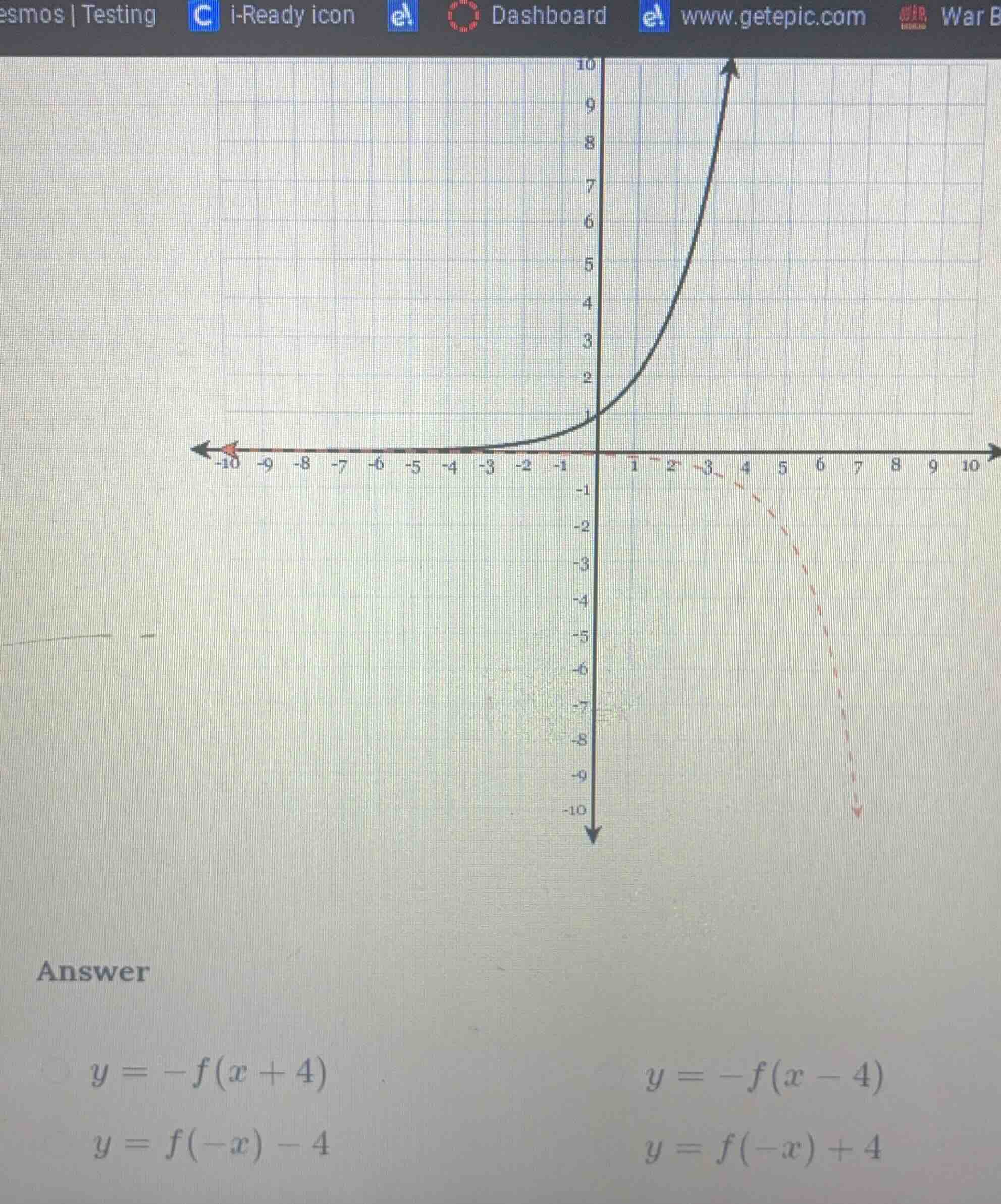
The original function (black curve) seems to be an exponential - like function with a horizontal asymptote at \(y = 0\) (the x - axis) and passing through \((0,1)\). Let's assume the original function is \(y = f(x)\).
Step2: Analyze the transformation for each option
- Option \(y=-f(x + 4)\):
- The transformation \(y = f(x+4)\) is a horizontal shift of the graph of \(y = f(x)\) 4 units to the left. Then \(y=-f(x + 4)\) reflects the graph of \(y = f(x + 4)\) over the x - axis. The original graph of \(f(x)\) has a horizontal asymptote at \(y = 0\) and passes through \((0,1)\). Shifting 4 units left and reflecting over the x - axis will not match the red dashed curve.
- Option \(y=-f(x - 4)\):
- The transformation \(y = f(x - 4)\) is a horizontal shift of the graph of \(y = f(x)\) 4 units to the right. Then \(y=-f(x - 4)\) reflects the graph of \(y = f(x - 4)\) over the x - axis. The red dashed curve is on the right side of the y - axis, but the shape and position do not match this transformation.
- Option \(y=f(-x)-4\):
- The transformation \(y = f(-x)\) is a reflection of the graph of \(y = f(x)\) over the y - axis. Then \(y=f(-x)-4\) is a vertical shift of the graph of \(y = f(-x)\) 4 units down.
- The original function \(y = f(x)\) (black) when reflected over the y - axis (\(y = f(-x)\)) will have a mirror - image about the y - axis. Then shifting down 4 units will make the horizontal asymptote \(y=- 4\) (since the original horizontal asymptote is \(y = 0\)) and the y - intercept of \(y = f(-x)\) (which is \(f(0)=1\)) will be shifted down to \(y=1 - 4=-3\)? Wait, no. Wait, the red dashed curve has a "opening" downward (since it's a reflection and shift) and is below the x - axis. Wait, let's re - examine. The original function \(y = f(x)\) is increasing for \(x\geq0\) (since it goes from near \(y = 0\) on the left to \(y = 1\) at \(x = 0\) and then increases). The function \(y=f(-x)\) is the reflection over the y - axis, so it is decreasing for \(x\geq0\) (since for \(y = f(x)\), when \(x\) increases, \(y\) increases; for \(y = f(-x)\), when \(x\) increases, \(-x\) decreases, so \(y\) decreases). Then \(y=f(-x)-4\) shifts this graph down 4 units. The red dashed curve appears to be a reflection over the y - axis of the original function and shifted down. Let's check the horizontal asymptote. The original function \(y = f(x)\) has a horizontal asymptote \(y = 0\) (as \(x
ightarrow-\infty\)). For \(y = f(-x)\), as \(x
ightarrow\infty\), \(-x
ightarrow-\infty\), so \(y = f(-x)\) has a horizontal asymptote \(y = 0\) as \(x
ightarrow\infty\). Then \(y=f(-x)-4\) has a horizontal asymptote \(y=-4\) as \(x
ightarrow\infty\), which matches the red dashed curve (it goes down as[LLM SSE On Failure]

Snap & solve any problem in the app
Get step-by-step solutions on Sovi AI
Photo-based solutions with guided steps
Explore more problems and detailed explanations
Step1: Analyze the original function
The original function (black curve) seems to be an exponential - like function with a horizontal asymptote at \(y = 0\) (the x - axis) and passing through \((0,1)\). Let's assume the original function is \(y = f(x)\).
Step2: Analyze the transformation for each option
- Option \(y=-f(x + 4)\):
- The transformation \(y = f(x+4)\) is a horizontal shift of the graph of \(y = f(x)\) 4 units to the left. Then \(y=-f(x + 4)\) reflects the graph of \(y = f(x + 4)\) over the x - axis. The original graph of \(f(x)\) has a horizontal asymptote at \(y = 0\) and passes through \((0,1)\). Shifting 4 units left and reflecting over the x - axis will not match the red dashed curve.
- Option \(y=-f(x - 4)\):
- The transformation \(y = f(x - 4)\) is a horizontal shift of the graph of \(y = f(x)\) 4 units to the right. Then \(y=-f(x - 4)\) reflects the graph of \(y = f(x - 4)\) over the x - axis. The red dashed curve is on the right side of the y - axis, but the shape and position do not match this transformation.
- Option \(y=f(-x)-4\):
- The transformation \(y = f(-x)\) is a reflection of the graph of \(y = f(x)\) over the y - axis. Then \(y=f(-x)-4\) is a vertical shift of the graph of \(y = f(-x)\) 4 units down.
- The original function \(y = f(x)\) (black) when reflected over the y - axis (\(y = f(-x)\)) will have a mirror - image about the y - axis. Then shifting down 4 units will make the horizontal asymptote \(y=- 4\) (since the original horizontal asymptote is \(y = 0\)) and the y - intercept of \(y = f(-x)\) (which is \(f(0)=1\)) will be shifted down to \(y=1 - 4=-3\)? Wait, no. Wait, the red dashed curve has a "opening" downward (since it's a reflection and shift) and is below the x - axis. Wait, let's re - examine. The original function \(y = f(x)\) is increasing for \(x\geq0\) (since it goes from near \(y = 0\) on the left to \(y = 1\) at \(x = 0\) and then increases). The function \(y=f(-x)\) is the reflection over the y - axis, so it is decreasing for \(x\geq0\) (since for \(y = f(x)\), when \(x\) increases, \(y\) increases; for \(y = f(-x)\), when \(x\) increases, \(-x\) decreases, so \(y\) decreases). Then \(y=f(-x)-4\) shifts this graph down 4 units. The red dashed curve appears to be a reflection over the y - axis of the original function and shifted down. Let's check the horizontal asymptote. The original function \(y = f(x)\) has a horizontal asymptote \(y = 0\) (as \(x
ightarrow-\infty\)). For \(y = f(-x)\), as \(x
ightarrow\infty\), \(-x
ightarrow-\infty\), so \(y = f(-x)\) has a horizontal asymptote \(y = 0\) as \(x
ightarrow\infty\). Then \(y=f(-x)-4\) has a horizontal asymptote \(y=-4\) as \(x
ightarrow\infty\), which matches the red dashed curve (it goes down as[LLM SSE On Failure]