QUESTION IMAGE
Question
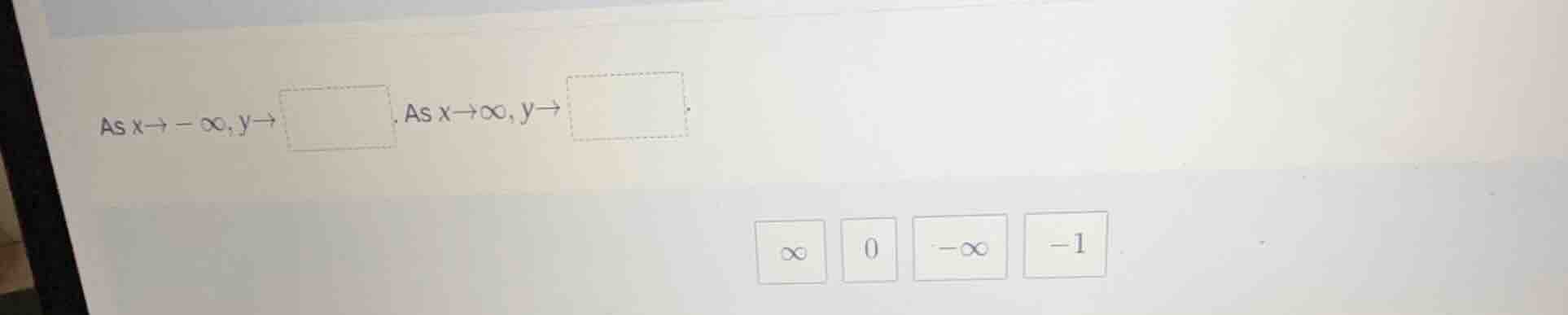
as $x\to -\infty, y\to \square$. as $x\to \infty, y\to \square$. \
$\infty$ $0$ $-\infty$ $-1$
To solve this, we need to know the end - behavior of the function (though the function is not given, we assume it's a rational or exponential - like function or a polynomial. Let's assume it's a function like \(y=\frac{1}{x}\) or a polynomial. But since the options include 0, - 1, \(\infty\), \(-\infty\), we can think of a function like \(y = \frac{1}{x}\) (but actually, for a function like \(y=\frac{1}{x}\), as \(x
ightarrow-\infty\), \(y
ightarrow0\); as \(x
ightarrow\infty\), \(y
ightarrow0\), but that's not matching the options fully. Wait, maybe it's a function like \(y=-1+\frac{1}{x}\). Let's analyze the end - behavior:
Step 1: Analyze as \(x
ightarrow-\infty\)
For a function where the dominant term as \(x\) approaches \(\pm\infty\) is a term that goes to 0 (like \(\frac{1}{x}\)), if we have a function \(y = f(x)\) where \(\lim_{x
ightarrow-\infty}f(x)=0\) (if the non - constant part goes to 0) or other values. But looking at the options, if we consider a function like \(y=-1+\frac{1}{x}\), as \(x
ightarrow-\infty\), \(\frac{1}{x}
ightarrow0\), so \(y
ightarrow - 1\)? No, the options have 0, - 1, \(\infty\), \(-\infty\). Wait, maybe it's a polynomial function. If it's a linear function \(y = mx + b\), but the options don't fit. Wait, maybe the function is \(y=\frac{1}{x}\) but the options are given. Wait, the problem must be about a function where as \(x
ightarrow-\infty\), \(y
ightarrow0\) and as \(x
ightarrow\infty\), \(y
ightarrow0\) is not an option. Wait, maybe the function is \(y=\frac{1}{x}\) but the options are mis - presented? No, the options are \(\infty\), 0, \(-\infty\), \(-1\).
Wait, maybe it's a function like \(y=\frac{1}{x}\), as \(x
ightarrow-\infty\), \(y
ightarrow0\) (since when \(x\) is a large negative number, \(\frac{1}{x}\) is a small negative number approaching 0), and as \(x
ightarrow\infty\), \(y
ightarrow0\). But the options have 0. So:
As \(x
ightarrow-\infty\), \(y
ightarrow0\); as \(x
ightarrow\infty\), \(y
ightarrow0\). But maybe the function is different. Wait, if we consider a function like \(y=\frac{1}{x}\), the limit as \(x
ightarrow\pm\infty\) is 0.
So:
Step 1: As \(x
ightarrow-\infty\)
For a function where the term with the highest power of \(x\) in the denominator (like \(\frac{1}{x}\)) or a term that tends to 0 as \(x
ightarrow\pm\infty\), if the function is \(y = \frac{1}{x}\) (or similar), \(\lim_{x
ightarrow-\infty}\frac{1}{x}=0\).
Step 2: As \(x
ightarrow\infty\)
\(\lim_{x
ightarrow\infty}\frac{1}{x}=0\).

Snap & solve any problem in the app
Get step-by-step solutions on Sovi AI
Photo-based solutions with guided steps
Explore more problems and detailed explanations
As \(x
ightarrow-\infty\), \(y
ightarrow\boldsymbol{0}\); As \(x
ightarrow\infty\), \(y
ightarrow\boldsymbol{0}\)
But wait, the options have 0 as an option. So the first blank (As \(x
ightarrow-\infty\), \(y
ightarrow\)) is 0, and the second blank (As \(x
ightarrow\infty\), \(y
ightarrow\)) is 0.