QUESTION IMAGE
Question
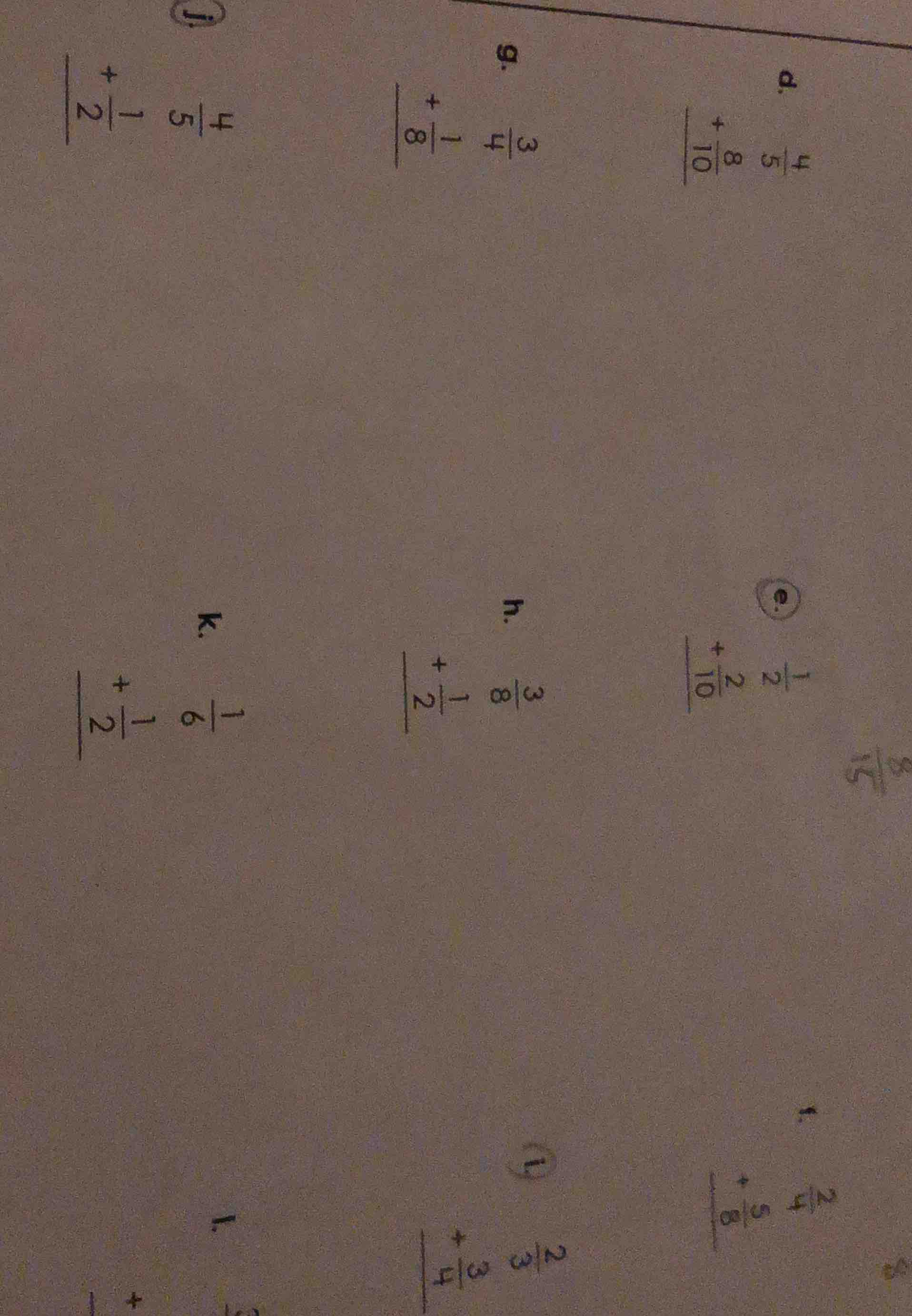
i. \\( \frac{4}{5} - \frac{8}{10} \\) +
g. \\( \frac{3}{4} - \frac{1}{8} \\) +
j. \\( \frac{4}{5} - \frac{1}{2} \\) +
!. \\( -\frac{1}{2} + \frac{2}{10} \\) +
f. \\( \frac{3}{8} - \frac{1}{2} \\) +
k. \\( -\frac{1}{6} - \frac{1}{2} \\) +
- \\( \frac{2}{3} + \frac{3}{4} \\) +
\\( \frac{2}{5} + \frac{5}{10} \\) +
Let's take the first problem (assuming it's \(\frac{4}{5} + \frac{8}{10}\)) as an example.
Step1: Simplify the fraction
Simplify \(\frac{8}{10}\) to \(\frac{4}{5}\) (dividing numerator and denominator by 2).
Step2: Add the fractions
Now we have \(\frac{4}{5} + \frac{4}{5}\). Since the denominators are the same, we add the numerators: \(4 + 4 = 8\), so the result is \(\frac{8}{5}\) or \(1\frac{3}{5}\).
Let's take another problem, say \(-\frac{1}{2} + \frac{2}{10}\).
Step1: Simplify the fraction
Simplify \(\frac{2}{10}\) to \(\frac{1}{5}\).
Step2: Find a common denominator
The common denominator of 2 and 5 is 10. Convert \(-\frac{1}{2}\) to \(-\frac{5}{10}\) and \(\frac{1}{5}\) to \(\frac{2}{10}\).
Step3: Add the fractions
\(-\frac{5}{10} + \frac{2}{10} = \frac{-5 + 2}{10} = -\frac{3}{10}\).
For \(\frac{4}{5} - \frac{1}{2}\):
Step1: Find a common denominator
The common denominator of 5 and 2 is 10. Convert \(\frac{4}{5}\) to \(\frac{8}{10}\) and \(\frac{1}{2}\) to \(\frac{5}{10}\).
Step2: Subtract the fractions
\(\frac{8}{10} - \frac{5}{10} = \frac{8 - 5}{10} = \frac{3}{10}\).
For \(\frac{3}{4} - \frac{1}{8}\):
Step1: Find a common denominator
The common denominator of 4 and 8 is 8. Convert \(\frac{3}{4}\) to \(\frac{6}{8}\).
Step2: Subtract the fractions
\(\frac{6}{8} - \frac{1}{8} = \frac{6 - 1}{8} = \frac{5}{8}\).
For \(\frac{3}{8} - \frac{1}{2}\):
Step1: Find a common denominator
The common denominator of 8 and 2 is 8. Convert \(\frac{1}{2}\) to \(\frac{4}{8}\).
Step2: Subtract the fractions
\(\frac{3}{8} - \frac{4}{8} = \frac{3 - 4}{8} = -\frac{1}{8}\).
For \(-\frac{1}{6} - \frac{1}{2}\):
Step1: Find a common denominator
The common denominator of 6 and 2 is 6. Convert \(-\frac{1}{2}\) to \(-\frac{3}{6}\).
Step2: Subtract the fractions
\(-\frac{1}{6} - \frac{3}{6} = \frac{-1 - 3}{6} = -\frac{4}{6} = -\frac{2}{3}\) (simplifying the fraction by dividing numerator and denominator by 2).
For \(\frac{2}{3} + \frac{3}{4}\):
Step1: Find a common denominator
The common denominator of 3 and 4 is 12. Convert \(\frac{2}{3}\) to \(\frac{8}{12}\) and \(\frac{3}{4}\) to \(\frac{9}{12}\).
Step2: Add the fractions
\(\frac{8}{12} + \frac{9}{12} = \frac{8 + 9}{12} = \frac{17}{12} = 1\frac{5}{12}\).
For \(\frac{2}{5} + \frac{5}{10}\):
Step1: Simplify the fraction
Simplify \(\frac{5}{10}\) to \(\frac{1}{2}\).
Step2: Find a common denominator
The common denominator of 5 and 2 is 10. Convert \(\frac{2}{5}\) to \(\frac{4}{10}\) and \(\frac{1}{2}\) to \(\frac{5}{10}\).
Step3: Add the fractions
\(\frac{4}{10} + \frac{5}{10} = \frac{4 + 5}{10} = \frac{9}{10}\).

Snap & solve any problem in the app
Get step-by-step solutions on Sovi AI
Photo-based solutions with guided steps
Explore more problems and detailed explanations
The answers for the respective problems (assuming the order of problems as per the image) are:
- \(\frac{8}{5}\) (or \(1\frac{3}{5}\))
- \(\frac{5}{8}\)
- \(\frac{3}{10}\)
- \(-\frac{3}{10}\)
- \(-\frac{1}{8}\)
- \(-\frac{2}{3}\)
- \(1\frac{5}{12}\)
- \(\frac{9}{10}\)