QUESTION IMAGE
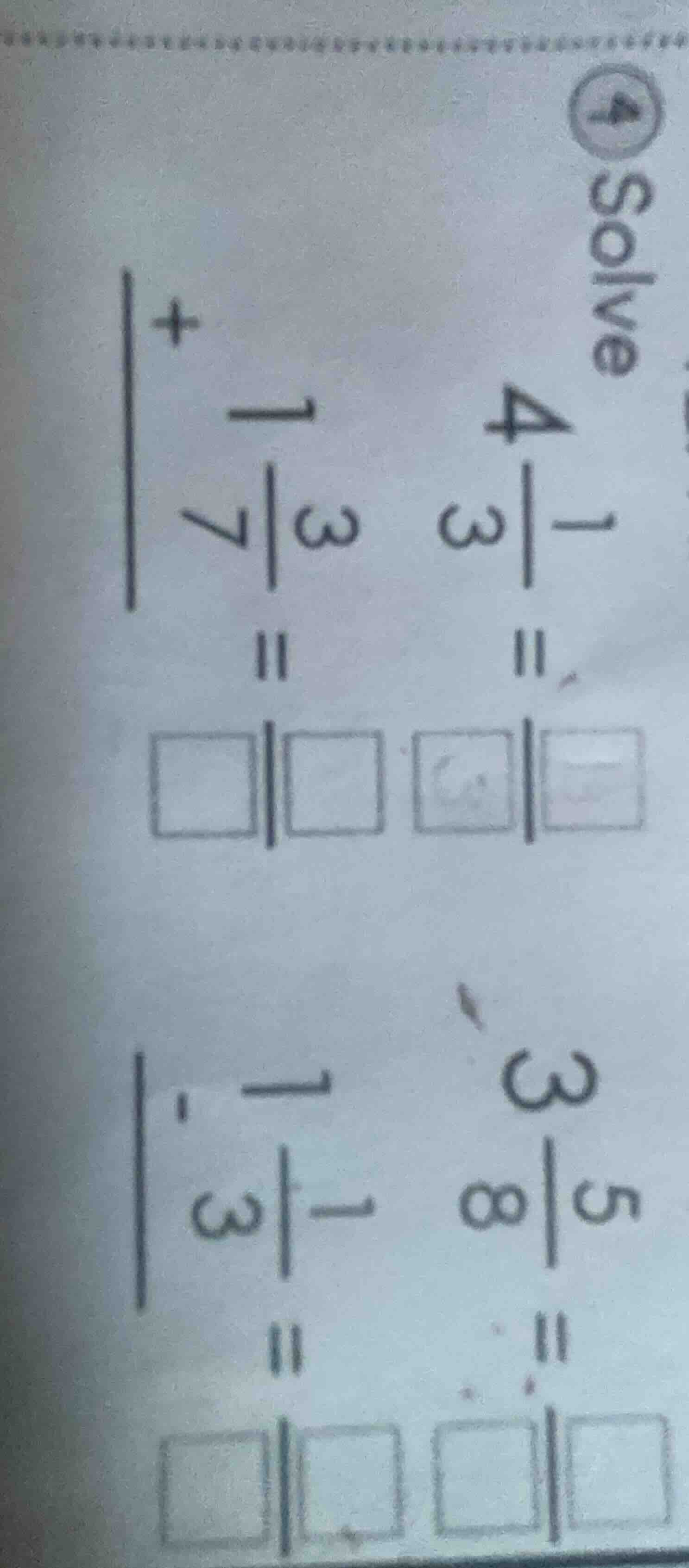
Question
solve
$4 - \frac{1}{3} = \frac{\square}{\square}$
$1 + \frac{3}{7} = \frac{\square}{\square}$
$3 - \frac{5}{8} = \frac{\square}{\square}$
$1 - \frac{1}{3} = \frac{\square}{\square}$
First Problem: \(4\frac{1}{3}=\frac{\square}{\square}\)
Step1: Convert mixed number to improper fraction.
A mixed number \(a\frac{b}{c}\) (where \(a\) is the whole number, \(b\) is the numerator, and \(c\) is the denominator) can be converted to an improper fraction using the formula \(\frac{a\times c + b}{c}\). For \(4\frac{1}{3}\), \(a = 4\), \(b = 1\), \(c = 3\). So we calculate \(4\times3+1\) for the new numerator.
\(4\times3 + 1=12 + 1 = 13\)
Step2: The denominator remains the same.
The denominator \(c\) is 3. So \(4\frac{1}{3}=\frac{13}{3}\)
Step1: Convert mixed number to improper fraction.
Using the formula for converting mixed number \(a\frac{b}{c}\) to improper fraction \(\frac{a\times c + b}{c}\). Here, \(a = 1\), \(b = 3\), \(c = 7\). Calculate the new numerator: \(1\times7+3\).
\(1\times7 + 3=7 + 3 = 10\)
Step2: The denominator remains the same.
The denominator \(c\) is 7. So \(1\frac{3}{7}=\frac{10}{7}\)
Step1: Convert mixed number to improper fraction.
For the mixed number \(3\frac{5}{8}\), \(a = 3\), \(b = 5\), \(c = 8\). Using the formula \(\frac{a\times c + b}{c}\), calculate the new numerator: \(3\times8+5\).
\(3\times8 + 5=24 + 5 = 29\)
Step2: The denominator remains the same.
The denominator \(c\) is 8. So \(3\frac{5}{8}=\frac{29}{8}\)

Snap & solve any problem in the app
Get step-by-step solutions on Sovi AI
Photo-based solutions with guided steps
Explore more problems and detailed explanations
\(\frac{13}{3}\)