QUESTION IMAGE
Question
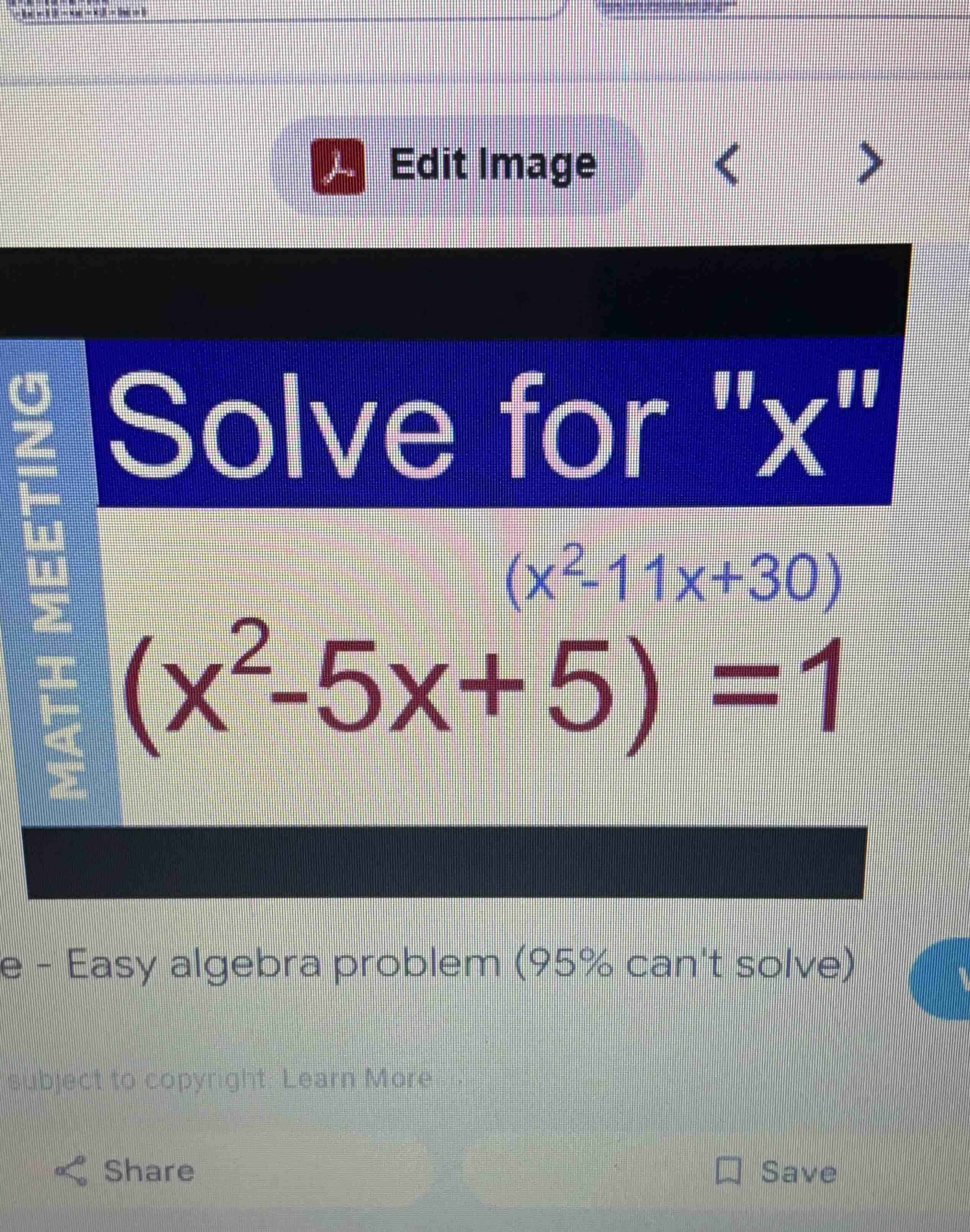
solve for \x\
$(x^{2}-11x + 30)$
$(x^{2}-5x + 5)=1$
Step1: Analyze the equation structure
We have the equation \((x^{2}-5x + 5)^{x^{2}-11x + 30}=1\). We know that \(a^{b}=1\) can happen in three cases:
- Case 1: \(a = 1\) (since \(1^{n}=1\) for any \(n\))
- Case 2: \(a=- 1\) and \(b\) is even (since \((-1)^{\text{even}} = 1\))
- Case 3: \(b = 0\) and \(a
eq0\) (since \(a^{0}=1\) for \(a
eq0\))
Step2: Case 1: \(x^{2}-5x + 5=1\)
Solve the quadratic equation \(x^{2}-5x + 5 = 1\), which simplifies to \(x^{2}-5x+4 = 0\).
Factor the quadratic: \((x - 1)(x - 4)=0\).
So \(x=1\) or \(x = 4\).
We need to check if these values are valid. For \(x = 1\), the exponent \(x^{2}-11x + 30=1-11 + 30=20\), and \(1^{20}=1\). For \(x = 4\), the exponent \(x^{2}-11x + 30=16-44 + 30=2\), and \(1^{2}=1\). So both are valid.
Step3: Case 2: \(x^{2}-5x + 5=-1\)
Solve the quadratic equation \(x^{2}-5x + 5=-1\), which simplifies to \(x^{2}-5x+6 = 0\).
Factor the quadratic: \((x - 2)(x - 3)=0\).
So \(x = 2\) or \(x=3\).
Now check the exponent for each:
- For \(x = 2\), the exponent \(x^{2}-11x + 30=4-22 + 30=12\) (even). Then \((-1)^{12}=1\), so \(x = 2\) is valid.
- For \(x = 3\), the exponent \(x^{2}-11x + 30=9-33 + 30=6\) (even). Then \((-1)^{6}=1\), so \(x = 3\) is valid.
Step4: Case 3: \(x^{2}-11x + 30=0\) and \(x^{2}-5x + 5
eq0\)
Solve the quadratic equation \(x^{2}-11x + 30=0\). Factor it: \((x - 5)(x - 6)=0\). So \(x = 5\) or \(x=6\).
Now check \(x^{2}-5x + 5\) for these values:
- For \(x = 5\), \(x^{2}-5x + 5=25-25 + 5=5
eq0\). Then \(5^{0}=1\), so \(x = 5\) is valid.
- For \(x = 6\), \(x^{2}-5x + 5=36-30 + 5=11
eq0\). Then \(11^{0}=1\), so \(x = 6\) is valid.

Snap & solve any problem in the app
Get step-by-step solutions on Sovi AI
Photo-based solutions with guided steps
Explore more problems and detailed explanations
The solutions for \(x\) are \(x = 1,2,3,4,5,6\)