QUESTION IMAGE
Question
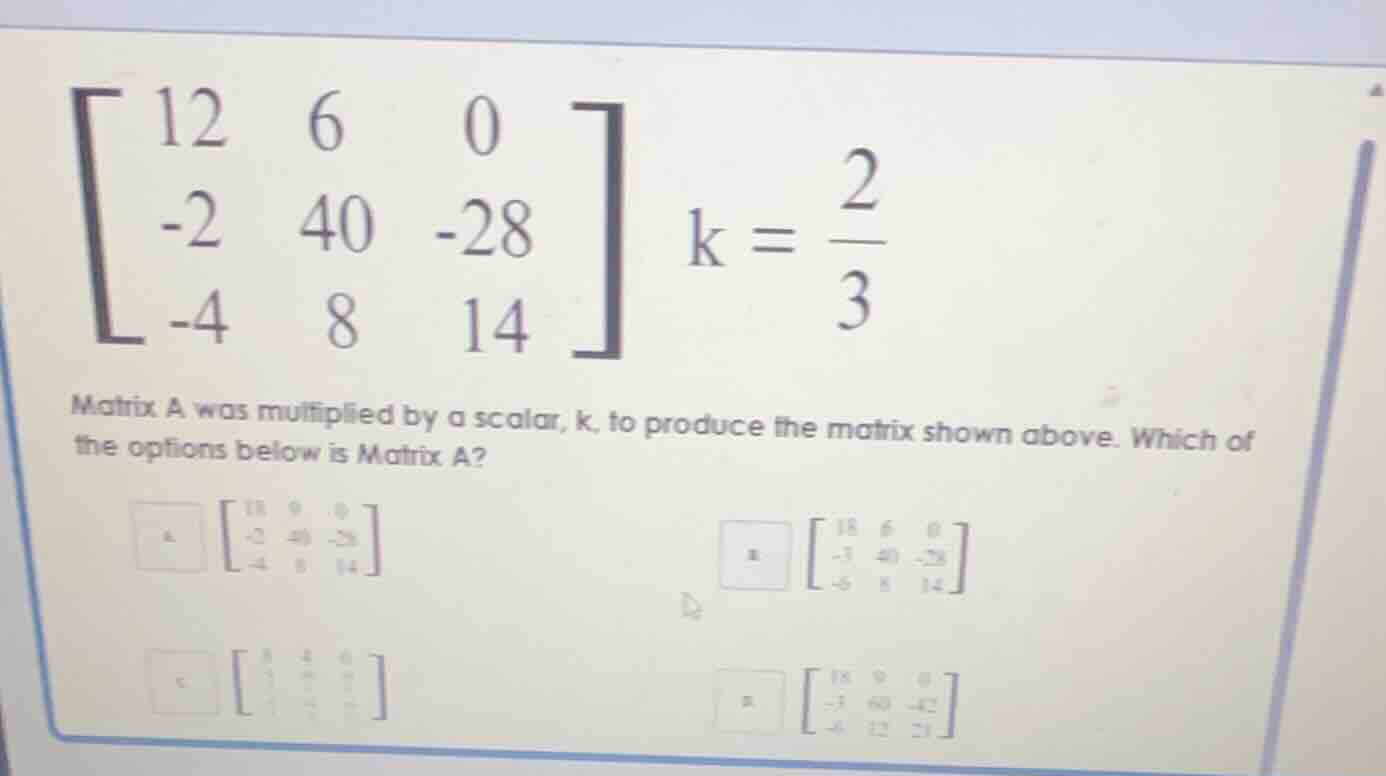
matrix a was multiplied by a scalar, k, to produce the matrix shown above. which of the options below is matrix a?\\(\
\\) \\(k = \frac{2}{3}\\) (options for matrix a are shown in the image, with some partially visible due to ocr limitations but the question context is about scalar multiplication of matrices to find original matrix a)
Step1: Recall scalar multiplication of matrix
When a matrix is multiplied by a scalar \( k \), each element \( a_{ij} \) of the original matrix \( A \) is related to the element \( b_{ij} \) of the resulting matrix \( B \) by the formula \( b_{ij}=k\times a_{ij} \). So, to find \( A \), we need to solve for \( a_{ij} \) using \( a_{ij}=\frac{b_{ij}}{k} \), where \( k = \frac{2}{3} \), so \( \frac{1}{k}=\frac{3}{2} \).
Step2: Calculate the first element of the first row
The first element of the given matrix (let's call it \( B \)) is \( 12 \). So, the corresponding element in \( A \) is \( 12\div\frac{2}{3}=12\times\frac{3}{2} = 18 \).
Step3: Calculate the second element of the first row
The second element of \( B \) is \( 6 \). Then, the element in \( A \) is \( 6\div\frac{2}{3}=6\times\frac{3}{2}=9 \)? Wait, no, wait the options: Wait, maybe I misread the matrix. Wait the given matrix is \(
\) and \( k = \frac{2}{3} \). Wait, no, actually, the matrix shown is \( k\times A \), so \( A=\frac{1}{k}\times \) (the matrix). So \( \frac{1}{k}=\frac{3}{2} \). Let's check the first row first element: \( 12\times\frac{3}{2}=18 \), second element: \( 6\times\frac{3}{2} = 9 \)? Wait no, wait the options: Wait option B (the second option) has first row \( [18, 6, 0] \)? No, wait the options: Let's re-express. Wait the matrix given is \( B = kA \), so \( A=\frac{B}{k} \). So each element of \( A \) is element of \( B \) divided by \( k \) (or multiplied by \( \frac{3}{2} \)).
First row, first element: \( 12\div\frac{2}{3}=12\times\frac{3}{2}=18 \)
First row, second element: \( 6\div\frac{2}{3}=6\times\frac{3}{2}=9 \)? Wait no, the option B (the second option) has first row \( [18, 6, 0] \)? Wait no, maybe I made a mistake. Wait the options: Let's look at the options again. Wait the first option (A) is \(
\)? No, the first option's first row is \( [18, 9, 0] \)? Wait the user's image: Wait the options:
Option A: \(
\)
Option B: \(
\)? No, wait the user's image: Wait the second option (B) has first row \( [18, 6, 0] \), second row \( [-3, 40, -42] \), third row \( [-6, 8, 21] \)? No, maybe I misread. Wait let's do the calculation properly.
Given \( B = kA \), \( k=\frac{2}{3} \), so \( A = B \div k = B\times\frac{3}{2} \)
First row, first element: \( 12\times\frac{3}{2}=18 \)
First row, second element: \( 6\times\frac{3}{2}=9 \)
First row, third element: \( 0\times\frac{3}{2}=0 \)
Second row, first element: \( -2\times\frac{3}{2}=-3 \)
Second row, second element: \( 40\times\frac{3}{2}=60 \)? Wait no, wait the given matrix's second row is \( [-2, 40, -28] \). Wait, no! Wait the matrix is \(
\), and this is \( kA \), so \( A \) is this matrix divided by \( k=\frac{2}{3} \), i.e., multiplied by \( \frac{3}{2} \).
So second row, first element: \( -2\times\frac{3}{2}=-3 \)
Second row, second element: \( 40\times\frac{3}{2}=60 \)
Second row, third element: \( -28\times\frac{3}{2}=-42 \)
Third row, first element: \( -4\times\frac{3}{2}=-6 \)
Third row, second element: \( 8\times\frac{3}{2}=12 \)
Third row, third element: \( 14\times\frac{3}{2}=21 \)
First row, second element: \( 6\times\frac{3}{2}=9 \)? Wait no, first row second element: \( 6\times\frac{3}{2}=9 \), first row third element: \( 0\times\frac{3}{2}=0 \)
Wait but the first option (A) has first…

Snap & solve any problem in the app
Get step-by-step solutions on Sovi AI
Photo-based solutions with guided steps
Explore more problems and detailed explanations
D. \(
\)