QUESTION IMAGE
Question
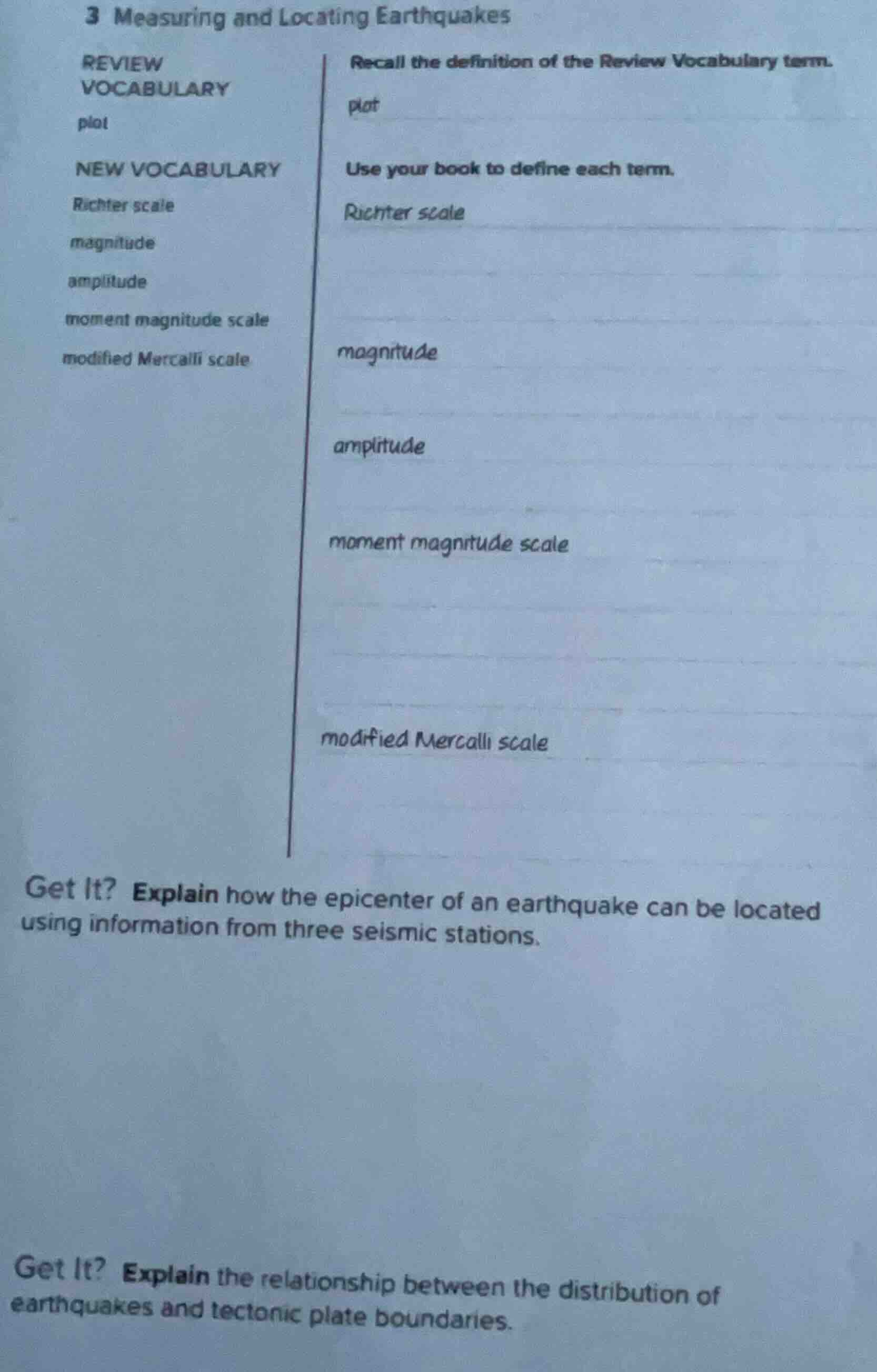
3 measuring and locating earthquakes
review
vocabulary
plot
new vocabulary
richter scale
magnitude
amplitude
moment magnitude scale
modified mercalli scale
recall the definition of the review vocabulary term.
plot
use your book to define each term.
richter scale
magnitude
amplitude
moment magnitude scale
modified mercalli scale
get it? explain how the epicenter of an earthquake can be located using information from three seismic stations.
get it? explain the relationship between the distribution of earthquakes and tectonic plate boundaries.
First "Get It?" Question (Locating Epicenter)
- Each seismic station calculates the distance to the epicenter using the time difference between P - waves and S - waves.
- With this distance, a circle (centered at the station, radius = distance) is drawn on a map.
- Three such circles from three stations intersect at one point, which is the epicenter.
- Tectonic plates move, and at their boundaries (convergent, divergent, transform), stress builds up.
- Convergent boundaries (e.g., subduction zones) have earthquakes from plate collision/subduction. Divergent boundaries (e.g., mid - ocean ridges) have quakes from plate separation. Transform boundaries (e.g., San Andreas) have quakes from plate sliding past each other.
- Most earthquakes occur along these boundaries (e.g., Ring of Fire is a convergent/divergent boundary zone with many quakes), while intra - plate quakes (within plates) are less common, often from old fault reactivation.

Snap & solve any problem in the app
Get step-by-step solutions on Sovi AI
Photo-based solutions with guided steps
Explore more problems and detailed explanations
To locate an earthquake's epicenter using three seismic stations: 1. Each station determines the distance to the epicenter by analyzing the time difference between P - waves (faster) and S - waves (slower) arrival. 2. For each station, a circle is plotted on a map with the station at the center and the calculated distance as the radius. 3. The point where the three circles intersect is the epicenter.