QUESTION IMAGE
Question
mechanical weathering
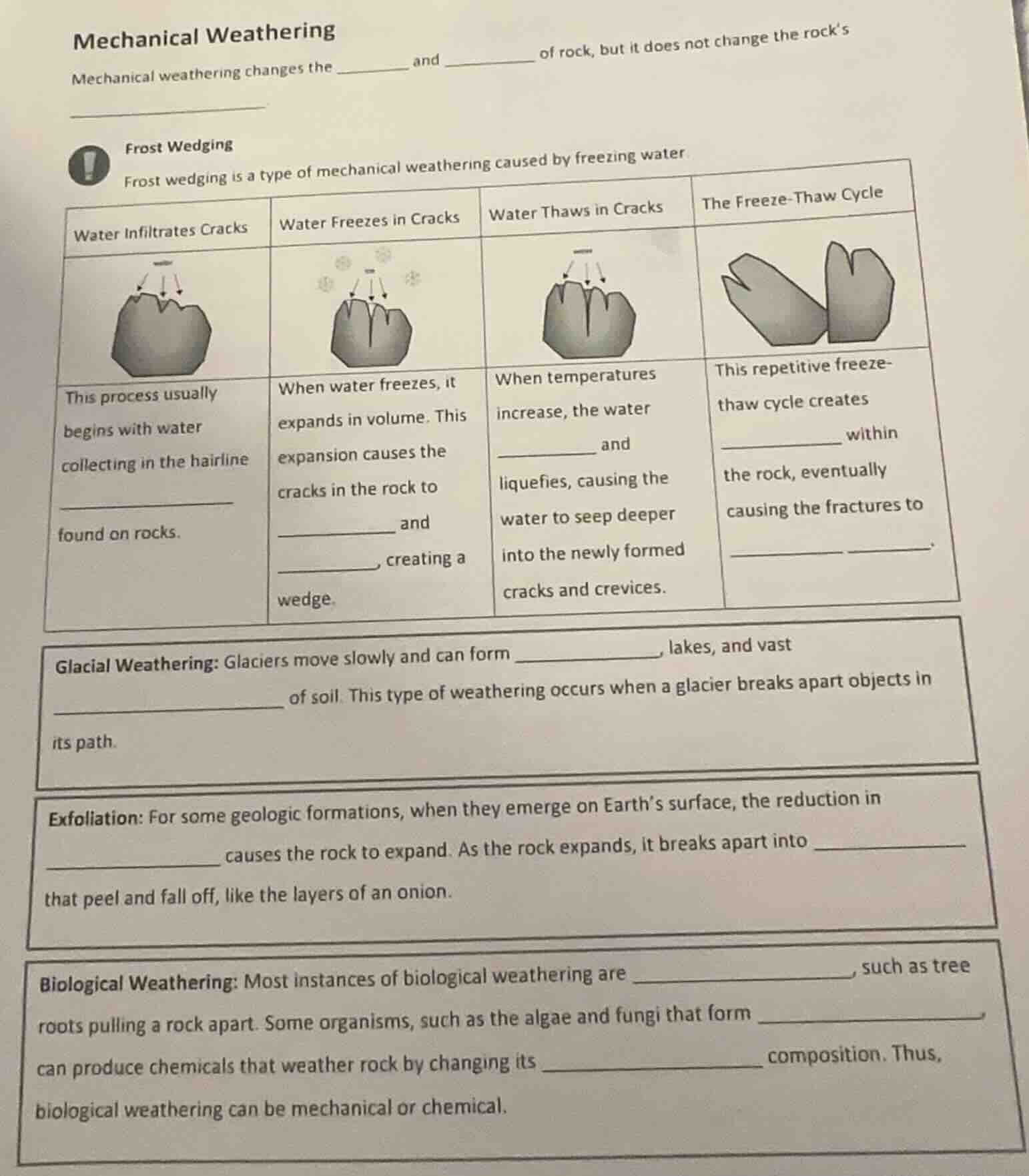
mechanical weathering changes the ____ and ____ of rock, but it does not change the rock’s
______
frost wedging
frost wedging is a type of mechanical weathering caused by freezing water
| water infiltrates cracks | water freezes in cracks | water thaws in cracks | the freeze - thaw cycle |
|---|---|---|---|
| this process usually begins with water collecting in the hairline ______ found on rocks. | when water freezes, it expands in volume. this expansion causes the cracks in the rock to ____ and ____, creating a wedge. | when temperatures increase, the water ______ and liquefies, causing the water to seep deeper into the newly formed cracks and crevices. | this repetitive freeze - thaw cycle creates ____ within the rock, eventually causing the fractures to __ ____. |
glacial weathering: glaciers move slowly and can form ____, lakes, and vast ____ of soil. this type of weathering occurs when a glacier breaks apart objects in its path.
exfoliation: for some geologic formations, when they emerge on earth’s surface, the reduction in ____ causes the rock to expand. as the rock expands, it breaks apart into ____ that peel and fall off, like the layers of an onion.
biological weathering: most instances of biological weathering are ____, such as tree roots pulling a rock apart. some organisms, such as the algae and fungi that form __, can produce chemicals that weather rock by changing its ____ composition. thus, biological weathering can be mechanical or chemical.
Mechanical Weathering Fill - ins
1. Mechanical Weathering Basics
Mechanical weathering changes the size and shape of rock, but it does not change the rock’s chemical composition.
2. Frost Wedging
- Water Infiltrates Cracks: This process usually begins with water collecting in the hairline cracks found on rocks.
- Water Freezes in Cracks: When water freezes, it expands in volume. This expansion causes the cracks in the rock to widen and deepen, creating a wedge.
- Water Thaws in Cracks: When temperatures increase, the water melts and liquefies, causing the water to seep deeper into the newly formed cracks and crevices.
- The Freeze - Thaw Cycle: This repetitive freeze - thaw cycle creates stress within the rock, eventually causing the fractures to enlarge and break apart.
3. Glacial Weathering
Glaciers move slowly and can form valleys, lakes, and vast deposits of soil. This type of weathering occurs when a glacier breaks apart objects in its path.
4. Exfoliation
For some geologic formations, when they emerge on Earth’s surface, the reduction in pressure causes the rock to expand. As the rock expands, it breaks apart into sheets that peel and fall off, like the layers of an onion.
5. Biological Weathering
Most instances of biological weathering are mechanical, such as tree roots pulling a rock apart. Some organisms, such as the algae and fungi that form lichens, can produce chemicals that weather rock by changing its chemical composition. Thus, biological weathering can be mechanical or chemical.
Final Answers (Filled - in Blanks)
- size; shape; chemical composition
- cracks; widen; deepen; melts
- stress; enlarge; break apart
- valleys; deposits
- pressure; sheets
- mechanical; lichens; chemical

Snap & solve any problem in the app
Get step-by-step solutions on Sovi AI
Photo-based solutions with guided steps
Explore more problems and detailed explanations
Mechanical Weathering Fill - ins
1. Mechanical Weathering Basics
Mechanical weathering changes the size and shape of rock, but it does not change the rock’s chemical composition.
2. Frost Wedging
- Water Infiltrates Cracks: This process usually begins with water collecting in the hairline cracks found on rocks.
- Water Freezes in Cracks: When water freezes, it expands in volume. This expansion causes the cracks in the rock to widen and deepen, creating a wedge.
- Water Thaws in Cracks: When temperatures increase, the water melts and liquefies, causing the water to seep deeper into the newly formed cracks and crevices.
- The Freeze - Thaw Cycle: This repetitive freeze - thaw cycle creates stress within the rock, eventually causing the fractures to enlarge and break apart.
3. Glacial Weathering
Glaciers move slowly and can form valleys, lakes, and vast deposits of soil. This type of weathering occurs when a glacier breaks apart objects in its path.
4. Exfoliation
For some geologic formations, when they emerge on Earth’s surface, the reduction in pressure causes the rock to expand. As the rock expands, it breaks apart into sheets that peel and fall off, like the layers of an onion.
5. Biological Weathering
Most instances of biological weathering are mechanical, such as tree roots pulling a rock apart. Some organisms, such as the algae and fungi that form lichens, can produce chemicals that weather rock by changing its chemical composition. Thus, biological weathering can be mechanical or chemical.
Final Answers (Filled - in Blanks)
- size; shape; chemical composition
- cracks; widen; deepen; melts
- stress; enlarge; break apart
- valleys; deposits
- pressure; sheets
- mechanical; lichens; chemical