QUESTION IMAGE
Question
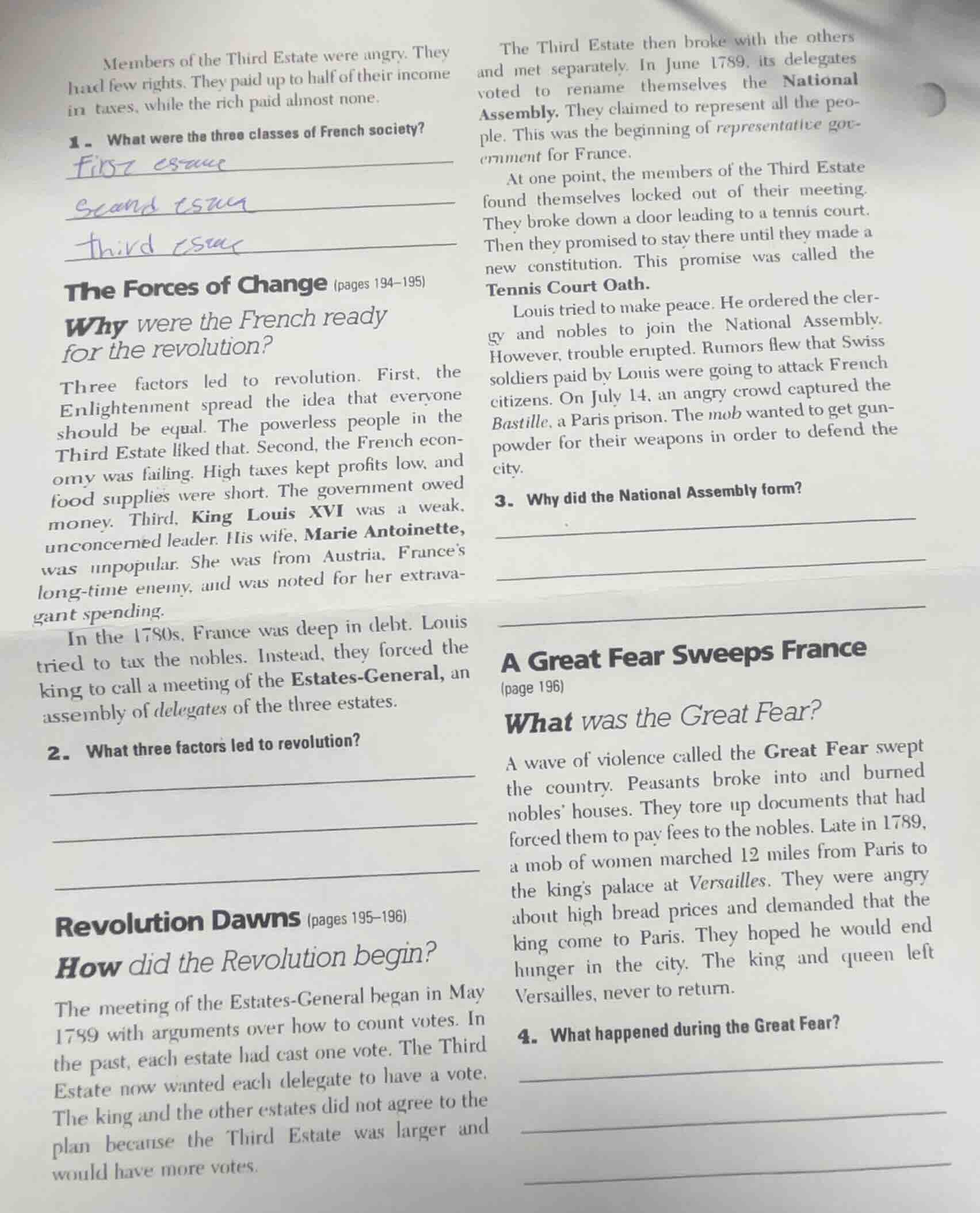
members of the third estate were angry. they had few rights. they paid up to half of their income in taxes, while the rich paid almost none.
- what were the three classes of french society?
the forces of change (pages 194 - 195)
why were the french ready for the revolution?
three factors led to revolution. first, the enlightenment spread the idea that everyone should be equal. the powerless people in the third estate liked that. second, the french economy was failing. high taxes kept profits low, and food supplies were short. the government owed money. third, king louis xvi was a weak, unconcerned leader. his wife, marie antoinette, was unpopular. she was from austria, france’s long - time enemy, and was noted for her extravagant spending.
in the 1780s, france was deep in debt. louis tried to tax the nobles. instead, they forced the king to call a meeting of the estates - general, an assembly of delegates of the three estates.
- what three factors led to revolution?
revolution dawns (pages 195 - 196)
how did the revolution begin?
the meeting of the estates - general began in may 1789 with arguments over how to count votes. in the past, each estate had cast one vote. the third estate now wanted each delegate to have a vote. the king and the other estates did not agree to the plan because the third estate was larger and would have more votes.
the third estate then broke with the others and met separately. in june 1789, its delegates voted to rename themselves the national assembly. they claimed to represent all the people. this was the beginning of representative government for france.
at one point, the members of the third estate found themselves locked out of their meeting. they broke down a door leading to a tennis court. then they promised to stay there until they made a new constitution. this promise was called the tennis court oath.
louis tried to make peace. he ordered the clergy and nobles to join the national assembly. however, trouble erupted. rumors flew that swiss soldiers paid by louis were going to attack french citizens. on july 14, an angry crowd captured the bastille, a paris prison. the mob wanted to get gunpowder for their weapons in order to defend the city.
- why did the national assembly form?
a great fear sweeps france (page 196)
what was the great fear?
a wave of violence called the great fear swept the country. peasants broke into and burned nobles’ houses. they tore up documents that had forced them to pay fees to the nobles. late in 1789, a mob of women marched 12 miles from paris to the king’s palace at versailles. they were angry about high bread prices and demanded that the king come to paris. they hoped he would end hunger in the city. the king and queen left versailles, never to return.
- what happened during the great fear?
Question 1
The text is about French society's classes. From historical context (French Revolution era), the three estates (classes) were First Estate (clergy), Second Estate (nobility), Third Estate (commoners like peasants, workers, bourgeoisie). The handwritten part has errors, but based on history, the three classes are First Estate (Clergy), Second Estate (Nobility), Third Estate (Commoners).
The text under "Why were the French ready for the revolution?" lists three factors: 1) Enlightenment spread equality ideas (Third Estate liked this). 2) French economy failing (high taxes, low profits, food shortages, government debt). 3) King Louis XVI was weak/unconcerned, Marie Antoinette was unpopular (extravagant spending, from France's enemy Austria).
The text says the Third Estate broke with others, met separately in June 1789. Their delegates voted to rename themselves National Assembly, claiming to represent all people. This was due to the Estates - General voting dispute (Third Estate wanted each delegate to vote, others disagreed), so they broke off to form a body representing all people.

Snap & solve any problem in the app
Get step-by-step solutions on Sovi AI
Photo-based solutions with guided steps
Explore more problems and detailed explanations
- First Estate (Clergy)
- Second Estate (Nobility)
- Third Estate (Commoners)