QUESTION IMAGE
Question
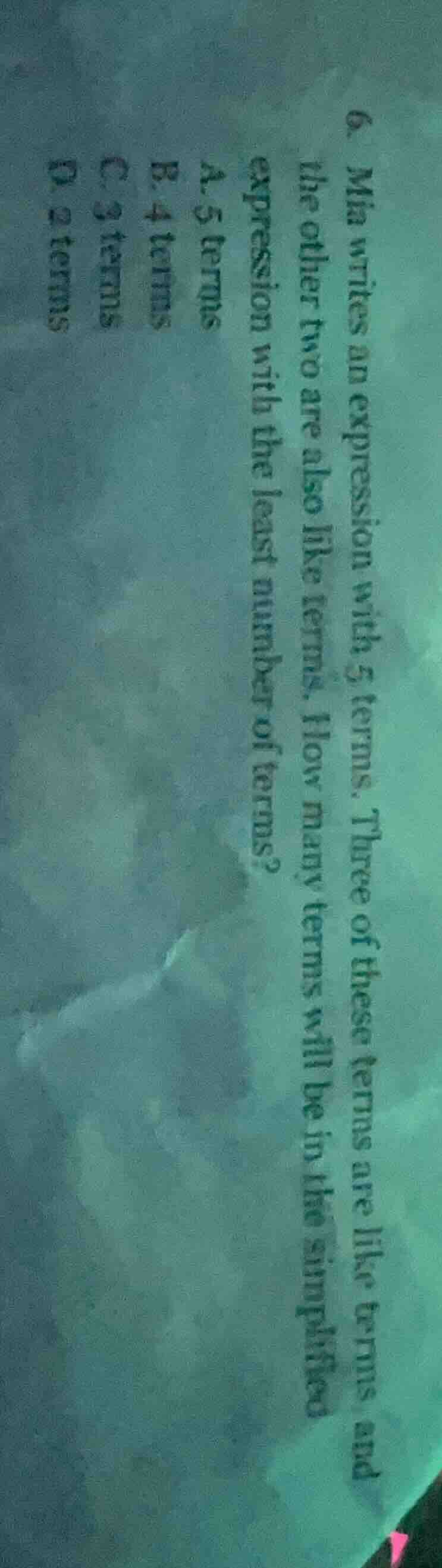
- mia writes an expression with 5 terms. three of these terms are like terms and the other two are also like terms. how many terms will be in the simplified expression with the least number of terms?
a. 5 terms
b. 4 terms
c. 3 terms
d. 2 terms
Step1: Understand like terms
Like terms can be combined. Here, 3 terms are like terms, and another 2 terms are like terms. Wait, no, the problem says: Mia writes an expression with 5 terms. Three of these terms are like terms and the other two are also like terms. So we have two groups of like terms: one group of 3 terms and one group of 2 terms.
Step2: Combine like terms
When we combine the 3 like terms, they become 1 term. When we combine the 2 like terms, they become 1 term. Then, are there any remaining terms? Wait, no, total terms are 5: 3 (group 1) + 2 (group 2) = 5. So combining group 1 (3 terms) into 1 term, group 2 (2 terms) into 1 term. Wait, no, wait: the problem says "three of these terms are like terms and the other two are also like terms". So total like terms: 3 (one set) and 2 (another set). So when simplifying, we combine the 3 like terms into 1 term, and the 2 like terms into 1 term. Wait, but wait, is there a third set? No, total terms are 5: 3 + 2 = 5. So after combining, we have 1 (from 3) + 1 (from 2) = 2? Wait, no, that can't be. Wait, maybe I misread. Wait, the problem says: "Mia writes an expression with 5 terms. Three of these terms are like terms and the other two are also like terms." So "the other two" – so 5 terms: 3 (like) + 2 (like) = 5. So when we combine the 3 like terms, they become 1 term. The 2 like terms become 1 term. So total terms after simplifying: 1 + 1 = 2? Wait, no, that's not right. Wait, maybe the "other two" – wait, 5 terms: 3 are like, and the remaining 2 are like (so those 2 are like each other, but not like the 3). So we have two groups: 3 terms (group A) and 2 terms (group B). Group A can be combined into 1 term, group B can be combined into 1 term. So total terms: 1 + 1 = 2? But that's option D. Wait, but let's check again. Wait, maybe I made a mistake. Wait, 5 terms: 3 (like) + 2 (like) = 5. So combining 3 terms: 3 terms → 1 term. Combining 2 terms: 2 terms → 1 term. So total terms: 1 + 1 = 2? But that seems too few. Wait, no, wait: maybe the "other two" – so 5 terms: 3 (like) and 2 (like, but different from the 3). So when you combine the 3 like terms, you get 1 term. The 2 like terms, you get 1 term. So total terms: 1 + 1 = 2. But let's check the options. Option D is 2 terms. But wait, maybe I misinterpret. Wait, maybe the "other two" – so 5 terms: 3 (like) and then the other two (so 5 - 3 = 2) are like. So yes, 3 and 2. So combining 3 into 1, 2 into 1. So total 2 terms. But let's check the options. Option D is 2 terms. But wait, maybe the problem is: 3 like terms (so they can be combined) and the other two are like terms (so they can be combined). So 3 terms → 1, 2 terms → 1. So 1 + 1 = 2. So the answer is D? Wait, but let's re-express. Let's take an example. Suppose the expression is 3x + 2x + x + 4y + 5y. Wait, no, that's 5 terms? 3x, 2x, x (three like terms: 3x + 2x + x = 6x) and 4y, 5y (two like terms: 4y + 5y = 9y). So the simplified expression is 6x + 9y, which has 2 terms. Ah, right! So in this example, 5 terms (3x, 2x, x, 4y, 5y) → simplify to 6x + 9y (2 terms). So that's 2 terms. So the answer is D. Wait, but let's check the options. Option D is 2 terms. So that's correct.

Snap & solve any problem in the app
Get step-by-step solutions on Sovi AI
Photo-based solutions with guided steps
Explore more problems and detailed explanations
D. 2 terms