QUESTION IMAGE
Question
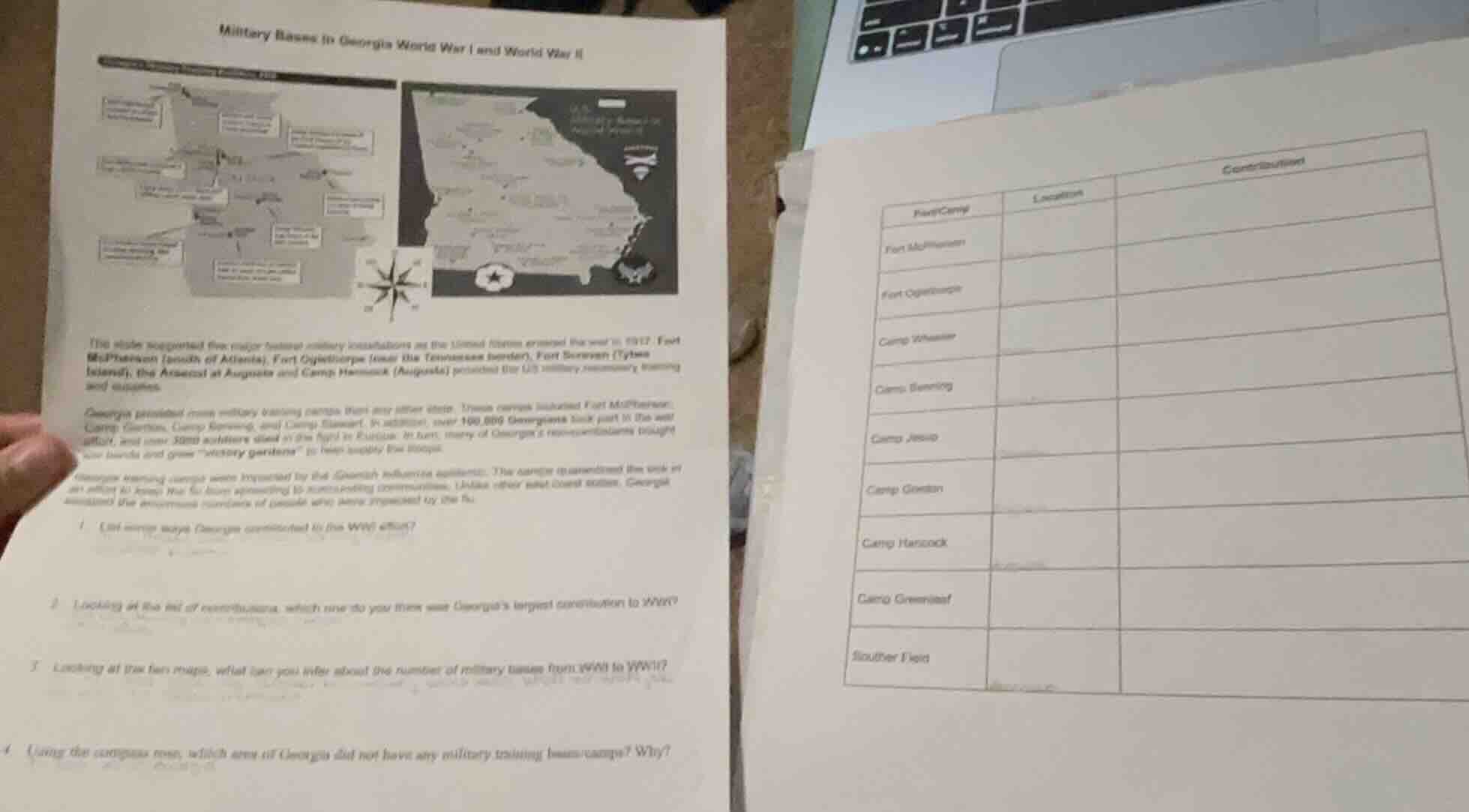
military bases in georgia world war i and world war ii
the slide suggested five major federal military installations as the united states entered the war in 1917: fort mcpherson (south of atlanta), fort oglethorpe (near the tennessee border), fort screven (tybee island), the arsenal at augusta and camp hancock (augusta) protected the us military, economy, training and supplies.
georgia provided more military training camps than any other state. these camps included fort mcpherson, camp gordon, camp stewart, and camp gillem. in addition, over 100,000 georgians took part in the war effort, and over 3,000 soldiers died in the fight to freedom. in turn, many of georgia’s residents/farmers bought war bonds and grew “victory gardens” to help supply the troops.
georgia’s training camps were important to the georgia’s military equipment. the state’s quarantined the sick or as a place to house wwi flu (spreading to surrounding communities). unlike other southeastern states, georgia minimized the environmental concerns of people who were impacted by the flu.
- list three ways georgians contributed to the wwi effort?
- looking at the list of contributions, which one do you think was georgia’s largest contribution to wwi?
- looking at the two maps, what can you infer about the number of military bases from wwi to wwii?
- using the compass rose, which area of georgia did not have any military training bases/camps? why?
| post/camp | location | contributions |
|---|---|---|
| fort oglethorpe | ||
| camp wheeler | ||
| camp stewart | ||
| camp jesup | ||
| camp gordon | ||
| camp hancock | ||
| camp greenleaf | ||
| screven fort |
- For question 1: Georgia contributed by hosting 5 major federal military installations, operating more training camps than any other state, supplying over 300,000 soldiers, having civilians grow victory gardens for food, and housing German POWs.
- For question 2: Georgia's largest contribution was likely supplying over 300,000 soldiers, as this was a massive direct manpower input to the war effort.
- For question 3: From WWI to WWII, the number of military bases in Georgia increased, as the text notes Georgia had more training camps than any other state during the wars, and the map shows expanded installations.
- For question 4: The southeast (coastal/Atlantic side) likely had no training bases/camps. This is because the area was used for POW camps instead, as noted in the text, and the map does not mark training sites there.
For the table:
- Fort McPherson: Location: Near Atlanta; Contribution: Provided US military necessary training and supplies
- Fort Oglethorpe: Location: Near Tennessee border; Contribution: Provided US military necessary training and supplies
- Camp Wheeler: Location: Not specified in text (map reference); Contribution: Trained US military personnel
- Camp Banning: Location: Not specified in text (map reference); Contribution: Trained US military personnel
- Camp Jesup: Location: Not specified in text (map reference); Contribution: Trained US military personnel
- Camp Gordon: Location: Not specified in text (map reference); Contribution: Trained US military personnel
- Camp Hancock: Location: Augusta; Contribution: Provided US military necessary training and supplies
- Camp Greenleaf: Location: Not specified in text (map reference); Contribution: Trained US military personnel
- Souther Field: Location: Not specified in text (map reference); Contribution: Trained US military personnel
- Fort Screven: Location: Tybee Island; Contribution: Provided US military necessary training and supplies
- Annex at Augusta: Location: Augusta; Contribution: Provided US military necessary training and supplies

Snap & solve any problem in the app
Get step-by-step solutions on Sovi AI
Photo-based solutions with guided steps
Explore more problems and detailed explanations
- Georgia contributed by hosting federal military installations, operating more training camps than any other state, supplying over 300,000 soldiers, having civilians grow victory gardens, and housing German POWs.
- Georgia's largest contribution to WWI was supplying over 300,000 soldiers for the war effort.
- The number of military bases in Georgia increased from WWI to WWII, as the state expanded its military infrastructure to support the larger war effort.
- The southeast (Atlantic coastal area) of Georgia had no military training bases/camps; this area was used to house German prisoner-of-war camps instead.
Table Completion:
- Fort McPherson: Location: Near Atlanta; Contribution: Provided US military training and supplies
- Fort Oglethorpe: Location: Near Tennessee border; Contribution: Provided US military training and supplies
- Camp Wheeler: Location: Unspecified (map reference); Contribution: Trained US military personnel
- Camp Banning: Location: Unspecified (map reference); Contribution: Trained US military personnel
- Camp Jesup: Location: Unspecified (map reference); Contribution: Trained US military personnel
- Camp Gordon: Location: Unspecified (map reference); Contribution: Trained US military personnel
- Camp Hancock: Location: Augusta; Contribution: Provided US military training and supplies
- Camp Greenleaf: Location: Unspecified (map reference); Contribution: Trained US military personnel
- Souther Field: Location: Unspecified (map reference); Contribution: Trained US military personnel
- Fort Screven: Location: Tybee Island; Contribution: Provided US military training and supplies
- Annex at Augusta: Location: Augusta; Contribution: Provided US military training and supplies