QUESTION IMAGE
Question
mississippi. read the passages. then answer the question below:
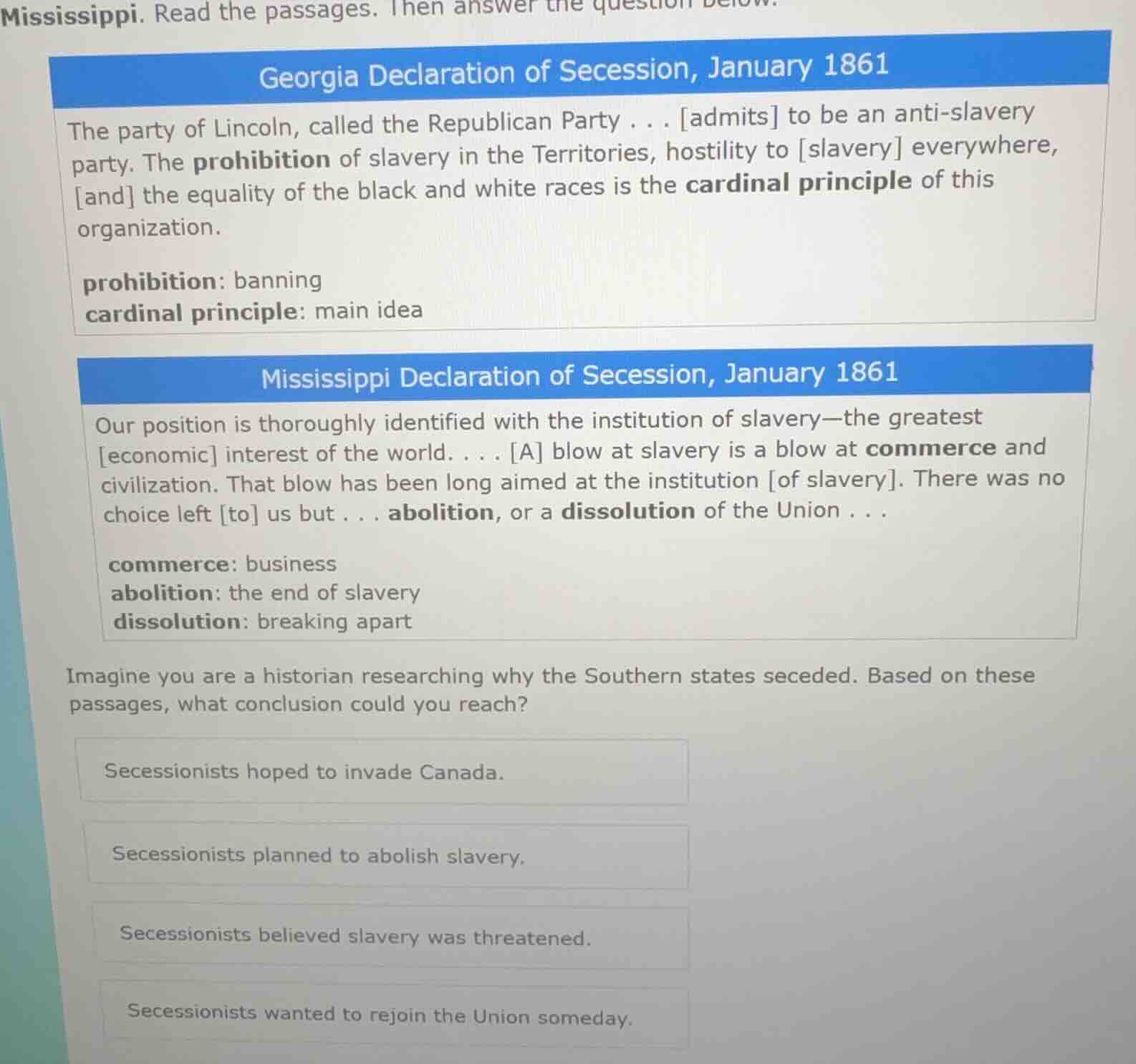
georgia declaration of secession, january 1861
the party of lincoln, called the republican party . . . admits to be an anti-slavery party. the prohibition of slavery in the territories, hostility to slavery everywhere, and the equality of the black and white races is the cardinal principle of this organization.
prohibition: banning
cardinal principle: main idea
mississippi declaration of secession, january 1861
our position is thoroughly identified with the institution of slavery—the greatest economic interest of the world. . . . a blow at slavery is a blow at commerce and civilization. that blow has been long aimed at the institution of slavery. there was no choice left to us but . . . abolition, or a dissolution of the union . . .
commerce: business
abolition: the end of slavery
dissolution: breaking apart
imagine you are a historian researching why the southern states seceded. based on these passages, what conclusion could you reach?
secessionists hoped to invade canada.
secessionists planned to abolish slavery.
secessionists believed slavery was threatened.
secessionists wanted to rejoin the union someday.
The Georgia Declaration states the Republican Party (Lincoln's party) is anti-slavery, with hostility to slavery as a core principle. The Mississippi Declaration frames slavery as their key economic interest, claiming attacks on slavery force a choice between ending slavery or leaving the Union. These show secessionists viewed the Republican-led government as a threat to slavery. The other options are unsupported: there is no mention of invading Canada, secessionists opposed abolition, and they chose to leave the Union rather than wanting to rejoin.

Snap & solve any problem in the app
Get step-by-step solutions on Sovi AI
Photo-based solutions with guided steps
Explore more problems and detailed explanations
Secessionists believed slavery was threatened.