QUESTION IMAGE
Question
modeling with rational functions
using an inverse variation function to solve problems
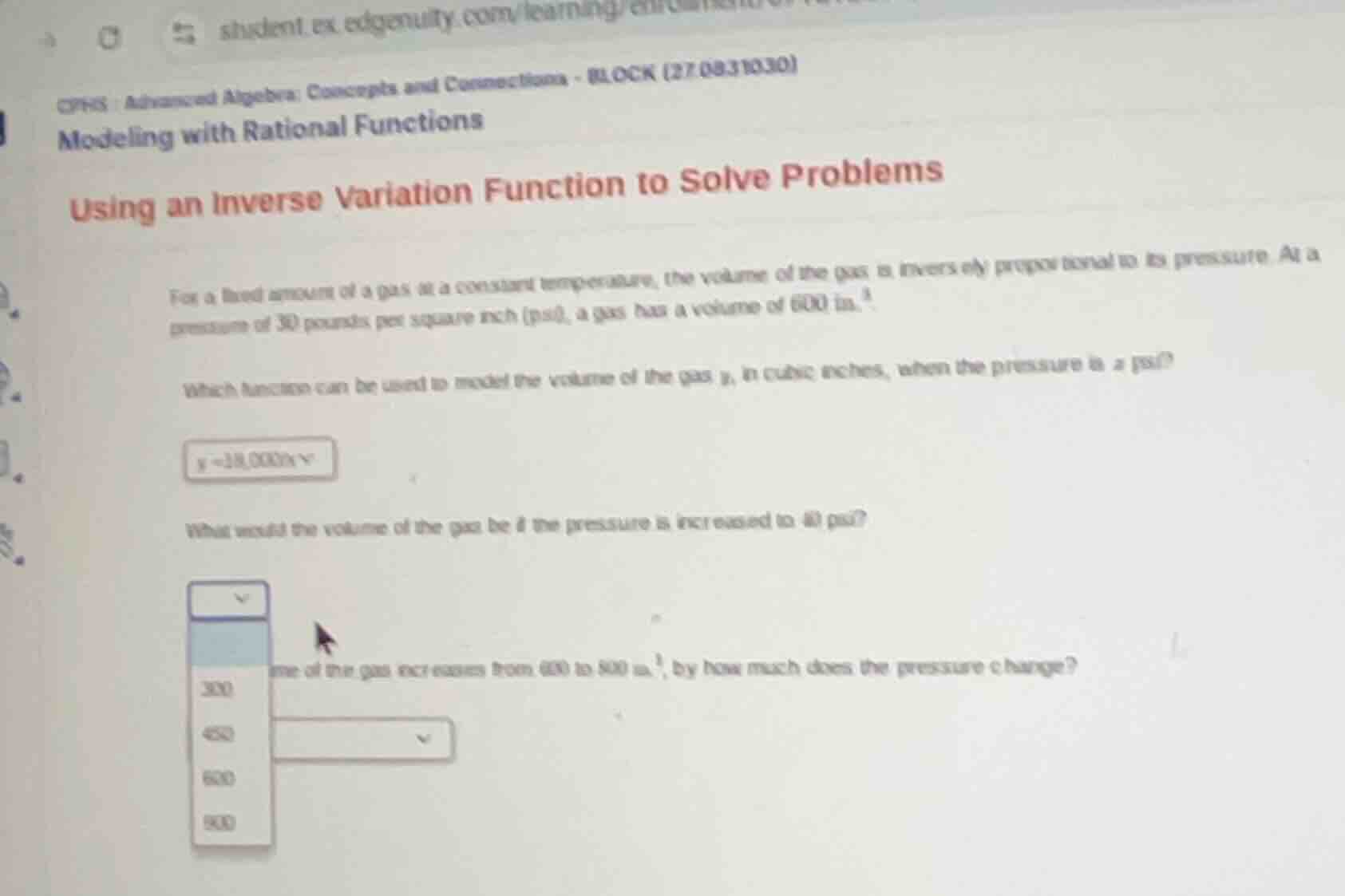
for a fixed amount of a gas at a constant temperature, the volume of the gas is inversely proportional to its pressure. at a pressure of 30 pounds per square inch (psi), a gas has a volume of 600 in.³
which function can be used to model the volume of the gas y, in cubic inches, when the pressure is x psi?
y = 18,000x?
what would the volume of the gas be if the pressure is increased to 40 psi?
dropdown with 300, 450, 600, 900
if the volume of the gas increases from 600 to 900 in.³, by how much does the pressure change?
dropdown with options, part visible
Part 1: Find the function for volume and pressure
Step1: Recall inverse variation formula
Inverse variation is modeled as \( y = \frac{k}{x} \), where \( k \) is the constant of variation. Here, volume \( y \) (in \( \text{in}^3 \)) varies inversely with pressure \( x \) (in psi), so \( y=\frac{k}{x} \).
Step2: Find the constant \( k \)
We know when \( x = 30 \) psi, \( y = 600 \text{ in}^3 \). Substitute into the formula:
\( 600=\frac{k}{30} \)
Multiply both sides by 30: \( k = 600\times30 = 18000 \).
Step3: Write the function
Substitute \( k = 18000 \) into \( y=\frac{k}{x} \), so the function is \( y=\frac{18000}{x} \).
Part 2: Volume when pressure is 40 psi
Step1: Use the function \( y=\frac{18000}{x} \)
We need to find \( y \) when \( x = 40 \) psi. Substitute \( x = 40 \) into the function:
\( y=\frac{18000}{40} \)
Step2: Calculate the value
\( \frac{18000}{40}=450 \). So the volume is 450 cubic inches.
Part 3: Pressure change when volume increases from 600 to 900 \( \text{in}^3 \)
Step1: Find pressure for \( y = 600 \)
We already know when \( y = 600 \), \( x = 30 \) psi (given).
Step2: Find pressure for \( y = 900 \)
Use \( y=\frac{18000}{x} \), substitute \( y = 900 \):
\( 900=\frac{18000}{x} \)
Multiply both sides by \( x \): \( 900x = 18000 \)
Divide by 900: \( x=\frac{18000}{900}=20 \) psi.
Step3: Calculate the pressure change
Initial pressure: 30 psi, Final pressure: 20 psi. Change in pressure: \( 30 - 20 = 10 \) psi (decrease of 10 psi, or change by - 10 psi; but if we consider the magnitude of change, it's 10 psi).

Snap & solve any problem in the app
Get step-by-step solutions on Sovi AI
Photo-based solutions with guided steps
Explore more problems and detailed explanations
s:
- The function is \( \boldsymbol{y=\frac{18000}{x}} \).
- Volume at 40 psi is \( \boldsymbol{450} \) cubic inches.
- The pressure changes by \( \boldsymbol{10} \) psi (decreases by 10 psi, from 30 to 20 psi).