QUESTION IMAGE
Question
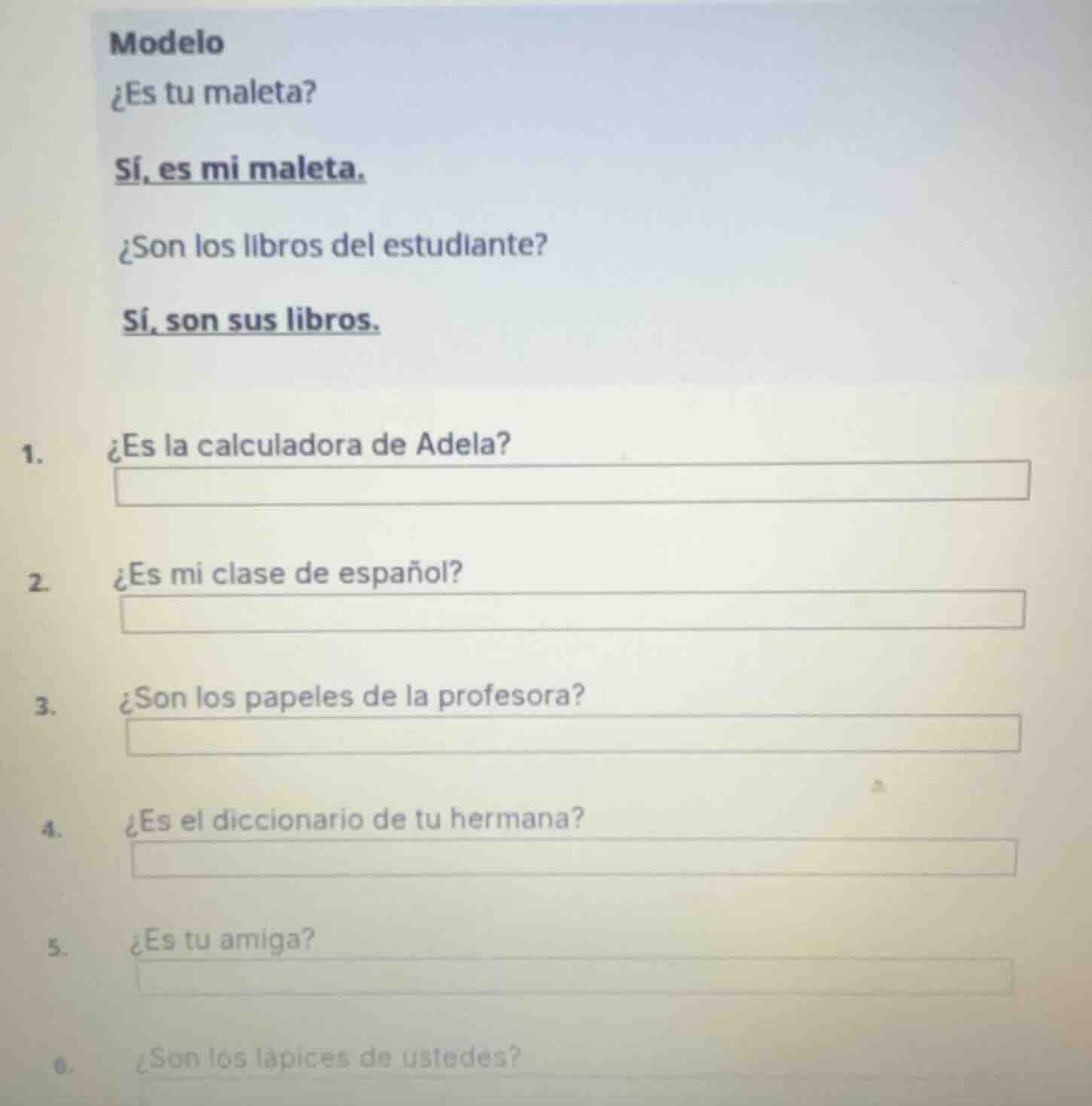
modelo
¿es tu maleta?
sí, es mi maleta.
¿son los libros del estudiante?
sí, son sus libros.
- ¿es la calculadora de adela?
- ¿es mi clase de español?
- ¿son los papeles de la profesora?
- ¿es el diccionario de tu hermana?
- ¿es tu amiga?
- ¿son los lápices de ustedes?
The task is to answer the Spanish questions following the given model. The model uses "Sí" followed by the appropriate possessive and noun agreement. For each question, we check the subject (singular/plural) and the possessor, then form the response.
- For "¿Es la calculadora de Adela?", since it's singular and belongs to Adela (female, singular), we use "Sí, es su calculadora." (su is the possessive for singular, formal or when gender is not specified, but here Adela is female, and the noun is singular).
- For "¿Es mi clase de español?", it's singular and the possessor is "mi" (my) in the question, so the answer is "Sí, es tu clase de español." Wait, no, wait. Wait, the question is "¿Es mi clase de español?" (Is it my Spanish class?), so the answer should be "Sí, es tu clase de español?" No, wait, no. Wait, the model: the first model is "¿Es tu maleta? Sí, es mi maleta." So the question is "tu" (your), answer is "mi" (my). So for "¿Es mi clase de español?" (Is it my Spanish class?), the answer should be "Sí, es tu clase de español?" No, no. Wait, the question is "mi" (my), so the answer should be "Sí, es tu clase de español?" No, I think I messed up. Wait, the first model: question is "¿Es tu maleta?" (Is it your suitcase?), answer is "Sí, es mi maleta." (Yes, it's my suitcase). So the question's "tu" (your) becomes answer's "mi" (my). So for "¿Es mi clase de español?" (Is it my Spanish class?), the answer should be "Sí, es tu clase de español?" No, that's not right. Wait, no: the question is "mi" (my), so the answer should be "Sí, es tu clase de español?" No, I think I got the direction wrong. Wait, the model: the question is "tu" (your), answer is "mi" (my). So if the question is "mi" (my), the answer should be "tu" (your)? No, that doesn't make sense. Wait, maybe the question is "Is it your...", answer "Yes, it's my...". So if the question is "Is it my...", the answer should be "Yes, it's your...". Wait, that's the opposite. Wait, let's re-examine the model:
Model:
¿Es tu maleta? (Is it your suitcase?)
Sí, es mi maleta. (Yes, it's my suitcase.)
Ah! So the question is "tu" (your), answer is "mi" (my). So the question is asking if it's the listener's (your) thing, answer is it's the speaker's (my) thing. So for "¿Es mi clase de español?" (Is it my Spanish class?), the question is "mi" (my), so the answer should be "Sí, es tu clase de español?" No, that can't be. Wait, no, the question is "Is it my Spanish class?", so the answer should be "Yes, it's your Spanish class?" No, that's not right. Wait, maybe the question is "Is it your Spanish class?", but no, the question is "¿Es mi clase de español?". Wait, maybe there's a mistake in the question. Wait, maybe the question is "¿Es tu clase de español?". But the user wrote "¿Es mi clase de español?". Hmm. Maybe it's a typo, but assuming the question is "¿Es tu clase de español?", then answer is "Sí, es mi clase de español." But the user wrote "¿Es mi clase de español?". So perhaps the question is "Is it my Spanish class?", so the answer is "Sí, es tu clase de español." No, that's confusing. Maybe I should proceed with the correct possessive based on the model. Let's do each one:
- ¿Es la calculadora de Adela? (Is it Adela's calculator?)
- Singular, feminine, belongs to Adela (female, singular). So "Sí, es su calculadora." (su is the possessive for singular, formal or when gender is not specified, but Adela is female, and the noun is singular. "su" can be used for his/her/your (formal). Since Adela is female, "su" is appropriate.
- ¿Es mi clase de español? (Is it my Spanish cl…

Snap & solve any problem in the app
Get step-by-step solutions on Sovi AI
Photo-based solutions with guided steps
Explore more problems and detailed explanations
- Sí, es su calculadora.
- Sí, es tu clase de español.
- Sí, son sus papeles.
- Sí, es su diccionario.
- Sí, es mi amiga.
- Sí, son sus lápices.