QUESTION IMAGE
Question
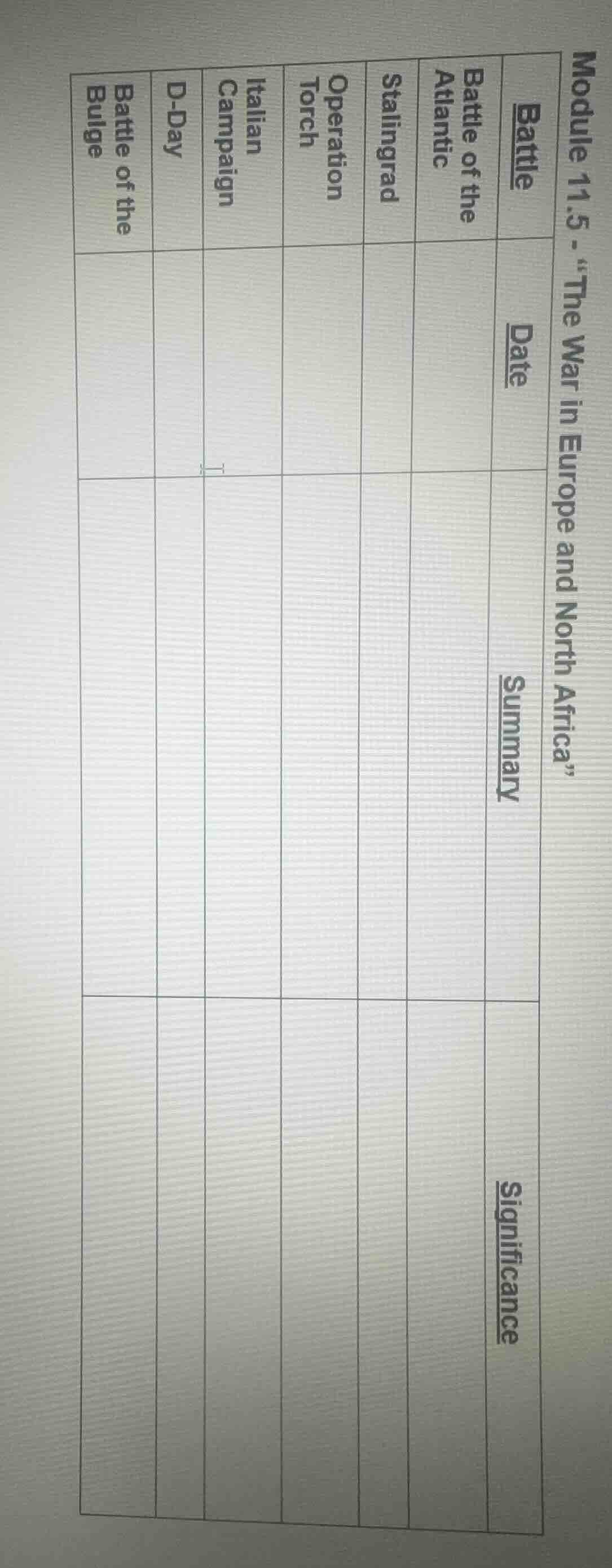
module 11.5 - \the war in europe and north africa\
battle | battle of the atlantic | stalingrad | operation torch | italian campaign | d - day | battle of the bulge
date | | | | | |
summary | | | | | |
significance | | | | | |
Brief Explanations
This table requires filling in key details of major WWII European/North African battles, including their dates, core events, and historical importance. All information is based on established World War II historical records.

Snap & solve any problem in the app
Get step-by-step solutions on Sovi AI
Photo-based solutions with guided steps
Explore more problems and detailed explanations
| Battle | Date | Summary | Significance |
|---|---|---|---|
| Stalingrad | August 1942 - February 1943 | A brutal urban battle where Soviet forces defended the city of Stalingrad against invading German troops. The fighting involved house-to-house combat, and the Soviets eventually encircled and captured the German 6th Army. | Marked the first major decisive defeat of Nazi Germany on land; turned the tide of the Eastern Front, putting Germany on the defensive for the rest of the war. |
| Operation Torch | November 8 - 16, 1942 | The Allied amphibious invasion of French North Africa (Morocco, Algeria, Tunisia). Led by U.S. and British forces, it aimed to push Axis troops (German and Italian) out of North Africa and open a second front against Germany. | Opened a new Allied front in North Africa, led to the eventual Axis surrender in North Africa in 1943, and provided a testing ground for amphibious invasion tactics used later in the war. |
| Italian Campaign | July 1943 - May 1945 | Allied invasion of Sicily, followed by an advance through mainland Italy. The campaign involved heavy fighting against German defensive lines (like the Gustav Line) and the eventual fall of Rome in 1944. | Drew German troops away from the Eastern and Western Fronts, weakened Axis control of the Mediterranean, and led to the surrender of Italy in 1943, splitting the Axis powers. |
| D-Day | June 6, 1944 | The Allied amphibious invasion of Normandy, France, with landings on five beaches (Utah, Omaha, Gold, Juno, Sword). It was the largest seaborne invasion in history, involving over 156,000 Allied troops. | Opened the long-awaited Western Front in Europe, allowing Allied forces to push toward Germany and accelerating the end of the war in Europe. |
| Battle of the Bulge | December 16, 1944 - January 25, 1945 | A surprise German offensive in the Ardennes Forest (Belgium, Luxembourg, France) that created a "bulge" in the Allied lines. The Allies eventually repelled the attack after heavy fighting, including the defense of Bastogne. | Was the last major German offensive on the Western Front; depleted German reserves and resources, ensuring the eventual Allied victory in Europe within months. |