QUESTION IMAGE
Question
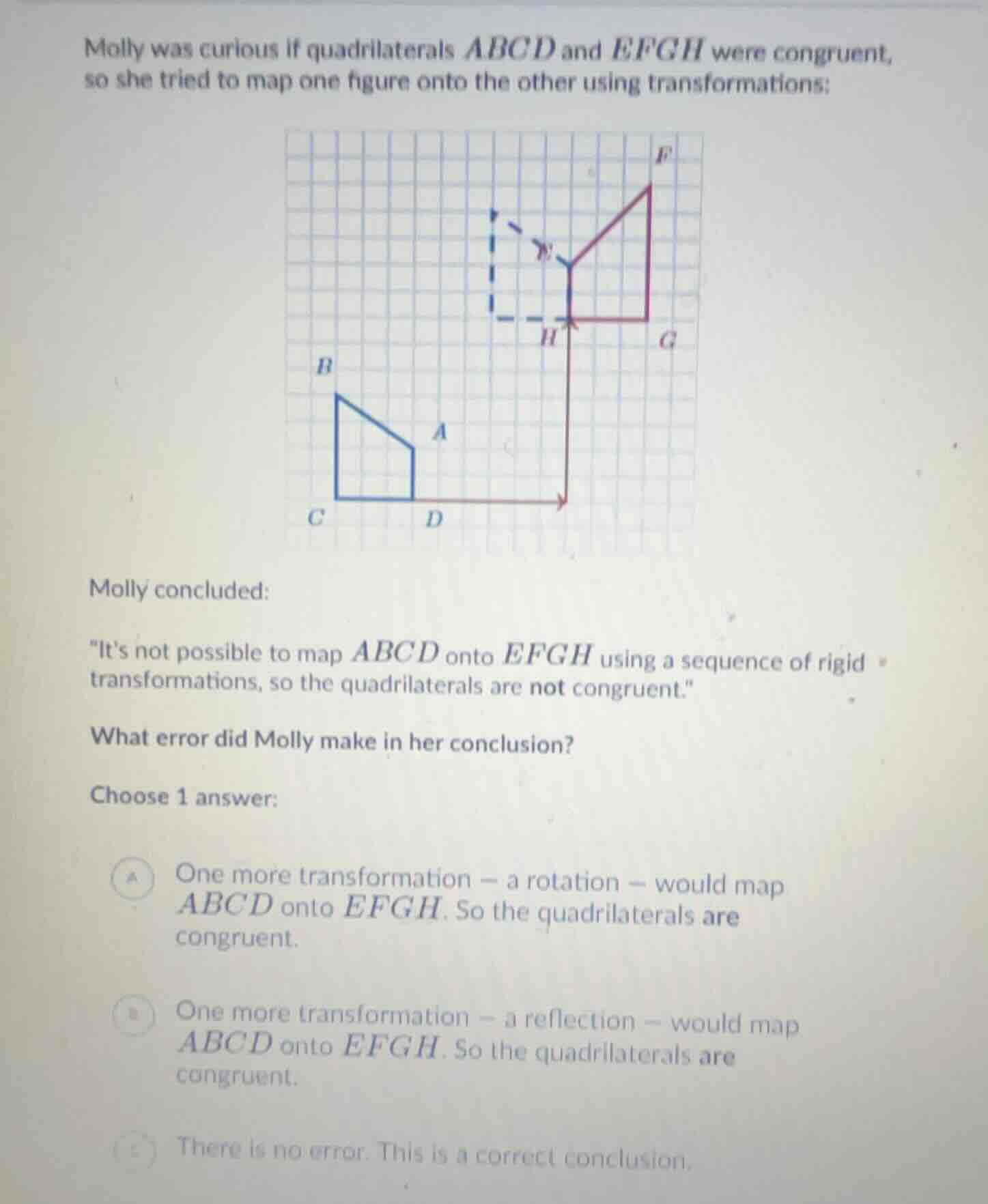
molly was curious if quadrilaterals (abcd) and (efgh) were congruent, so she tried to map one figure onto the other using transformations:
molly concluded:
\its not possible to map (abcd) onto (efgh) using a sequence of rigid transformations, so the quadrilaterals are not congruent.\
what error did molly make in her conclusion?
choose 1 answer:
a one more transformation — a rotation — would map (abcd) onto (efgh). so the quadrilaterals are congruent.
b one more transformation — a reflection — would map (abcd) onto (efgh). so the quadrilaterals are congruent.
c there is no error. this is a correct conclusion.
Rigid transformations (translations, rotations, reflections) preserve congruence. The diagram shows that after the translation Molly did, a reflection (flip over a line) would align quadrilateral ABCD perfectly with EFGH. Molly incorrectly assumed no sequence of rigid transformations exists, but a reflection is a valid rigid transformation that would complete the mapping, proving the quadrilaterals are congruent.

Snap & solve any problem in the app
Get step-by-step solutions on Sovi AI
Photo-based solutions with guided steps
Explore more problems and detailed explanations
B. One more transformation – a reflection – would map ABCD onto EFGH. So the quadrilaterals are congruent.