QUESTION IMAGE
Question
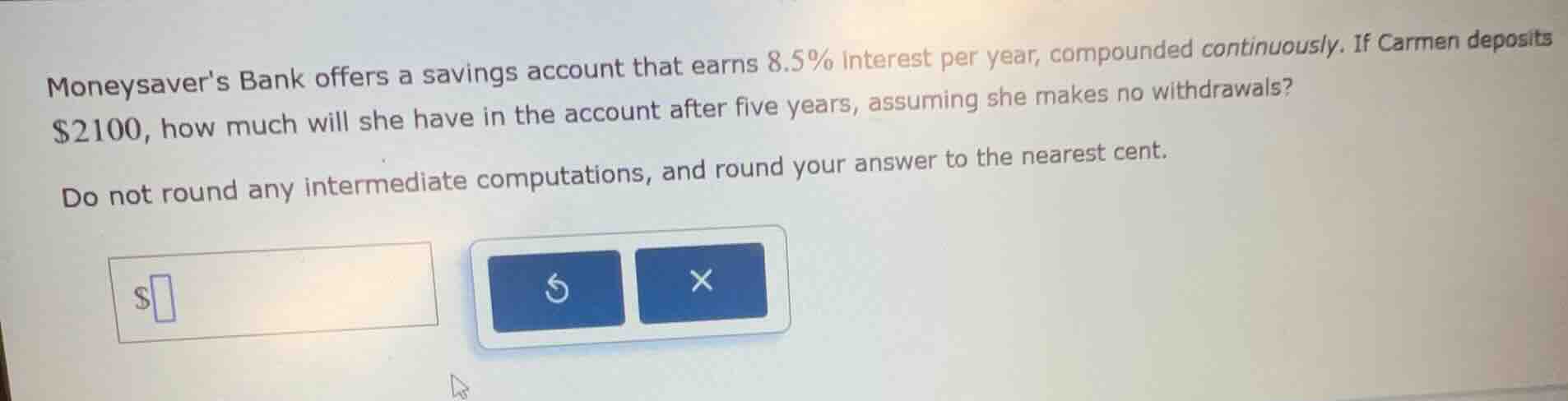
moneysavers bank offers a savings account that earns 8.5% interest per year, compounded continuously. if carmen deposits $2100, how much will she have in the account after five years, assuming she makes no withdrawals? do not round any intermediate computations, and round your answer to the nearest cent.
Step1: Recall the formula for continuous compounding
The formula for continuous compounding is $A = Pe^{rt}$, where $P$ is the principal amount, $r$ is the annual interest rate (in decimal), $t$ is the time in years, and $e$ is the base of the natural logarithm.
Here, $P = 2100$, $r = 0.085$ (since $8.5\%=0.085$), and $t = 5$.
Step2: Substitute the values into the formula
Substitute $P = 2100$, $r = 0.085$, and $t = 5$ into the formula:
$A = 2100\times e^{(0.085\times 5)}$
Step3: Calculate the exponent
First, calculate the exponent: $0.085\times 5 = 0.425$
Step4: Calculate the value of $e^{0.425}$
Using a calculator, $e^{0.425}\approx1.52932018$
Step5: Calculate the final amount
Multiply 2100 by the value of $e^{0.425}$:
$A = 2100\times1.52932018\approx3211.57$

Snap & solve any problem in the app
Get step-by-step solutions on Sovi AI
Photo-based solutions with guided steps
Explore more problems and detailed explanations
$\$3211.57$