QUESTION IMAGE
Question
monitoring progress and modeling wit
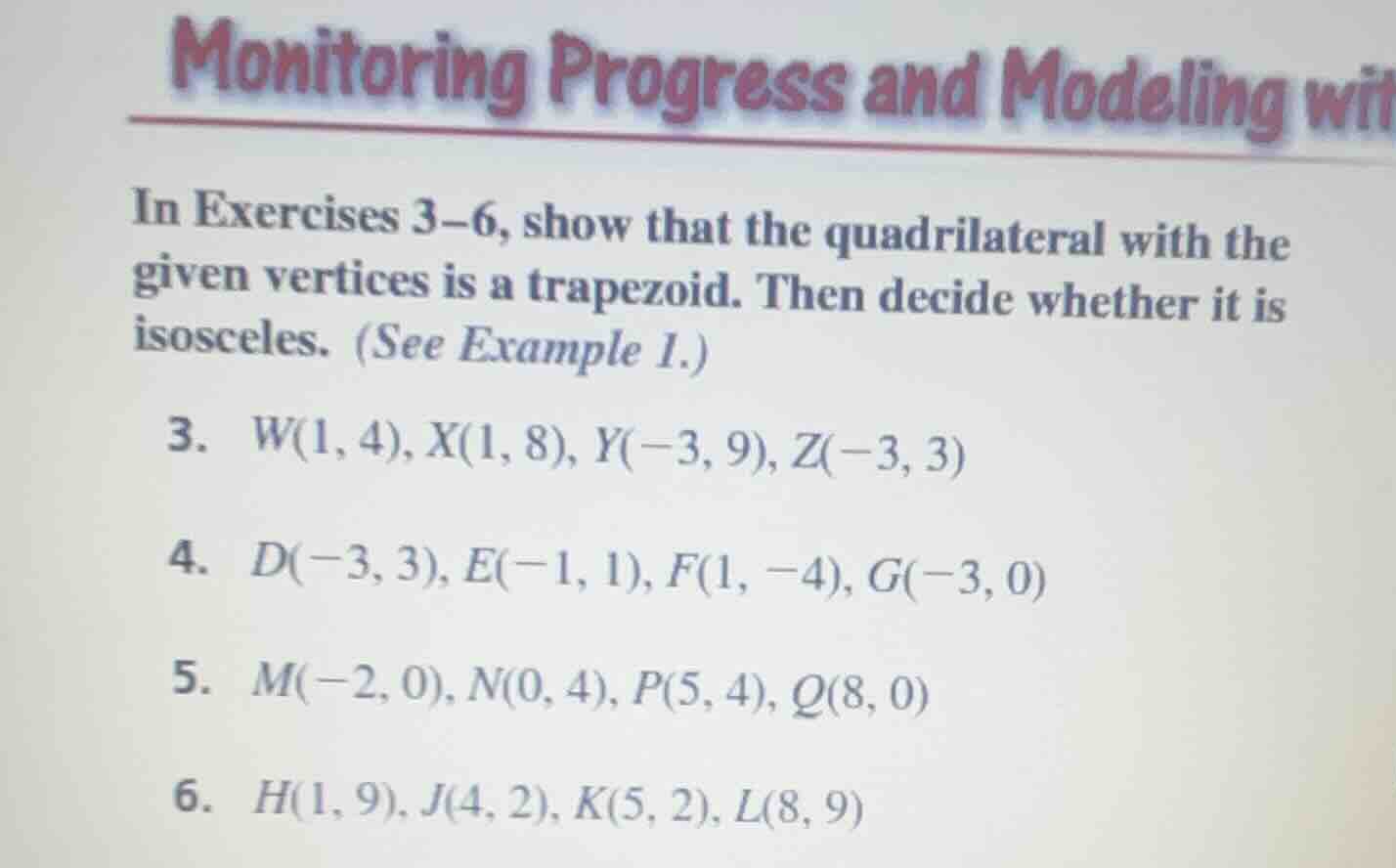
in exercises 3–6, show that the quadrilateral with the
given vertices is a trapezoid. then decide whether it is
isosceles. (see example 1.)
- w(1, 4), x(1, 8), y(-3, 9), z(-3, 3)
- d(-3, 3), e(-1, 1), f(1, -4), g(-3, 0)
- m(-2, 0), n(0, 4), p(5, 4), q(8, 0)
- h(1, 9), j(4, 2), k(5, 2), l(8, 9)
Let's solve problem 3 first:
Problem 3: Vertices \( W(1, 4) \), \( X(1, 8) \), \( Y(-3, 9) \), \( Z(-3, 3) \)
To show a quadrilateral is a trapezoid, we need to show that at least one pair of sides is parallel. Parallel lines have the same slope. The slope formula between two points \( (x_1, y_1) \) and \( (x_2, y_2) \) is \( m = \frac{y_2 - y_1}{x_2 - x_1} \).
Step 1: Find the slope of \( WX \)
Points \( W(1, 4) \) and \( X(1, 8) \)
Since \( x_1 = x_2 = 1 \), the slope is undefined (vertical line).
Step 2: Find the slope of \( XY \)
Points \( X(1, 8) \) and \( Y(-3, 9) \)
\( m_{XY} = \frac{9 - 8}{-3 - 1} = \frac{1}{-4} = -\frac{1}{4} \)
Step 3: Find the slope of \( YZ \)
Points \( Y(-3, 9) \) and \( Z(-3, 3) \)
Since \( x_1 = x_2 = -3 \), the slope is undefined (vertical line).
Step 4: Find the slope of \( ZW \)
Points \( Z(-3, 3) \) and \( W(1, 4) \)
\( m_{ZW} = \frac{4 - 3}{1 - (-3)} = \frac{1}{4} \)
Now, \( WX \) (slope undefined, vertical) and \( YZ \) (slope undefined, vertical) are parallel. So, \( WXYZ \) is a trapezoid.
To check if it's isosceles, we check the lengths of the non - parallel sides (\( XY \) and \( ZW \)) or the distances between the endpoints of the parallel sides.
Length of \( WX \): \( \vert 8 - 4\vert=4 \) (since it's a vertical line, distance is difference in y - coordinates)
Length of \( YZ \): \( \vert 9 - 3\vert = 6 \) (vertical line, distance is difference in y - coordinates)
Length of \( XY \): \( \sqrt{(-3 - 1)^2+(9 - 8)^2}=\sqrt{(-4)^2 + 1^2}=\sqrt{16 + 1}=\sqrt{17} \)
Length of \( ZW \): \( \sqrt{(1+3)^2+(4 - 3)^2}=\sqrt{16 + 1}=\sqrt{17} \)
Since the lengths of the non - parallel sides \( XY \) and \( ZW \) are equal, the trapezoid is isosceles.
Problem 4: Vertices \( D(-3, 3) \), \( E(-1, 1) \), \( F(1, -4) \), \( G(-3, 0) \)
Step 1: Find the slope of \( DE \)
Points \( D(-3, 3) \) and \( E(-1, 1) \)
\( m_{DE}=\frac{1 - 3}{-1+3}=\frac{-2}{2}=-1 \)
Step 2: Find the slope of \( EF \)
Points \( E(-1, 1) \) and \( F(1, -4) \)
\( m_{EF}=\frac{-4 - 1}{1 + 1}=\frac{-5}{2}=-2.5 \)
Step 3: Find the slope of \( FG \)
Points \( F(1, -4) \) and \( G(-3, 0) \)
\( m_{FG}=\frac{0 + 4}{-3 - 1}=\frac{4}{-4}=-1 \)
Step 4: Find the slope of \( GD \)
Points \( G(-3, 0) \) and \( D(-3, 3) \)
Since \( x_1=x_2 = - 3 \), the slope is undefined (vertical line)
Since \( m_{DE}=m_{FG}=-1 \), \( DE \parallel FG \). So, \( DEFG \) is a trapezoid.
Now, check if it's isosceles.
Length of \( DE \): \( \sqrt{(-1 + 3)^2+(1 - 3)^2}=\sqrt{4 + 4}=\sqrt{8}=2\sqrt{2} \)
Length of \( FG \): \( \sqrt{(-3 - 1)^2+(0 + 4)^2}=\sqrt{16 + 16}=\sqrt{32}=4\sqrt{2} \)
Length of \( EF \): \( \sqrt{(1 + 1)^2+(-4 - 1)^2}=\sqrt{4 + 25}=\sqrt{29} \)
Length of \( GD \): \( \vert3 - 0\vert = 3 \) (vertical line)
Since the lengths of the non - parallel sides \( EF \) and \( GD \) are not equal, the trapezoid is not isosceles.
Problem 5: Vertices \( M(-2, 0) \), \( N(0, 4) \), \( P(5, 4) \), \( Q(8, 0) \)
Step 1: Find the slope of \( MN \)
Points \( M(-2, 0) \) and \( N(0, 4) \)
\( m_{MN}=\frac{4 - 0}{0 + 2}=\frac{4}{2}=2 \)
Step 2: Find the slope of \( NP \)
Points \( N(0, 4) \) and \( P(5, 4) \)
Since \( y_1 = y_2 = 4 \), the slope is \( 0 \) (horizontal line)
Step 3: Find the slope of \( PQ \)
Points \( P(5, 4) \) and \( Q(8, 0) \)
\( m_{PQ}=\frac{0 - 4}{8 - 5}=\frac{-4}{3}=-\frac{4}{3} \)
Step 4: Find the slope of \( QM \)
Points \( Q(8, 0) \) and \( M(-2, 0) \)
Since \( y_1 = y_2 = 0 \), the slope is \( 0 \) (horizontal line)
Since \( m_{NP}=m_{QM}=0 \),…

Snap & solve any problem in the app
Get step-by-step solutions on Sovi AI
Photo-based solutions with guided steps
Explore more problems and detailed explanations
Let's solve problem 3 first:
Problem 3: Vertices \( W(1, 4) \), \( X(1, 8) \), \( Y(-3, 9) \), \( Z(-3, 3) \)
To show a quadrilateral is a trapezoid, we need to show that at least one pair of sides is parallel. Parallel lines have the same slope. The slope formula between two points \( (x_1, y_1) \) and \( (x_2, y_2) \) is \( m = \frac{y_2 - y_1}{x_2 - x_1} \).
Step 1: Find the slope of \( WX \)
Points \( W(1, 4) \) and \( X(1, 8) \)
Since \( x_1 = x_2 = 1 \), the slope is undefined (vertical line).
Step 2: Find the slope of \( XY \)
Points \( X(1, 8) \) and \( Y(-3, 9) \)
\( m_{XY} = \frac{9 - 8}{-3 - 1} = \frac{1}{-4} = -\frac{1}{4} \)
Step 3: Find the slope of \( YZ \)
Points \( Y(-3, 9) \) and \( Z(-3, 3) \)
Since \( x_1 = x_2 = -3 \), the slope is undefined (vertical line).
Step 4: Find the slope of \( ZW \)
Points \( Z(-3, 3) \) and \( W(1, 4) \)
\( m_{ZW} = \frac{4 - 3}{1 - (-3)} = \frac{1}{4} \)
Now, \( WX \) (slope undefined, vertical) and \( YZ \) (slope undefined, vertical) are parallel. So, \( WXYZ \) is a trapezoid.
To check if it's isosceles, we check the lengths of the non - parallel sides (\( XY \) and \( ZW \)) or the distances between the endpoints of the parallel sides.
Length of \( WX \): \( \vert 8 - 4\vert=4 \) (since it's a vertical line, distance is difference in y - coordinates)
Length of \( YZ \): \( \vert 9 - 3\vert = 6 \) (vertical line, distance is difference in y - coordinates)
Length of \( XY \): \( \sqrt{(-3 - 1)^2+(9 - 8)^2}=\sqrt{(-4)^2 + 1^2}=\sqrt{16 + 1}=\sqrt{17} \)
Length of \( ZW \): \( \sqrt{(1+3)^2+(4 - 3)^2}=\sqrt{16 + 1}=\sqrt{17} \)
Since the lengths of the non - parallel sides \( XY \) and \( ZW \) are equal, the trapezoid is isosceles.
Problem 4: Vertices \( D(-3, 3) \), \( E(-1, 1) \), \( F(1, -4) \), \( G(-3, 0) \)
Step 1: Find the slope of \( DE \)
Points \( D(-3, 3) \) and \( E(-1, 1) \)
\( m_{DE}=\frac{1 - 3}{-1+3}=\frac{-2}{2}=-1 \)
Step 2: Find the slope of \( EF \)
Points \( E(-1, 1) \) and \( F(1, -4) \)
\( m_{EF}=\frac{-4 - 1}{1 + 1}=\frac{-5}{2}=-2.5 \)
Step 3: Find the slope of \( FG \)
Points \( F(1, -4) \) and \( G(-3, 0) \)
\( m_{FG}=\frac{0 + 4}{-3 - 1}=\frac{4}{-4}=-1 \)
Step 4: Find the slope of \( GD \)
Points \( G(-3, 0) \) and \( D(-3, 3) \)
Since \( x_1=x_2 = - 3 \), the slope is undefined (vertical line)
Since \( m_{DE}=m_{FG}=-1 \), \( DE \parallel FG \). So, \( DEFG \) is a trapezoid.
Now, check if it's isosceles.
Length of \( DE \): \( \sqrt{(-1 + 3)^2+(1 - 3)^2}=\sqrt{4 + 4}=\sqrt{8}=2\sqrt{2} \)
Length of \( FG \): \( \sqrt{(-3 - 1)^2+(0 + 4)^2}=\sqrt{16 + 16}=\sqrt{32}=4\sqrt{2} \)
Length of \( EF \): \( \sqrt{(1 + 1)^2+(-4 - 1)^2}=\sqrt{4 + 25}=\sqrt{29} \)
Length of \( GD \): \( \vert3 - 0\vert = 3 \) (vertical line)
Since the lengths of the non - parallel sides \( EF \) and \( GD \) are not equal, the trapezoid is not isosceles.
Problem 5: Vertices \( M(-2, 0) \), \( N(0, 4) \), \( P(5, 4) \), \( Q(8, 0) \)
Step 1: Find the slope of \( MN \)
Points \( M(-2, 0) \) and \( N(0, 4) \)
\( m_{MN}=\frac{4 - 0}{0 + 2}=\frac{4}{2}=2 \)
Step 2: Find the slope of \( NP \)
Points \( N(0, 4) \) and \( P(5, 4) \)
Since \( y_1 = y_2 = 4 \), the slope is \( 0 \) (horizontal line)
Step 3: Find the slope of \( PQ \)
Points \( P(5, 4) \) and \( Q(8, 0) \)
\( m_{PQ}=\frac{0 - 4}{8 - 5}=\frac{-4}{3}=-\frac{4}{3} \)
Step 4: Find the slope of \( QM \)
Points \( Q(8, 0) \) and \( M(-2, 0) \)
Since \( y_1 = y_2 = 0 \), the slope is \( 0 \) (horizontal line)
Since \( m_{NP}=m_{QM}=0 \), \( NP \parallel QM \). So, \( MNPQ \) is a trapezoid.
Check if it's isosceles:
Length of \( NP \): \( \vert5 - 0\vert = 5 \) (horizontal line, distance is difference in x - coordinates)
Length of \( QM \): \( \vert8+2\vert = 10 \) (horizontal line, distance is difference in x - coordinates)
Length of \( MN \): \( \sqrt{(0 + 2)^2+(4 - 0)^2}=\sqrt{4 + 16}=\sqrt{20}=2\sqrt{5} \)
Length of \( PQ \): \( \sqrt{(8 - 5)^2+(0 - 4)^2}=\sqrt{9 + 16}=\sqrt{25}=5 \)
Since the lengths of the non - parallel sides \( MN \) and \( PQ \) are equal (\( 2\sqrt{5}\approx4.47\) and \( 5\)? Wait, no, \( \sqrt{20} = 2\sqrt{5}\approx4.47\) and \( \sqrt{25}=5 \). Wait, let's recalculate the lengths of the legs (non - parallel sides) and the diagonals.
Diagonal \( MP \): \( \sqrt{(5 + 2)^2+(4 - 0)^2}=\sqrt{49 + 16}=\sqrt{65} \)
Diagonal \( NQ \): \( \sqrt{(8 - 0)^2+(0 - 4)^2}=\sqrt{64 + 16}=\sqrt{80}=4\sqrt{5} \)
Wait, another way: For a trapezoid to be isosceles, the non - parallel sides should be equal or the diagonals should be equal.
Length of \( MN \): \( \sqrt{(0 + 2)^2+(4 - 0)^2}=\sqrt{4 + 16}=\sqrt{20} \)
Length of \( PQ \): \( \sqrt{(8 - 5)^2+(0 - 4)^2}=\sqrt{9 + 16}=\sqrt{25} \)
Length of \( NP \): \( 5 \), Length of \( QM \): \( 10 \)
Wait, diagonals: \( MP \): distance between \( M(-2,0) \) and \( P(5,4) \): \( \sqrt{(5 + 2)^2+(4 - 0)^2}=\sqrt{49 + 16}=\sqrt{65} \)
\( NQ \): distance between \( N(0,4) \) and \( Q(8,0) \): \( \sqrt{(8 - 0)^2+(0 - 4)^2}=\sqrt{64 + 16}=\sqrt{80} \)
Since \( \sqrt{65}
eq\sqrt{80} \) and \( \sqrt{20}
eq\sqrt{25} \), the trapezoid is not isosceles? Wait, no, let's re - check the slopes.
Wait, \( NP \) is from \( (0,4) \) to \( (5,4) \), slope \( 0 \). \( QM \) is from \( (8,0) \) to \( (-2,0) \), slope \( 0 \). So they are parallel (horizontal lines). The non - parallel sides are \( MN \) (from \( (-2,0) \) to \( (0,4) \)) and \( PQ \) (from \( (5,4) \) to \( (8,0) \)), and also \( NQ \) and \( MP \)? No, the two non - parallel sides are \( MN \) and \( PQ \), and also \( MQ \) and \( NP \) are the parallel sides. Wait, no, in a trapezoid, there are two parallel sides (bases) and two non - parallel sides (legs). So the legs are \( MN \) and \( PQ \), and the bases are \( NP \) and \( QM \).
Wait, length of \( MN \): \( \sqrt{(0 + 2)^2+(4 - 0)^2}=\sqrt{4 + 16}=\sqrt{20} \)
Length of \( PQ \): \( \sqrt{(8 - 5)^2+(0 - 4)^2}=\sqrt{9 + 16}=\sqrt{25} \)
Length of the diagonals: \( MP \): distance between \( M(-2,0) \) and \( P(5,4) \): \( \sqrt{(5 + 2)^2+(4 - 0)^2}=\sqrt{49 + 16}=\sqrt{65} \)
\( NQ \): distance between \( N(0,4) \) and \( Q(8,0) \): \( \sqrt{(8 - 0)^2+(0 - 4)^2}=\sqrt{64 + 16}=\sqrt{80} \)
Since the diagonals are not equal and the legs are not equal, the trapezoid is not isosceles.
Problem 6: Vertices \( H(1, 9) \), \( J(4, 2) \), \( K(5, 2) \), \( L(8, 9) \)
Step 1: Find the slope of \( HJ \)
Points \( H(1, 9) \) and \( J(4, 2) \)
\( m_{HJ}=\frac{2 - 9}{4 - 1}=\frac{-7}{3}=-\frac{7}{3} \)
Step 2: Find the slope of \( JK \)
Points \( J(4, 2) \) and \( K(5, 2) \)
Since \( y_1 = y_2 = 2 \), the slope is \( 0 \) (horizontal line)
Step 3: Find the slope of \( KL \)
Points \( K(5, 2) \) and \( L(8, 9) \)
\( m_{KL}=\frac{9 - 2}{8 - 5}=\frac{7}{3} \)
Step 4: Find the slope of \( LH \)
Points \( L(8, 9) \) and \( H(1, 9) \)
Since \( y_1 = y_2 = 9 \), the slope is \( 0 \) (horizontal line)
Since \( m_{JK}=m_{LH}=0 \), \( JK \parallel LH \). So, \( HJKL \) is a trapezoid.
Check if it's isosceles:
Length of \( JK \): \( \vert5 - 4\vert = 1 \) (horizontal line, distance is difference in x - coordinates)
Length of \( LH \): \( \vert8 - 1\vert = 7 \) (horizontal line, distance is difference in x - coordinates)
Length of \( HJ \): \( \sqrt{(4 - 1)^2+(2 - 9)^2}=\sqrt{9 + 49}=\sqrt{58} \)
Length of \( KL \): \( \sqrt{(8 - 5)^2+(9 - 2)^2}=\sqrt{9 + 49}=\sqrt{58} \)
Since the lengths of the non - parallel sides \( HJ \) and \( KL \) are equal, the trapezoid is isosceles.
Final Answers (for each problem):
Problem 3:
- It is a trapezoid (since \( WX \parallel YZ \)) and it is isosceles (since the non - parallel sides \( XY \) and \( ZW \) are equal in length).
Problem 4:
- It is a trapezoid (since \( DE \parallel FG \)) and it is not isosceles (since the non - parallel sides and diagonals are not equal in length).
Problem 5:
- It is a trapezoid (since \( NP \parallel QM \)) and it is not isosceles (since the non - parallel sides and diagonals are not equal in length).
Problem 6:
- It is a trapezoid (since \( JK \parallel LH \)) and it is isosceles (since the non - parallel sides \( HJ \) and \( KL \) are equal in length).