QUESTION IMAGE
Question
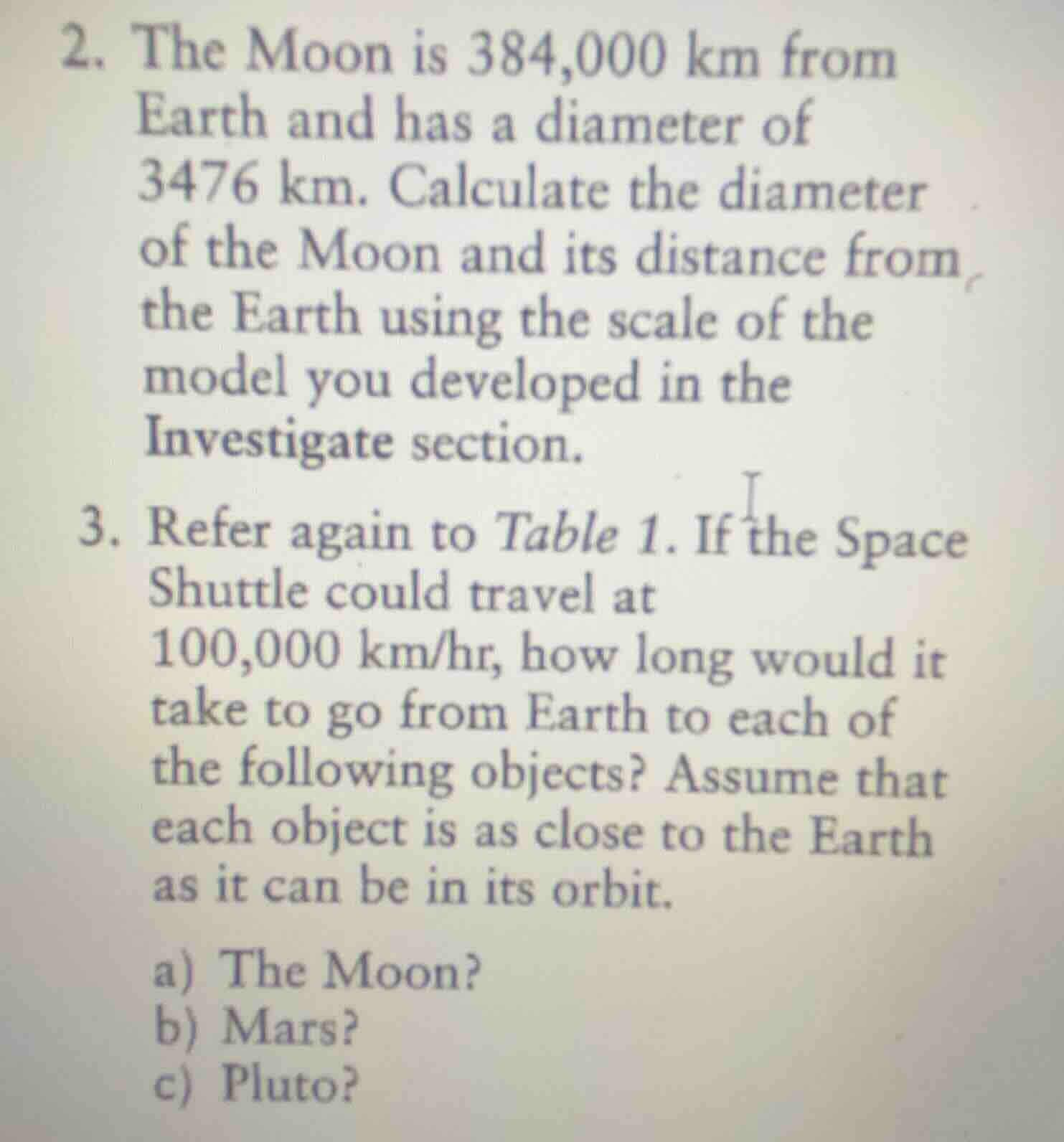
- the moon is 384,000 km from earth and has a diameter of 3476 km. calculate the diameter of the moon and its distance from the earth using the scale of the model you developed in the investigate section.
- refer again to table 1. if the space shuttle could travel at 100,000 km/hr, how long would it take to go from earth to each of the following objects? assume that each object is as close to the earth as it can be in its orbit.
a) the moon?
b) mars?
c) pluto?
Response
Problem 2 (Assuming a common scale, say 1:10,000,000 for example, since the "Investigate section" model isn't provided, we'll use a sample scale to demonstrate the method. Let's assume the scale from the model is 1: \( s \), but since it's not given, we'll proceed with the formula. The general formula for scaled diameter \( d_s \) is \( d_s=\frac{\text{Actual Diameter}}{s} \) and scaled distance \( D_s=\frac{\text{Actual Distance}}{s} \). For example, if the scale is 1:10,000,000 (1 cm represents 10,000,000 cm or 100 km):
Step1: Convert actual values to the same unit as the scale (if needed). Here, actual distance \( D = 384000 \) km \( = 38400000000 \) cm, actual diameter \( d = 3476 \) km \( = 347600000 \) cm.
Step2: Apply the scale formula. Let scale \( s = 10000000 \) (1 cm : 10,000,000 cm). Scaled distance \( D_s=\frac{38400000000}{10000000}=3840 \) cm \( = 38.4 \) m. Scaled diameter \( d_s=\frac{347600000}{10000000}=34.76 \) cm. (Note: Since the model's scale isn't provided, this is a demonstration. The key is using \( \text{Scaled Value}=\frac{\text{Actual Value}}{\text{Scale Factor}} \))
Problem 3a: Time to reach the Moon. The formula for time \( t \) is \( t=\frac{\text{Distance}}{\text{Speed}} \).
Step1: Identify distance to Moon (\( D = 384000 \) km) and speed (\( v = 100000 \) km/hr).
Step2: Apply time formula \( t=\frac{D}{v} \).
\( t=\frac{384000}{100000}=3.84 \) hours.
3b: (Assuming closest distance to Mars is about 54.6 million km, \( D = 54600000 \) km)
Step1: Identify distance to Mars (\( D = 54600000 \) km) and speed (\( v = 100000 \) km/hr).
Step2: Apply time formula \( t=\frac{D}{v} \).
\( t=\frac{54600000}{100000}=546 \) hours.
3c: (Assuming closest distance to Pluto is about 4.28 billion km, \( D = 4280000000 \) km)

Snap & solve any problem in the app
Get step-by-step solutions on Sovi AI
Photo-based solutions with guided steps
Explore more problems and detailed explanations
(Demonstration with scale 1:10,000,000):
Scaled distance to Earth: \( 38.4 \) m, Scaled diameter of Moon: \( 34.76 \) cm (Depends on the actual scale from the model)