QUESTION IMAGE
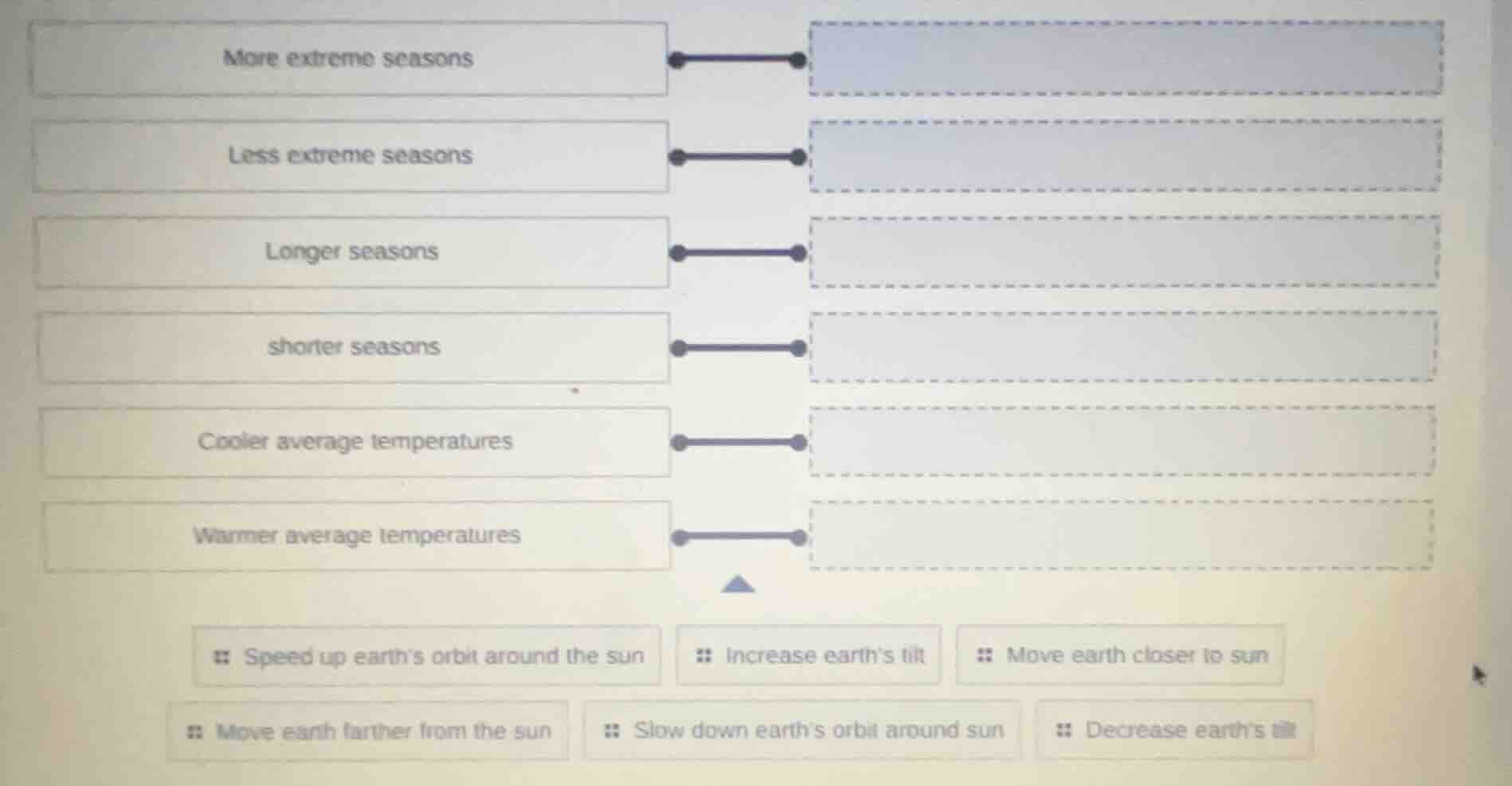
Question
more extreme seasons
less extreme seasons
longer seasons
shorter seasons
cooler average temperatures
warmer average temperatures
speed up earths orbit around the sun increase earths tilt move earth closer to sun
move earth farther from the sun slow down earths orbit around sun decrease earths tilt
To solve the problem of matching the seasonal effects with the corresponding Earth - related changes, we analyze each effect based on astronomical knowledge:
1. More extreme seasons
- Explanation: The tilt of the Earth's axis affects the intensity of seasons. When the Earth's tilt is increased, the difference in the amount of solar radiation received by different hemispheres during different times of the year (seasons) becomes more significant. So, more extreme seasons are caused by an increase in the Earth's tilt.
- Matching: More extreme seasons $\longleftrightarrow$ Increase earth's tilt
2. Less extreme seasons
- Explanation: A decrease in the Earth's tilt will reduce the difference in solar radiation received by different hemispheres across seasons. This leads to less extreme seasons.
- Matching: Less extreme seasons $\longleftrightarrow$ Decrease earth's tilt
3. Longer seasons
- Explanation: The time it takes for the Earth to complete one orbit around the Sun determines the length of a year and thus the length of seasons. If we slow down the Earth's orbit around the Sun, the time taken to complete an orbit (and hence the length of each season) will increase.
- Matching: Longer seasons $\longleftrightarrow$ Slow down earth's orbit around sun
4. Shorter seasons
- Explanation: Speeding up the Earth's orbit around the Sun means that the Earth will complete one orbit (and the seasons within that orbit) in a shorter amount of time. So, the seasons will be shorter.
- Matching: Shorter seasons $\longleftrightarrow$ Speed up earth's orbit around the sun
5. Cooler average temperatures
- Explanation: The distance of the Earth from the Sun affects the amount of solar energy the Earth receives. If we move the Earth farther from the Sun, the amount of solar radiation reaching the Earth's surface will decrease, resulting in cooler average temperatures.
- Matching: Cooler average temperatures $\longleftrightarrow$ Move earth farther from the sun
6. Warmer average temperatures
- Explanation: Moving the Earth closer to the Sun will increase the amount of solar radiation that the Earth receives. This increase in solar energy will lead to warmer average temperatures on the Earth.
- Matching: Warmer average temperatures $\longleftrightarrow$ Move earth closer to sun
The completed table (matching) is as follows:
| Seasonal Effect | Corresponding Earth - related Change |
|---|---|
| Less extreme seasons | Decrease earth's tilt |
| Longer seasons | Slow down earth's orbit around sun |
| Shorter seasons | Speed up earth's orbit around the sun |
| Cooler average temperatures | Move earth farther from the sun |
| Warmer average temperatures | Move earth closer to sun |

Snap & solve any problem in the app
Get step-by-step solutions on Sovi AI
Photo-based solutions with guided steps
Explore more problems and detailed explanations
To solve the problem of matching the seasonal effects with the corresponding Earth - related changes, we analyze each effect based on astronomical knowledge:
1. More extreme seasons
- Explanation: The tilt of the Earth's axis affects the intensity of seasons. When the Earth's tilt is increased, the difference in the amount of solar radiation received by different hemispheres during different times of the year (seasons) becomes more significant. So, more extreme seasons are caused by an increase in the Earth's tilt.
- Matching: More extreme seasons $\longleftrightarrow$ Increase earth's tilt
2. Less extreme seasons
- Explanation: A decrease in the Earth's tilt will reduce the difference in solar radiation received by different hemispheres across seasons. This leads to less extreme seasons.
- Matching: Less extreme seasons $\longleftrightarrow$ Decrease earth's tilt
3. Longer seasons
- Explanation: The time it takes for the Earth to complete one orbit around the Sun determines the length of a year and thus the length of seasons. If we slow down the Earth's orbit around the Sun, the time taken to complete an orbit (and hence the length of each season) will increase.
- Matching: Longer seasons $\longleftrightarrow$ Slow down earth's orbit around sun
4. Shorter seasons
- Explanation: Speeding up the Earth's orbit around the Sun means that the Earth will complete one orbit (and the seasons within that orbit) in a shorter amount of time. So, the seasons will be shorter.
- Matching: Shorter seasons $\longleftrightarrow$ Speed up earth's orbit around the sun
5. Cooler average temperatures
- Explanation: The distance of the Earth from the Sun affects the amount of solar energy the Earth receives. If we move the Earth farther from the Sun, the amount of solar radiation reaching the Earth's surface will decrease, resulting in cooler average temperatures.
- Matching: Cooler average temperatures $\longleftrightarrow$ Move earth farther from the sun
6. Warmer average temperatures
- Explanation: Moving the Earth closer to the Sun will increase the amount of solar radiation that the Earth receives. This increase in solar energy will lead to warmer average temperatures on the Earth.
- Matching: Warmer average temperatures $\longleftrightarrow$ Move earth closer to sun
The completed table (matching) is as follows:
| Seasonal Effect | Corresponding Earth - related Change |
|---|---|
| Less extreme seasons | Decrease earth's tilt |
| Longer seasons | Slow down earth's orbit around sun |
| Shorter seasons | Speed up earth's orbit around the sun |
| Cooler average temperatures | Move earth farther from the sun |
| Warmer average temperatures | Move earth closer to sun |