QUESTION IMAGE
Question
6.3.1. more triangle theorems
1.
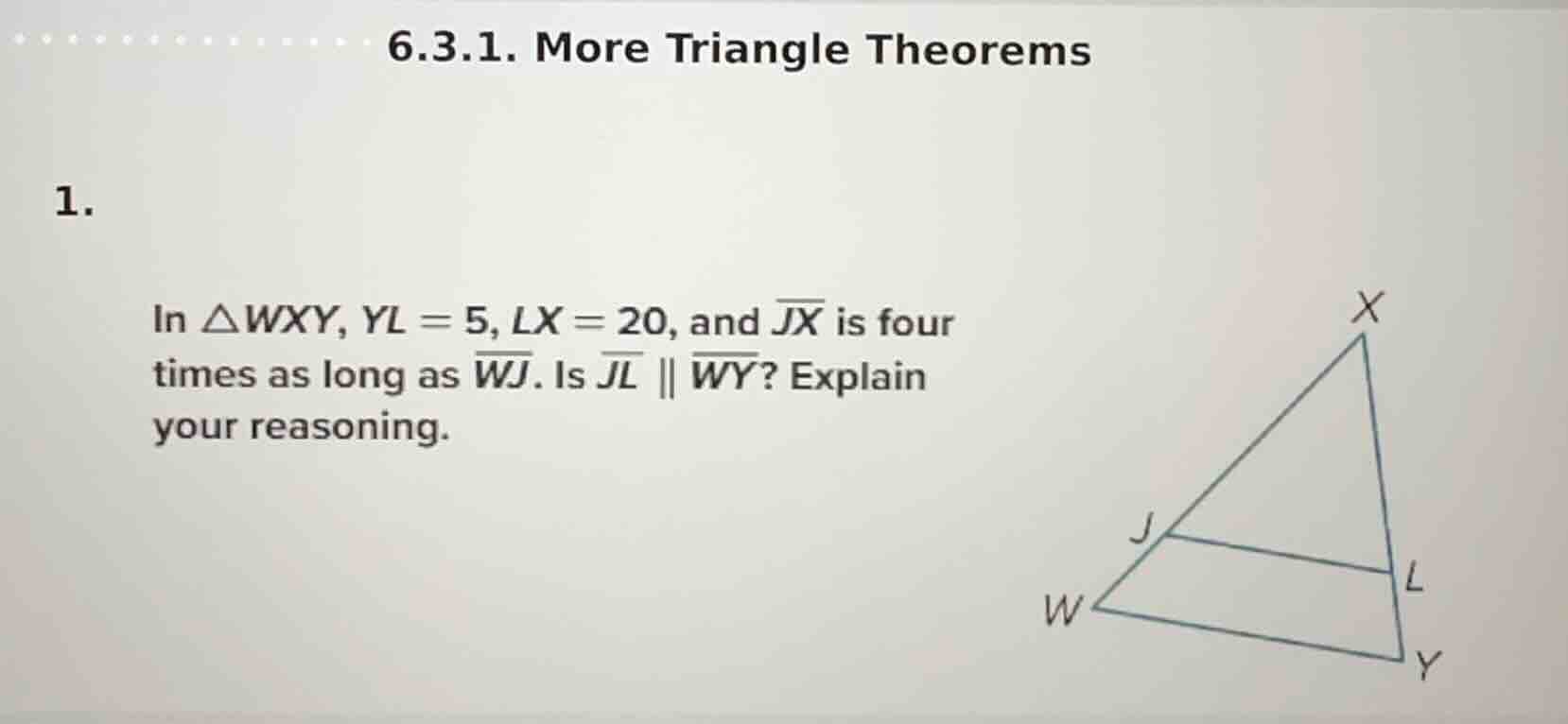
in △wxy, ( yl = 5 ), ( lx = 20 ), and ( overline{jx} ) is four times as long as ( overline{wj} ). is ( overline{jl} parallel overline{wy} )? explain your reasoning.
Step1: Find the ratio of \( YL \) to \( LX \)
We know \( YL = 5 \) and \( LX = 20 \). The ratio \( \frac{YL}{LX} \) is calculated as:
\( \frac{YL}{LX}=\frac{5}{20}=\frac{1}{4} \)
Step2: Find the ratio of \( WJ \) to \( JX \)
Given that \( JX \) is four times as long as \( WJ \), let \( WJ = x \), then \( JX = 4x \). The ratio \( \frac{WJ}{JX} \) is:
\( \frac{WJ}{JX}=\frac{x}{4x}=\frac{1}{4} \)
Step3: Apply the Converse of the Basic Proportionality Theorem (Thales' theorem)
The Converse of the Basic Proportionality Theorem states that if a line divides two sides of a triangle proportionally, then it is parallel to the third side.
In \( \triangle WXY \), the line \( JL \) divides sides \( WX \) (into segments \( WJ \) and \( JX \)) and \( XY \) (into segments \( YL \) and \( LX \)). We found that \( \frac{WJ}{JX}=\frac{YL}{LX}=\frac{1}{4} \), which means \( JL \) divides the two sides \( WX \) and \( XY \) proportionally.

Snap & solve any problem in the app
Get step-by-step solutions on Sovi AI
Photo-based solutions with guided steps
Explore more problems and detailed explanations
Yes, \( \overline{JL} \parallel \overline{WY} \) because by the Converse of the Basic Proportionality Theorem (Thales' theorem), since \( \frac{WJ}{JX}=\frac{YL}{LX}=\frac{1}{4} \), the line \( JL \) divides the two sides of \( \triangle WXY \) proportionally, so it is parallel to the third side \( WY \).