QUESTION IMAGE
Question
mother jones
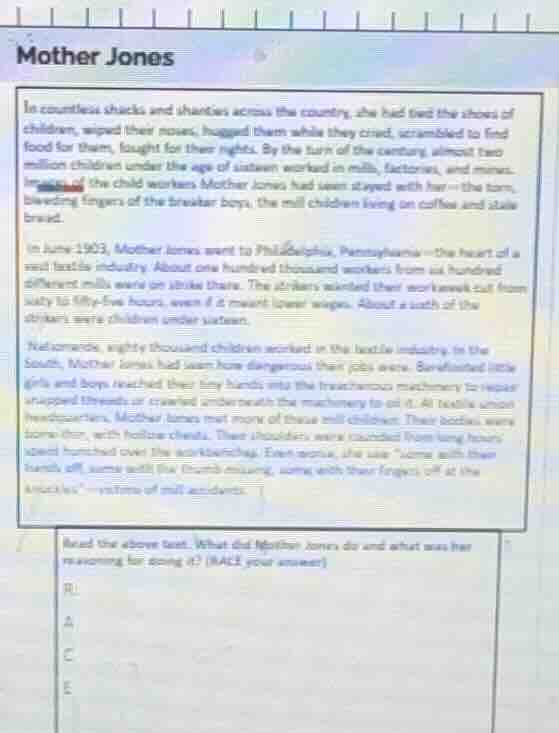
in countless shacks and shanties across the country, she had tied the shoes of children, wiped their noses, hugged them while they cried, scrambled to find food for them, fought for their rights. by the turn of the century, almost two million children under the age of sixteen worked in mills, factories, and mines. instead of the child workers mother jones had stayed with her—tom, bleeding fingers of the breaker boys, the mill children living on coffee and stale bread.
in june 1903, mother jones went to philadelphia, pennsylvania—the heart of a vast textile industry. about one hundred thousand workers from six hundred different mills went on strike there. the strikers wanted their workweek cut from sixty to fifty-five hours, even if it meant lower wages. about a sixth of the strikers were children under sixteen.
nationwide, eighty thousand children worked in the textile industry. in the south, mother jones had seen how dangerous their jobs were. barefooted little girls and boys reached their tiny hands into the treacherous machinery to repair snapped threads or crawled underneath the machinery to oil it. at textile union headquarters, mother jones met more of these mill children. their bodies were sore thin, with hollow chests. their shoulders were rounded from long hours bent hunched over the workbenches. even worse, she saw \some with their hands cut off with the thumb missing, some with their fingers off at the knuckles\—victims of mill accidents.
read the above text. what did mother jones do and what was her reasoning for doing it? (race your answer)
Mother Jones advocated for child workers by directly supporting them (caring for basic needs) and protesting child labor. Her reasoning stemmed from witnessing the widespread exploitation of nearly 2 million children under 16 in dangerous, low-wage factory/mill jobs, including harsh conditions like long hours, maiming machinery, and stunted physical development. She targeted industries like Philadelphia's textile mills and Southern bottle factories to expose and end this abuse.

Snap & solve any problem in the app
Get step-by-step solutions on Sovi AI
Photo-based solutions with guided steps
Explore more problems and detailed explanations
R (Role/Actions):
- She provided direct care to child workers: tied their shoes, wiped their noses, comforted them, and helped find food.
- She advocated for child workers' rights, fought against their exploitation in mills, factories, and mines, and protested the harsh labor conditions they faced.
A (Actions Details):
- In 1903, she went to Philadelphia (a textile industry hub) to support 100,000 striking workers, including child laborers who worked long hours for low pay.
- She highlighted the dangers of child labor in Southern bottle factories, where 80,000 children operated dangerous machinery, suffered injuries, and had stunted physical growth.
C (Context/Reasoning):
- She witnessed the widespread exploitation of nearly 2 million children under 16, who worked grueling, unsafe jobs with little pay.
- She saw the severe harm to children: maiming from machinery, stunted growth, and poor health from long hours and inadequate care.
E (Effect/Goal):
- Her actions aimed to expose the cruelty of child labor, fight for better working conditions and rights for child workers, and ultimately end the exploitation of children in the workforce.