QUESTION IMAGE
Question
mother jones
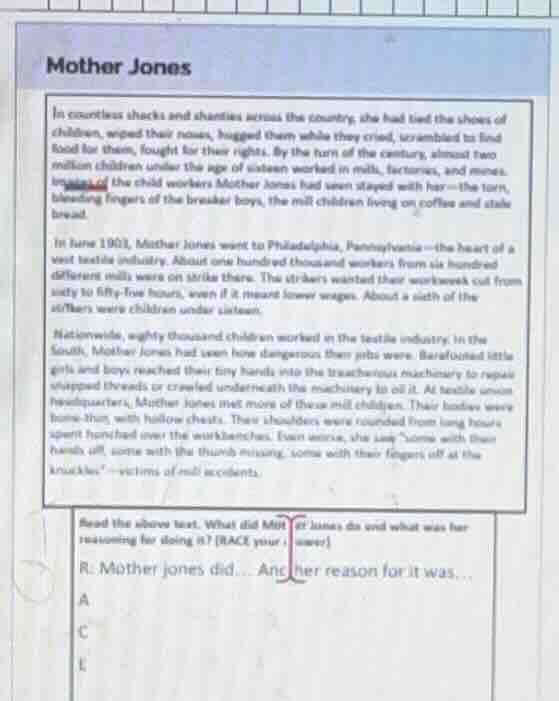
in countless shacks and shanties across the country, she had tied the shoes of children, wiped their noses, hugged them while they cried, scrambled to find food for them, fought for their rights. by the turn of the century, almost two million children under the age of sixteen worked in mills, factories, and mines. instead of the child workers mother jones had been steeped with her—the turn, blistered fingers of the breaker boys, the mill children living on coffee and stale bread.
in june 1903, mother jones went to philadelphia, pennsylvania—the heart of a vast textile industry. almost one hundred thousand workers from six hundred different mills went on strike there. the strikers wanted their workweek cut from sixty to fifty-five hours, even if it meant lower wages. about a sixth of the strikers were children under sixteen.
nationwide, eighty thousand children worked in the textile industry in the south. mother jones had seen how dangerous their jobs were. barefooted little girls and boys reached their tiny hands into the treacherous machinery to repair snapped threads or crawled underneath the machinery to oil it. at textile union headquarters, mother jones met most of these mill children. their bodies were bone-thin, with hollow chests. their shoulders were rounded from long hours spent hunched over the workbenches. even some who came with their hands still some with the thumb missing, some with their fingers off at the knuckles—victims of mill accidents.
read the above text. what did mother jones do and what was her reasoning for doing it? (race your answer)
r: mother jones did... and her reason for it was...
a
c
e
The text details Mother Jones' actions focused on advocating for child laborers. She lived among them, understood their harsh conditions, and took action to push for shorter workweeks (even if it meant lower wages) to reduce the exploitation of child workers under 16, as she witnessed the danger and harm of their factory labor.

Snap & solve any problem in the app
Get step-by-step solutions on Sovi AI
Photo-based solutions with guided steps
Explore more problems and detailed explanations
R: Mother Jones did live among child workers, advocated for their rights, and pushed for a shorter workweek for factory workers. And her reason for it was that she witnessed the extreme exploitation, dangerous working conditions, and physical harm endured by child laborers (as young as those under 16) in mills and factories, and sought to improve their lives and protect them from abuse.