QUESTION IMAGE
Question
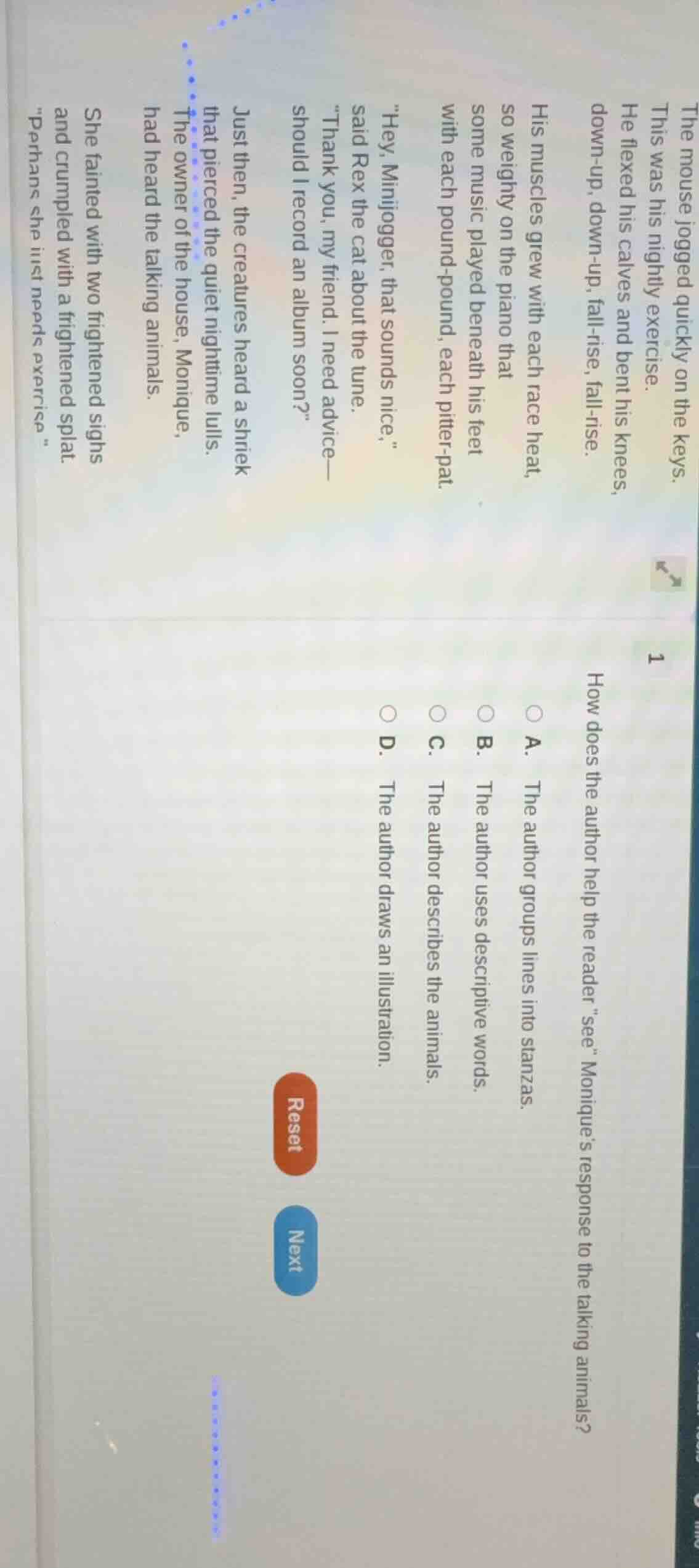
the mouse jogged quickly on the keys.
this was his nightly exercise.
he flexed his calves and bent his knees,
down - up, down - up, fall - rise, fall - rise.
his muscles grew with each race heat,
so weighty on the piano that
some music played beneath his feet
with each pound - pound, each pitter - pat.
\hey, minijogger, that sounds nice,\
said rex the cat about the tune.
\thank you, my friend. i need advice—
should i record an album soon?\
just then, the creatures heard a shriek
that pierced the quiet nighttime lulls.
the owner of the house, monique,
had heard the talking animals.
she fainted with two frightened sighs
and crumpled with a frightened splat.
\perhaps she first needs exercise.\
1
how does the author help the reader \see\ moniques response to the talking animals?
a. the author groups lines into stanzas.
b. the author uses descriptive words.
c. the author describes the animals.
d. the author draws an illustration.
The author uses specific, sensory language like "frightened sighs" and "frightened splat" to vividly depict Monique's physical reaction to the talking animals, letting readers visualize the scene. Grouping lines into stanzas is a structural choice that doesn't directly help "see" the reaction, describing animals isn't focused on Monique's response, and no illustration is provided.

Snap & solve any problem in the app
Get step-by-step solutions on Sovi AI
Photo-based solutions with guided steps
Explore more problems and detailed explanations
B. The author uses descriptive words.