QUESTION IMAGE
Question
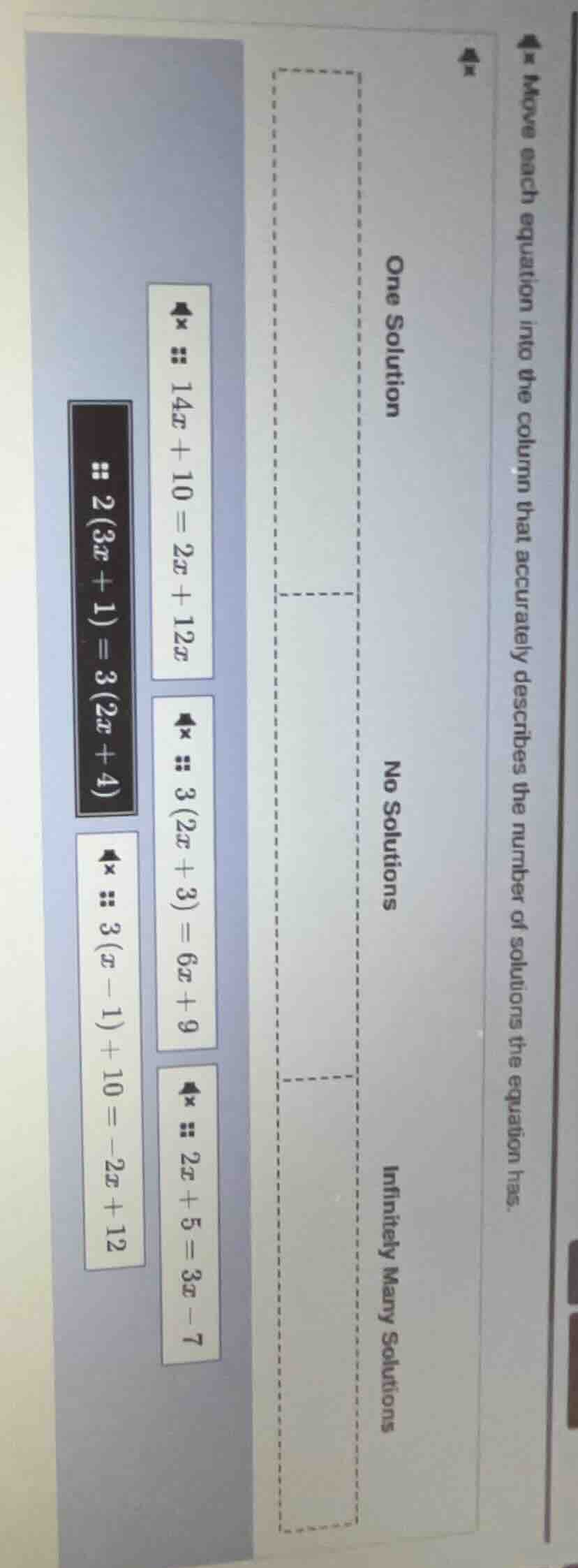
move each equation into the column that accurately describes the number of solutions the equation has.
one solution
no solutions
infinitely many solutions
14x + 10 = 2x + 12x
2(3x + 1) = 3(2x + 4)
3(2x + 3) = 6x + 9
3(x - 1) + 10 = -2x + 12
2x + 5 = 3x - 7
To solve this, we analyze each equation:
Equation 1: \(14x + 10 = 2x + 12x\)
Step 1: Simplify the right - hand side
Combine like terms on the right: \(2x+12x = 14x\). So the equation becomes \(14x + 10=14x\).
Step 2: Subtract \(14x\) from both sides
\(14x - 14x+10=14x - 14x\), which simplifies to \(10 = 0\). This is a contradiction, so the equation has no solutions.
Equation 2: \(2(3x + 1)=3(2x + 4)\)
Step 1: Expand both sides
Using the distributive property \(a(b + c)=ab+ac\), we get \(6x+2 = 6x + 12\).
Step 2: Subtract \(6x\) from both sides
\(6x-6x + 2=6x - 6x+12\), which simplifies to \(2 = 12\). This is a contradiction, so the equation has no solutions.
Equation 3: \(3(2x + 3)=6x + 9\)
Step 1: Expand the left - hand side
Using the distributive property, \(6x+9 = 6x + 9\).
Step 2: Analyze the equation
If we subtract \(6x\) from both sides, we get \(9 = 9\). This is always true, so the equation has infinitely many solutions.
Equation 4: \(2x + 5=3x - 7\)
Step 1: Subtract \(2x\) from both sides
\(2x-2x + 5=3x-2x - 7\), which simplifies to \(5=x - 7\).
Step 2: Add 7 to both sides
\(5 + 7=x-7 + 7\), so \(x = 12\). This equation has one solution.
Equation 5: \(3(x - 1)+10=-2x + 12\)
Step 1: Expand the left - hand side
Using the distributive property: \(3x-3 + 10=-2x + 12\). Combine like terms on the left: \(3x + 7=-2x + 12\).
Step 2: Add \(2x\) to both sides
\(3x+2x + 7=-2x+2x + 12\), which gives \(5x + 7=12\).
Step 3: Subtract 7 from both sides
\(5x+7 - 7=12 - 7\), so \(5x = 5\).
Step 4: Divide by 5
\(x=\frac{5}{5}=1\). This equation has one solution.
Classification:
- One Solution: \(2x + 5 = 3x-7\), \(3(x - 1)+10=-2x + 12\)
- No Solutions: \(14x + 10 = 2x+12x\), \(2(3x + 1)=3(2x + 4)\)
- Infinitely Many Solutions: \(3(2x + 3)=6x + 9\)
If we were to present the final answer in terms of moving the equations:
- Move \(2x + 5 = 3x-7\) and \(3(x - 1)+10=-2x + 12\) to the "One Solution" column.
- Move \(14x + 10 = 2x + 12x\) and \(2(3x + 1)=3(2x + 4)\) to the "No Solutions" column.
- Move \(3(2x + 3)=6x + 9\) to the "Infinitely Many Solutions" column.

Snap & solve any problem in the app
Get step-by-step solutions on Sovi AI
Photo-based solutions with guided steps
Explore more problems and detailed explanations
To solve this, we analyze each equation:
Equation 1: \(14x + 10 = 2x + 12x\)
Step 1: Simplify the right - hand side
Combine like terms on the right: \(2x+12x = 14x\). So the equation becomes \(14x + 10=14x\).
Step 2: Subtract \(14x\) from both sides
\(14x - 14x+10=14x - 14x\), which simplifies to \(10 = 0\). This is a contradiction, so the equation has no solutions.
Equation 2: \(2(3x + 1)=3(2x + 4)\)
Step 1: Expand both sides
Using the distributive property \(a(b + c)=ab+ac\), we get \(6x+2 = 6x + 12\).
Step 2: Subtract \(6x\) from both sides
\(6x-6x + 2=6x - 6x+12\), which simplifies to \(2 = 12\). This is a contradiction, so the equation has no solutions.
Equation 3: \(3(2x + 3)=6x + 9\)
Step 1: Expand the left - hand side
Using the distributive property, \(6x+9 = 6x + 9\).
Step 2: Analyze the equation
If we subtract \(6x\) from both sides, we get \(9 = 9\). This is always true, so the equation has infinitely many solutions.
Equation 4: \(2x + 5=3x - 7\)
Step 1: Subtract \(2x\) from both sides
\(2x-2x + 5=3x-2x - 7\), which simplifies to \(5=x - 7\).
Step 2: Add 7 to both sides
\(5 + 7=x-7 + 7\), so \(x = 12\). This equation has one solution.
Equation 5: \(3(x - 1)+10=-2x + 12\)
Step 1: Expand the left - hand side
Using the distributive property: \(3x-3 + 10=-2x + 12\). Combine like terms on the left: \(3x + 7=-2x + 12\).
Step 2: Add \(2x\) to both sides
\(3x+2x + 7=-2x+2x + 12\), which gives \(5x + 7=12\).
Step 3: Subtract 7 from both sides
\(5x+7 - 7=12 - 7\), so \(5x = 5\).
Step 4: Divide by 5
\(x=\frac{5}{5}=1\). This equation has one solution.
Classification:
- One Solution: \(2x + 5 = 3x-7\), \(3(x - 1)+10=-2x + 12\)
- No Solutions: \(14x + 10 = 2x+12x\), \(2(3x + 1)=3(2x + 4)\)
- Infinitely Many Solutions: \(3(2x + 3)=6x + 9\)
If we were to present the final answer in terms of moving the equations:
- Move \(2x + 5 = 3x-7\) and \(3(x - 1)+10=-2x + 12\) to the "One Solution" column.
- Move \(14x + 10 = 2x + 12x\) and \(2(3x + 1)=3(2x + 4)\) to the "No Solutions" column.
- Move \(3(2x + 3)=6x + 9\) to the "Infinitely Many Solutions" column.