QUESTION IMAGE
Question
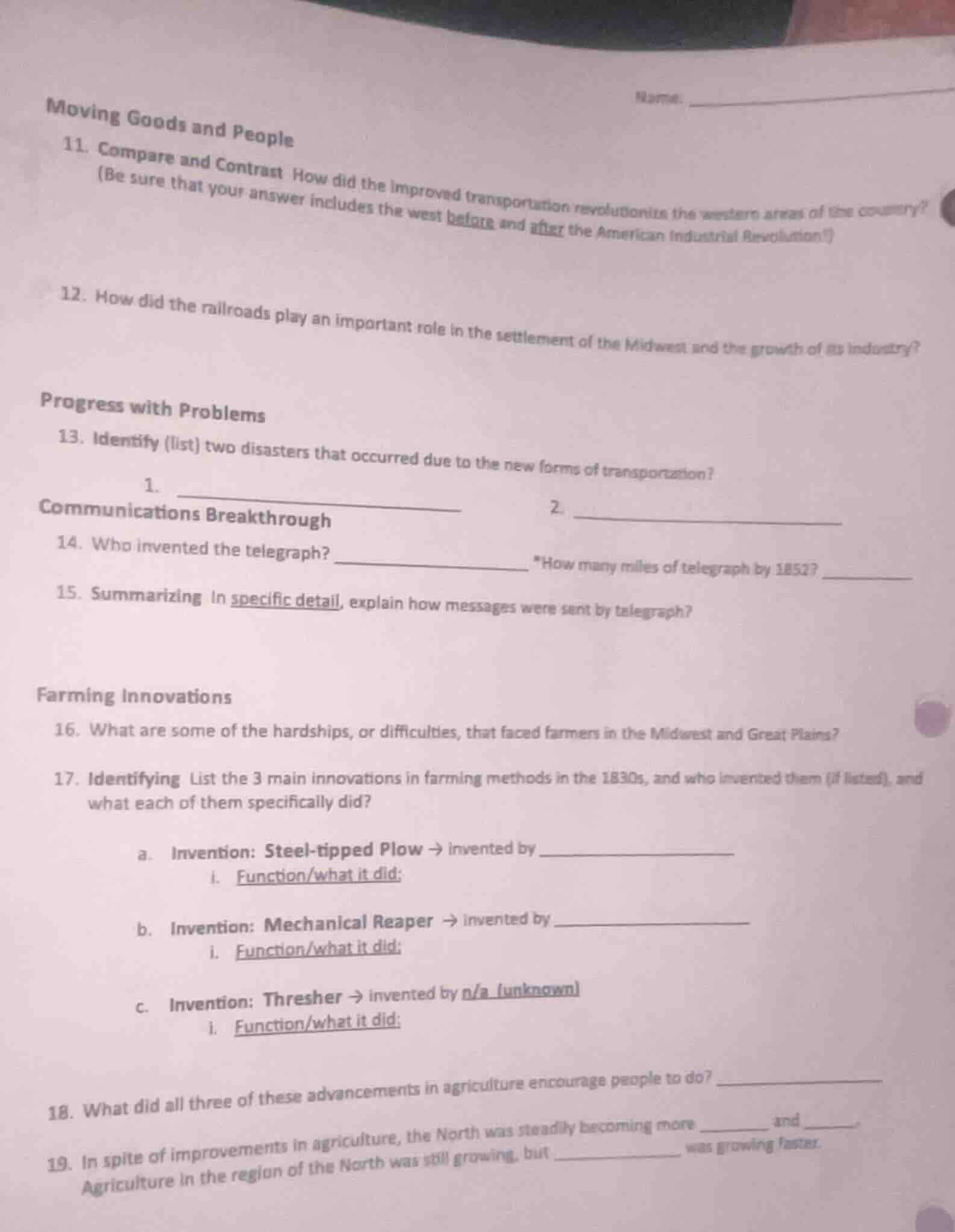
moving goods and people
- compare and contrast how did the improved transportation revolutionize the western areas of the country?
(be sure that your answer includes the west before and after the american industrial revolution?)
- how did the railroads play an important role in the settlement of the midwest and the growth of its industry?
progress with problems
- identify (list) two disasters that occurred due to the new forms of transportation?
1.
2.
communications breakthrough
- who invented the telegraph? *how many miles of telegraph by 1852?
- summarizing in specific detail, explain how messages were sent by telegraph?
farming innovations
- what are some of the hardships, or difficulties, that faced farmers in the midwest and great plains?
- identifying list the 3 main innovations in farming methods in the 1830s, and who invented them (if listed), and what each of them specifically did?
a. invention: steel - tipped plow → invented by
i. function/what it did:
b. invention: mechanical reaper → invented by
i. function/what it did:
c. invention: thresher → invented by n/a (unknown)
i. function/what it did:
- what did all three of these advancements in agriculture encourage people to do?
- in spite of improvements in agriculture, the north was steadily becoming more and
agriculture in the region of the north was still growing, but was growing faster.
- Before the Industrial Revolution: Western areas were sparsely settled, isolated, with only rough dirt roads and river travel (slow, seasonal). Trade was limited, and the region relied on subsistence farming. After: Improved transportation (canals, railroads, steamboats) connected the West to Eastern markets. Farmers could ship cash crops east efficiently, spurring commercial farming; population boomed as migration became easier, and towns grew as trade hubs.
- Railroads made fast, year-round travel to the Midwest possible, drawing settlers. They enabled farmers to ship grain and raw materials to Eastern factories quickly, and carried manufactured goods west, fueling industrial growth (like grain milling and meatpacking) by creating reliable supply and demand links.
- 1. Railroad collisions/derailments (common due to unregulated tracks, poor brakes). 2. Canal boat sinkings or dam failures (from shoddy construction or overloading).
- The telegraph was invented by Samuel Morse. By 1852, there were over 23,000 miles of telegraph lines in the U.S.
- Operators used Morse code (a system of dots and dashes representing letters/numbers). They tapped a key to send electrical pulses through a wire; the pulses activated an electromagnet at the receiving end, which moved a marker to make dots and dashes on paper tape. The receiving operator translated the code back into text.
- Hardships included harsh weather (droughts, blizzards), poor soil quality in some areas, lack of access to markets, scarcity of wood for housing/fuel, and conflicts with Indigenous peoples.
- a. Invented by John Deere. i. Cut through tough prairie sod easily, making Midwest farming feasible.
b. Invented by Cyrus McCormick. i. Mechanized wheat harvesting, cutting labor needs and increasing crop yields.
c. i. Separated grain from stalks/straw far faster than manual threshing, boosting efficiency.
- These advancements encouraged people to migrate to the Midwest and Great Plains to take up commercial farming, as the tools made large-scale, profitable agriculture possible.
- The North was becoming more industrialized and urbanized. Manufacturing was growing faster than agriculture.

Snap & solve any problem in the app
Get step-by-step solutions on Sovi AI
Photo-based solutions with guided steps
Explore more problems and detailed explanations
- Before the Industrial Revolution: The West was isolated, sparsely populated, with limited subsistence farming and only slow, seasonal river/dirt road travel. After: Improved transport (canals, railroads, steamboats) connected the West to Eastern markets, enabling commercial farming, spurring mass migration, and growing towns into trade hubs.
- Railroads enabled fast, year-round migration to the Midwest, drawing settlers. They also created reliable links to Eastern markets, letting farmers ship crops west and receive manufactured goods, fueling growth of local industries like grain milling and meatpacking.
- 1. Railroad derailments/collisions
- Canal boat sinkings or dam failures
- Samuel Morse; ~23,000 miles
- Operators used Morse code (dots/dashes for letters/numbers) to tap an electrical key, sending pulses through a wire. At the receiver, the pulses activated an electromagnet that marked the code on paper tape, which was then translated back to text.
- Harsh seasonal weather, poor prairie soil, limited market access, fuel/wood scarcity, and conflicts with Indigenous groups.
- a. John Deere; i. Cut through tough prairie sod for farming
b. Cyrus McCormick; i. Mechanized wheat harvesting to boost yields
c. i. Separated grain from stalks faster than manual labor
- Migrate to the Midwest/Great Plains for commercial farming
- industrialized, urbanized; manufacturing