QUESTION IMAGE
Question
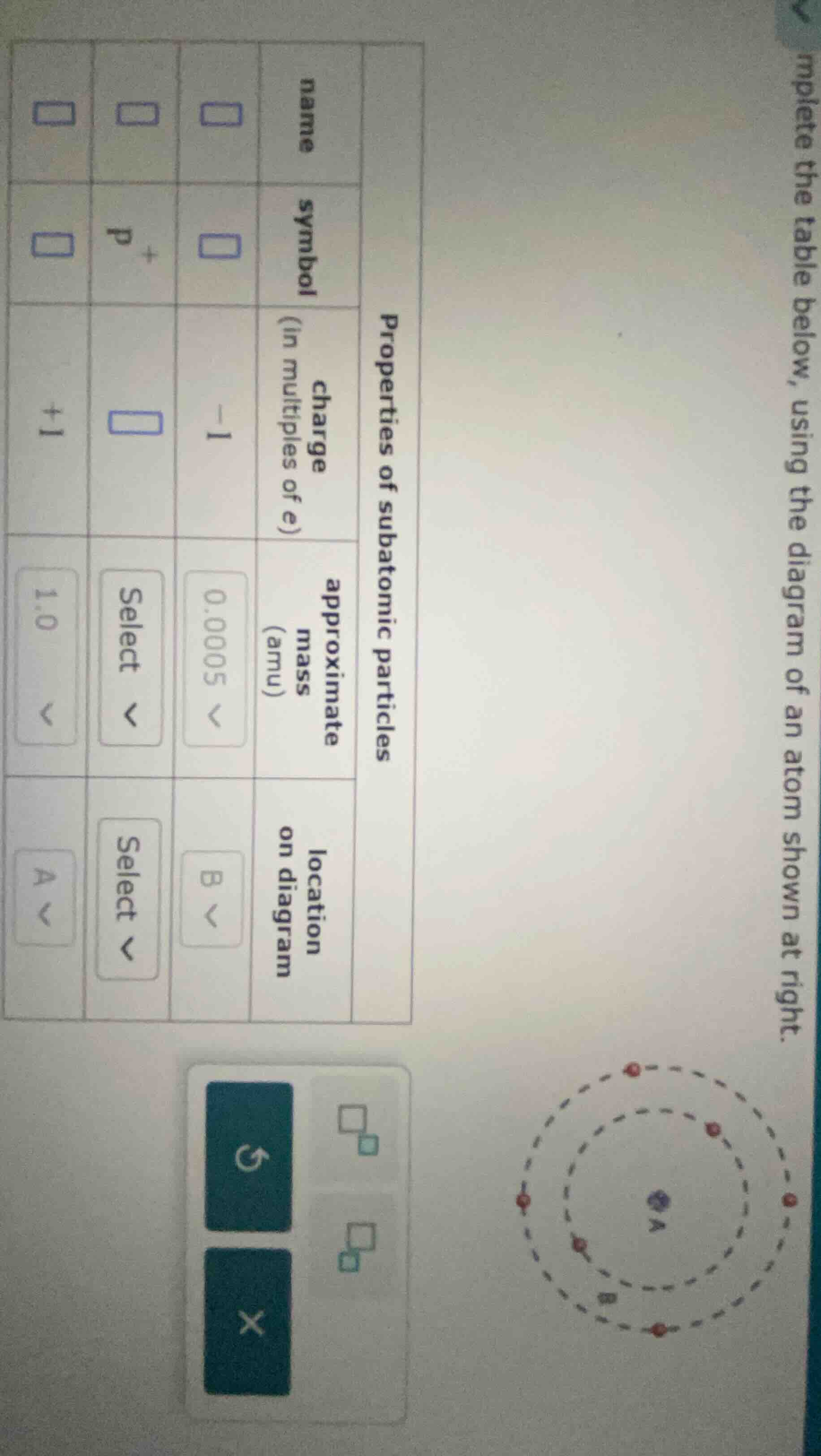
mplete the table below, using the diagram of an atom shown at right.
properties of subatomic particles
name
symbol
+ p
charge (in multiples of e)
-1
+1
approximate mass (amu)
0.0005
select
1.0
location on diagram
b
select
a
To solve the table for subatomic particles, we analyze each particle:
First Particle (Leftmost, Charge +1, Mass 1.0 amu, Location A)
- Name: Proton (positively charged, mass ~1 amu, in nucleus).
- Symbol: \( p^+ \) (or just \( p \), but \( p^+ \) is precise for charge).
- Charge: \( +1 \) (given).
- Mass: \( 1.0 \) amu (given, matches proton mass).
- Location: A (nucleus, as A is the central region).
Second Particle (Middle, Symbol \( +p \)? Wait, no—correcting: Middle particle (with symbol \( +p \) box? Wait, no, let’s re-express. Wait, the middle row (second column) has charge box, mass “Select”, location “Select”. Wait, no—let’s re-express the table structure:
| Column 1 | Column 2 | Column 3 | |
|---|---|---|---|
| Symbol | \( +p \)? No, wait—original table: |
Looking at the diagram:
- A (center) = nucleus (protons + neutrons).
- B (inner orbit) and outer orbits = electrons.
Third Particle (Rightmost, Charge -1, Mass 0.0005 amu, Location B)
- Name: Electron (negatively charged, mass ~0.0005 amu, in electron cloud/orbits).
- Symbol: \( e^- \) (or just \( e \)).
- Charge: \( -1 \) (given).
- Mass: \( 0.0005 \) amu (matches electron mass).
- Location: B (electron orbit, as B is a ring around A).
Middle Particle (Column 2, between proton and electron)
Wait, the middle column (second) has:
- Name: Neutron (neutral charge, mass ~1 amu, in nucleus).
- Symbol: \( n \) (no charge, so symbol \( n \)).
- Charge: \( 0 \) (neutrons have no charge).
- Mass: \( 1.0 \) amu (matches neutron mass, same as proton).
- Location: A (nucleus, same as proton).
Filling the Table:
| Name | Proton | Neutron | Electron |
|---|---|---|---|
| Charge | \( +1 \) | \( 0 \) | \( -1 \) |
| Mass | \( 1.0 \) | \( 1.0 \) | \( 0.0005 \) |
| Location | A | A | B |
Key Corrections:
- Middle particle (neutron) has charge \( 0 \), mass \( 1.0 \) amu, location A (nucleus), name Neutron, symbol \( n \).
- Leftmost (proton): charge \( +1 \), mass \( 1.0 \), location A, name Proton, symbol \( p^+ \).
- Rightmost (electron): charge \( -1 \), mass \( 0.0005 \), location B, name Electron, symbol \( e^- \).
If the table requires filling the middle (second) particle:
- Name: Neutron
- Symbol: \( n \)
- Charge: \( 0 \)
- Mass: \( 1.0 \) amu (select \( 1.0 \) from the dropdown)
- Location: A (select A from the dropdown)
For the leftmost (proton):
- Name: Proton
- Symbol: \( p^+ \) (or \( p \))
- Charge: \( +1 \) (given)
- Mass: \( 1.0 \) amu (given)
- Location: A (given)
For the rightmost (electron):
- Name: Electron
- Symbol: \( e^- \)
- Charge: \( -1 \) (given)
- Mass: \( 0.0005 \) amu (given)
- Location: B (select B from the dropdown)
Final Table (Filled):
| Name | Proton | Neutron | Electron |
|---|---|---|---|
| Charge | \( +1 \) | \( 0 \) | \( -1 \) |
| Mass | \( 1.0 \) | \( 1.0 \) | \( 0.0005 \) |
| Location | A | A | B |
(Adjust dropdowns: Middle particle’s mass = \( 1.0 \), location = A; middle particle’s charge = \( 0 \).)

Snap & solve any problem in the app
Get step-by-step solutions on Sovi AI
Photo-based solutions with guided steps
Explore more problems and detailed explanations
To solve the table for subatomic particles, we analyze each particle:
First Particle (Leftmost, Charge +1, Mass 1.0 amu, Location A)
- Name: Proton (positively charged, mass ~1 amu, in nucleus).
- Symbol: \( p^+ \) (or just \( p \), but \( p^+ \) is precise for charge).
- Charge: \( +1 \) (given).
- Mass: \( 1.0 \) amu (given, matches proton mass).
- Location: A (nucleus, as A is the central region).
Second Particle (Middle, Symbol \( +p \)? Wait, no—correcting: Middle particle (with symbol \( +p \) box? Wait, no, let’s re-express. Wait, the middle row (second column) has charge box, mass “Select”, location “Select”. Wait, no—let’s re-express the table structure:
| Column 1 | Column 2 | Column 3 | |
|---|---|---|---|
| Symbol | \( +p \)? No, wait—original table: |
Looking at the diagram:
- A (center) = nucleus (protons + neutrons).
- B (inner orbit) and outer orbits = electrons.
Third Particle (Rightmost, Charge -1, Mass 0.0005 amu, Location B)
- Name: Electron (negatively charged, mass ~0.0005 amu, in electron cloud/orbits).
- Symbol: \( e^- \) (or just \( e \)).
- Charge: \( -1 \) (given).
- Mass: \( 0.0005 \) amu (matches electron mass).
- Location: B (electron orbit, as B is a ring around A).
Middle Particle (Column 2, between proton and electron)
Wait, the middle column (second) has:
- Name: Neutron (neutral charge, mass ~1 amu, in nucleus).
- Symbol: \( n \) (no charge, so symbol \( n \)).
- Charge: \( 0 \) (neutrons have no charge).
- Mass: \( 1.0 \) amu (matches neutron mass, same as proton).
- Location: A (nucleus, same as proton).
Filling the Table:
| Name | Proton | Neutron | Electron |
|---|---|---|---|
| Charge | \( +1 \) | \( 0 \) | \( -1 \) |
| Mass | \( 1.0 \) | \( 1.0 \) | \( 0.0005 \) |
| Location | A | A | B |
Key Corrections:
- Middle particle (neutron) has charge \( 0 \), mass \( 1.0 \) amu, location A (nucleus), name Neutron, symbol \( n \).
- Leftmost (proton): charge \( +1 \), mass \( 1.0 \), location A, name Proton, symbol \( p^+ \).
- Rightmost (electron): charge \( -1 \), mass \( 0.0005 \), location B, name Electron, symbol \( e^- \).
If the table requires filling the middle (second) particle:
- Name: Neutron
- Symbol: \( n \)
- Charge: \( 0 \)
- Mass: \( 1.0 \) amu (select \( 1.0 \) from the dropdown)
- Location: A (select A from the dropdown)
For the leftmost (proton):
- Name: Proton
- Symbol: \( p^+ \) (or \( p \))
- Charge: \( +1 \) (given)
- Mass: \( 1.0 \) amu (given)
- Location: A (given)
For the rightmost (electron):
- Name: Electron
- Symbol: \( e^- \)
- Charge: \( -1 \) (given)
- Mass: \( 0.0005 \) amu (given)
- Location: B (select B from the dropdown)
Final Table (Filled):
| Name | Proton | Neutron | Electron |
|---|---|---|---|
| Charge | \( +1 \) | \( 0 \) | \( -1 \) |
| Mass | \( 1.0 \) | \( 1.0 \) | \( 0.0005 \) |
| Location | A | A | B |
(Adjust dropdowns: Middle particle’s mass = \( 1.0 \), location = A; middle particle’s charge = \( 0 \).)