QUESTION IMAGE
Question
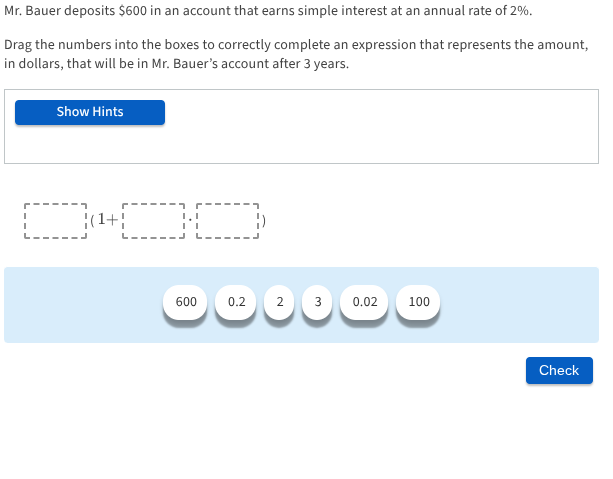
mr. bauer deposits $600 in an account that earns simple interest at an annual rate of 2%. drag the numbers into the boxes to correctly complete an expression that represents the amount, in dollars, that will be in mr. bauer’s account after 3 years. the expression format is (square(1 + squarecdotsquare)) with numbers 600, 0.2, 2, 3, 0.02, 100 to choose from.
Step1: Recall simple interest formula
The formula for the amount \( A \) in a simple - interest account is \( A = P(1 + rt) \), where \( P \) is the principal amount, \( r \) is the annual interest rate (in decimal form), and \( t \) is the time in years.
Step2: Identify values of \( P \), \( r \), and \( t \)
- The principal amount \( P=\$600\).
- The annual interest rate \( r = 2\%=0.02\) (since to convert a percentage to a decimal, we divide by 100, so \( 2\div100 = 0.02\)).
- The time \( t = 3\) years.
Step3: Substitute values into the formula
Substituting \( P = 600\), \( r=0.02\), and \( t = 3\) into the formula \( A=P(1 + rt) \), we get the expression \( 600(1 + 0.02\cdot3) \).

Snap & solve any problem in the app
Get step-by-step solutions on Sovi AI
Photo-based solutions with guided steps
Explore more problems and detailed explanations
The first box (the coefficient of the parentheses) is \( 600 \), the second box (the interest rate in decimal) is \( 0.02 \), and the third box (the time in years) is \( 3 \). So the completed expression is \( \boldsymbol{600}(1+\boldsymbol{0.02}\cdot\boldsymbol{3}) \)