QUESTION IMAGE
Question
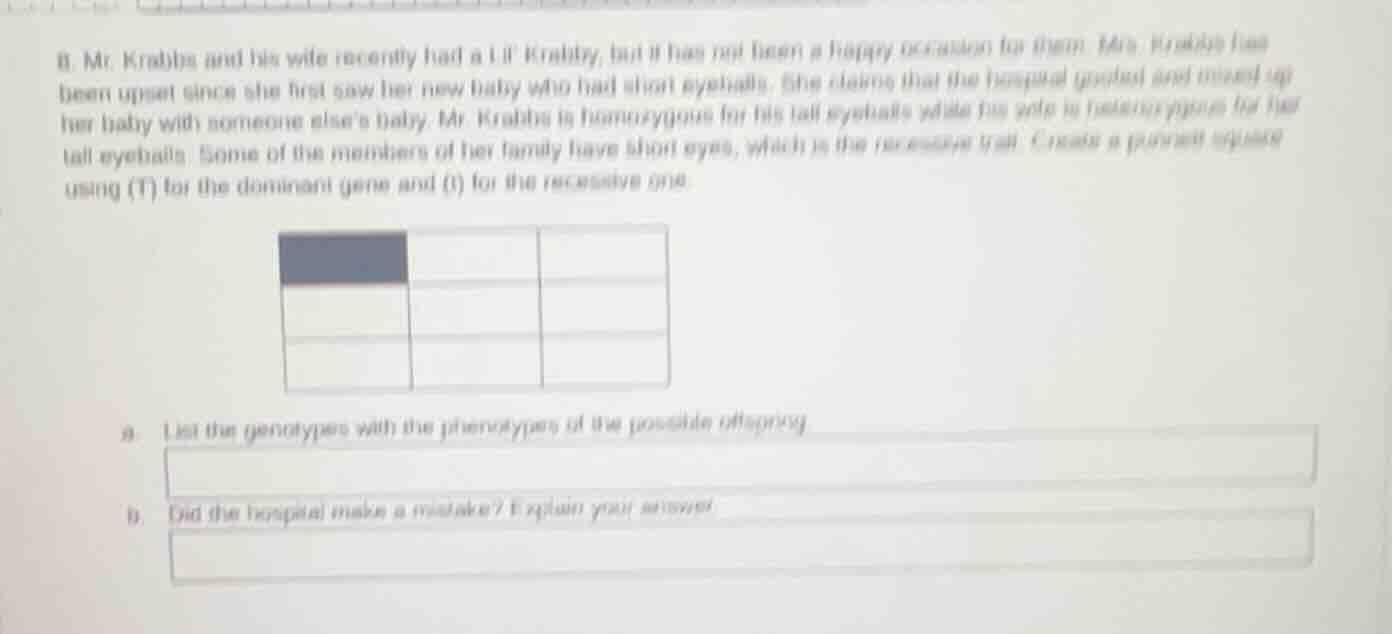
- mr. krabbs and his wife recently had a lil krabby, but it has not been a happy occasion for them. mrs. krabbs has been upset since she first saw her new baby who had short eyeballs. she claims that the hospital goofed and mixed up her baby with someone else’s baby. mr. krabbs is homozygous for his tall eyeballs while his wife is heterozygous for her tall eyeballs. some of the members of her family have short eyes, which is the recessive trait. create a punnett square using (t) for the dominant gene and (t) for the recessive one.
a. list the genotypes with the phenotypes of the possible offspring
b. did the hospital make a mistake? explain your answer
Part a)
Step1: Determine Parental Genotypes
Mr. Krabbs is homozygous for tall eyeballs, so his genotype is \( TT \). Mrs. Krabbs is heterozygous for tall eyeballs, so her genotype is \( Tt \). Short eyeballs is recessive (\( tt \)).
Step2: Set Up Punnett Square
The Punnett square will have Mr. Krabbs' alleles (\( T, T \)) on one side and Mrs. Krabbs' alleles (\( T, t \)) on the other.
| \( T \) | \( T \) | |
|---|---|---|
| \( t \) | \( Tt \) | \( Tt \) |
Step3: Determine Phenotypes/Genotypes
- Genotype \( TT \): Phenotype - Tall (homozygous dominant)
- Genotype \( Tt \): Phenotype - Tall (heterozygous, dominant trait expressed)
There is no possible \( tt \) (short) genotype from this cross.
Step1: Analyze Baby's Genotype
The baby has short eyeballs, which requires the \( tt \) genotype (recessive trait, needs two recessive alleles).
Step2: Analyze Parental Cross
From Mr. Krabbs (\( TT \)) and Mrs. Krabbs (\( Tt \)), the Punnett square shows only \( TT \) or \( Tt \) (both tall) offspring are possible. No \( tt \) (short) offspring can result.
Step3: Conclude Hospital Error
Since the baby has a genotype (\( tt \)) impossible from these parents, the hospital must have mixed up the baby.

Snap & solve any problem in the app
Get step-by-step solutions on Sovi AI
Photo-based solutions with guided steps
Explore more problems and detailed explanations
(a):
Possible offspring genotypes and phenotypes:
- \( TT \): Tall (homozygous dominant)
- \( Tt \): Tall (heterozygous)