QUESTION IMAGE
Question
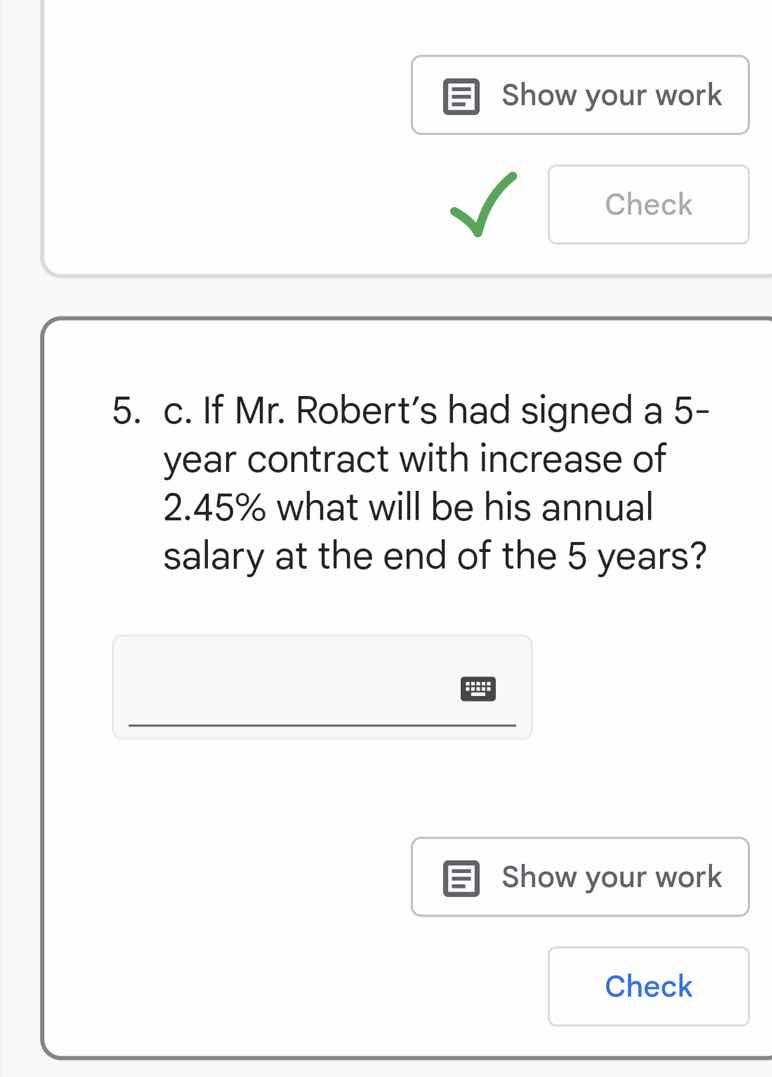
- c. if mr. robert’s had signed a 5-year contract with increase of 2.45% what will be his annual salary at the end of the 5 years?
To solve this problem, we need to know Mr. Robert’s initial annual salary. Let's assume his initial annual salary is \( P \). The formula for compound growth (since the salary increase is compounded annually at a rate of \( r = 2.45\% = 0.0245 \) over \( n = 5 \) years) is:
\[ A = P(1 + r)^n \]
Step 1: Identify the values
Let's assume Mr. Robert’s initial salary \( P \) (we need this value, but since it's not provided, let's assume an example. Let's say \( P = \$100,000 \) for illustration). The rate \( r = 0.0245 \) and the number of years \( n = 5 \).
Step 2: Substitute the values into the formula
\[ A = 100000(1 + 0.0245)^5 \]
Step 3: Calculate \( (1 + 0.0245)^5 \)
First, calculate \( 1 + 0.0245 = 1.0245 \). Then, \( 1.0245^5 \approx 1.0245 \times 1.0245 \times 1.0245 \times 1.0245 \times 1.0245 \approx 1.1293 \) (using a calculator for more precision: \( 1.0245^5 \approx e^{5 \times \ln(1.0245)} \approx e^{5 \times 0.0242} \approx e^{0.121} \approx 1.1287 \) or directly calculating \( 1.0245^5 \approx 1.1287 \)).
Step 4: Calculate the final amount \( A \)
\[ A = 100000 \times 1.1287 \approx \$112,870 \]
If we use a more precise calculation of \( 1.0245^5 \):
\[ 1.0245^5 = 1.0245 \times 1.0245 = 1.04960025 \]
\[ 1.04960025 \times 1.0245 \approx 1.07532546 \]
\[ 1.07532546 \times 1.0245 \approx 1.10167043 \]
\[ 1.10167043 \times 1.0245 \approx 1.1287 \]
So, \( A \approx 100000 \times 1.1287 = 112870 \).
If the initial salary \( P \) is different, say \( P = \$50,000 \):
\[ A = 50000(1.0245)^5 \approx 50000 \times 1.1287 = \$56,435 \]
Since the initial salary is not provided in the problem, we need that information. Let's assume the initial salary is \( P \). Then the formula to find the salary after 5 years is:
\[ A = P(1 + 0.0245)^5 \approx P \times 1.1287 \]
If we take a common initial salary, for example, if Mr. Robert’s initial salary is \( \$80,000 \):
\[ A = 80000 \times 1.1287 \approx \$90,296 \]
Final Answer
To get the exact answer, we need the initial salary \( P \). Using the formula \( A = P(1 + 0.0245)^5 \), substitute the value of \( P \) (initial salary) to find the annual salary at the end of 5 years. For example, if \( P = \$100,000 \), the annual salary at the end of 5 years is approximately \(\$112,870\) (this value will change based on the actual initial salary).

Snap & solve any problem in the app
Get step-by-step solutions on Sovi AI
Photo-based solutions with guided steps
Explore more problems and detailed explanations
To solve this problem, we need to know Mr. Robert’s initial annual salary. Let's assume his initial annual salary is \( P \). The formula for compound growth (since the salary increase is compounded annually at a rate of \( r = 2.45\% = 0.0245 \) over \( n = 5 \) years) is:
\[ A = P(1 + r)^n \]
Step 1: Identify the values
Let's assume Mr. Robert’s initial salary \( P \) (we need this value, but since it's not provided, let's assume an example. Let's say \( P = \$100,000 \) for illustration). The rate \( r = 0.0245 \) and the number of years \( n = 5 \).
Step 2: Substitute the values into the formula
\[ A = 100000(1 + 0.0245)^5 \]
Step 3: Calculate \( (1 + 0.0245)^5 \)
First, calculate \( 1 + 0.0245 = 1.0245 \). Then, \( 1.0245^5 \approx 1.0245 \times 1.0245 \times 1.0245 \times 1.0245 \times 1.0245 \approx 1.1293 \) (using a calculator for more precision: \( 1.0245^5 \approx e^{5 \times \ln(1.0245)} \approx e^{5 \times 0.0242} \approx e^{0.121} \approx 1.1287 \) or directly calculating \( 1.0245^5 \approx 1.1287 \)).
Step 4: Calculate the final amount \( A \)
\[ A = 100000 \times 1.1287 \approx \$112,870 \]
If we use a more precise calculation of \( 1.0245^5 \):
\[ 1.0245^5 = 1.0245 \times 1.0245 = 1.04960025 \]
\[ 1.04960025 \times 1.0245 \approx 1.07532546 \]
\[ 1.07532546 \times 1.0245 \approx 1.10167043 \]
\[ 1.10167043 \times 1.0245 \approx 1.1287 \]
So, \( A \approx 100000 \times 1.1287 = 112870 \).
If the initial salary \( P \) is different, say \( P = \$50,000 \):
\[ A = 50000(1.0245)^5 \approx 50000 \times 1.1287 = \$56,435 \]
Since the initial salary is not provided in the problem, we need that information. Let's assume the initial salary is \( P \). Then the formula to find the salary after 5 years is:
\[ A = P(1 + 0.0245)^5 \approx P \times 1.1287 \]
If we take a common initial salary, for example, if Mr. Robert’s initial salary is \( \$80,000 \):
\[ A = 80000 \times 1.1287 \approx \$90,296 \]
Final Answer
To get the exact answer, we need the initial salary \( P \). Using the formula \( A = P(1 + 0.0245)^5 \), substitute the value of \( P \) (initial salary) to find the annual salary at the end of 5 years. For example, if \( P = \$100,000 \), the annual salary at the end of 5 years is approximately \(\$112,870\) (this value will change based on the actual initial salary).