QUESTION IMAGE
Question
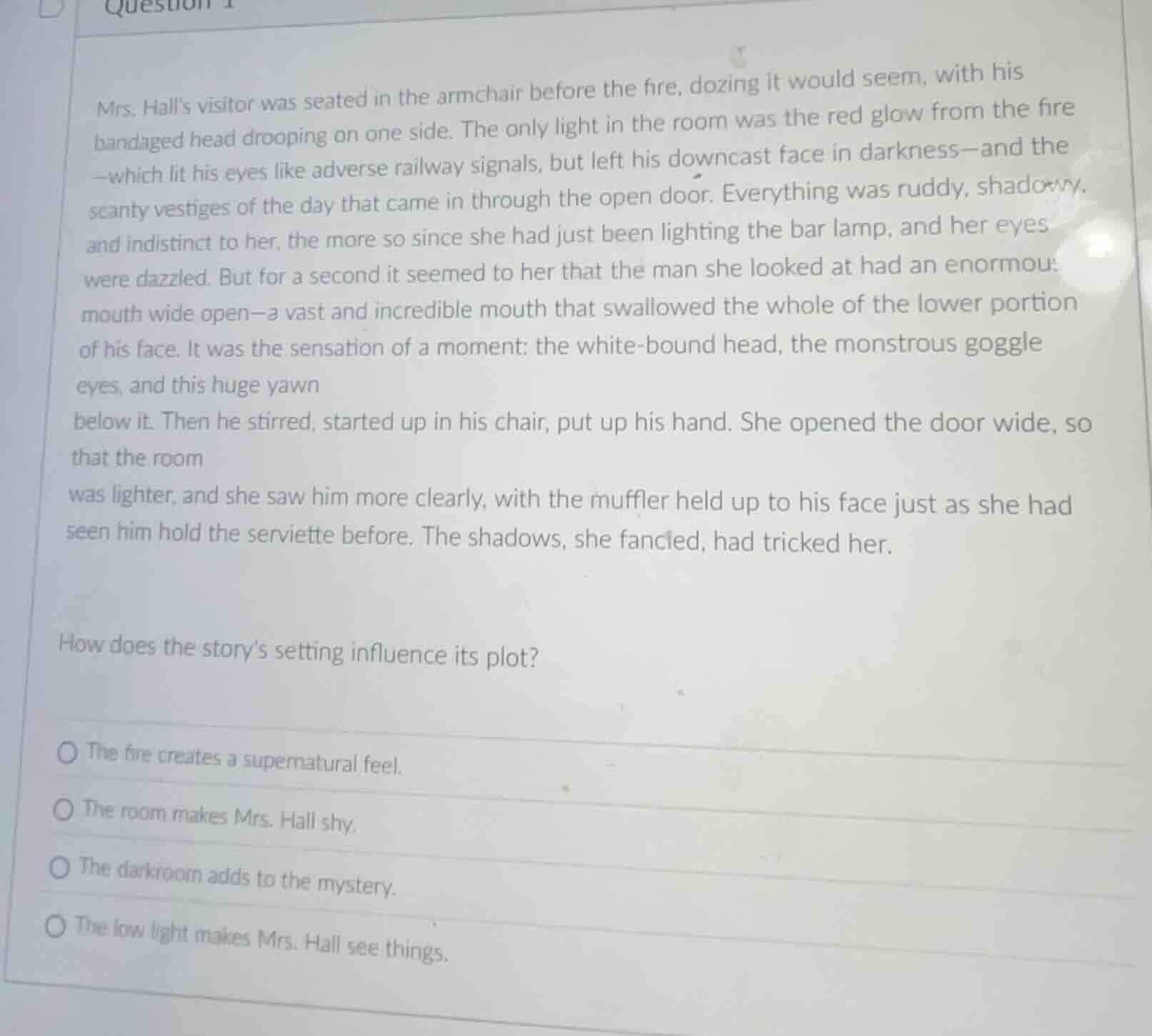
mrs. halls visitor was seated in the armchair before the fire, dozing it would seem, with his bandaged head drooping on one side. the only light in the room was the red glow from the fire—which lit his eyes like adverse railway signals, but left his downcast face in darkness—and the scanty vestiges of the day that came in through the open door. everything was ruddy, shadowy, and indistinct to her, the more so since she had just been lighting the bar lamp, and her eyes were dazzled. but for a second it seemed to her that the man she looked at had an enormous mouth wide open—a vast and incredible mouth that swallowed the whole of the lower portion of his face. it was the sensation of a moment: the white - bound head, the monstrous goggle eyes, and this huge yawn
below it. then he stirred, started up in his chair, put up his hand. she opened the door wide, so that the room
was lighter, and she saw him more clearly, with the muffler held up to his face just as she had seen him hold the serviette before. the shadows, she fancied, had tricked her.
how does the story’s setting influence its plot?
the fire creates a supernatural feel.
the room makes mrs. hall shy.
the dark room adds to the mystery.
the low light makes mrs. hall see things.
The dim, shadowy room (low light from the fire and fading daylight) causes Mrs. Hall to misperceive the visitor's face, creating a brief, eerie moment. This lack of clear visibility builds uncertainty around the mysterious visitor, which drives the plot's tension. The other options are incorrect: the fire does not create a supernatural feel directly, the room does not make Mrs. Hall shy, and "see things" is too vague compared to the core effect of building mystery.

Snap & solve any problem in the app
Get step-by-step solutions on Sovi AI
Photo-based solutions with guided steps
Explore more problems and detailed explanations
The dark room adds to the mystery.