QUESTION IMAGE
Question
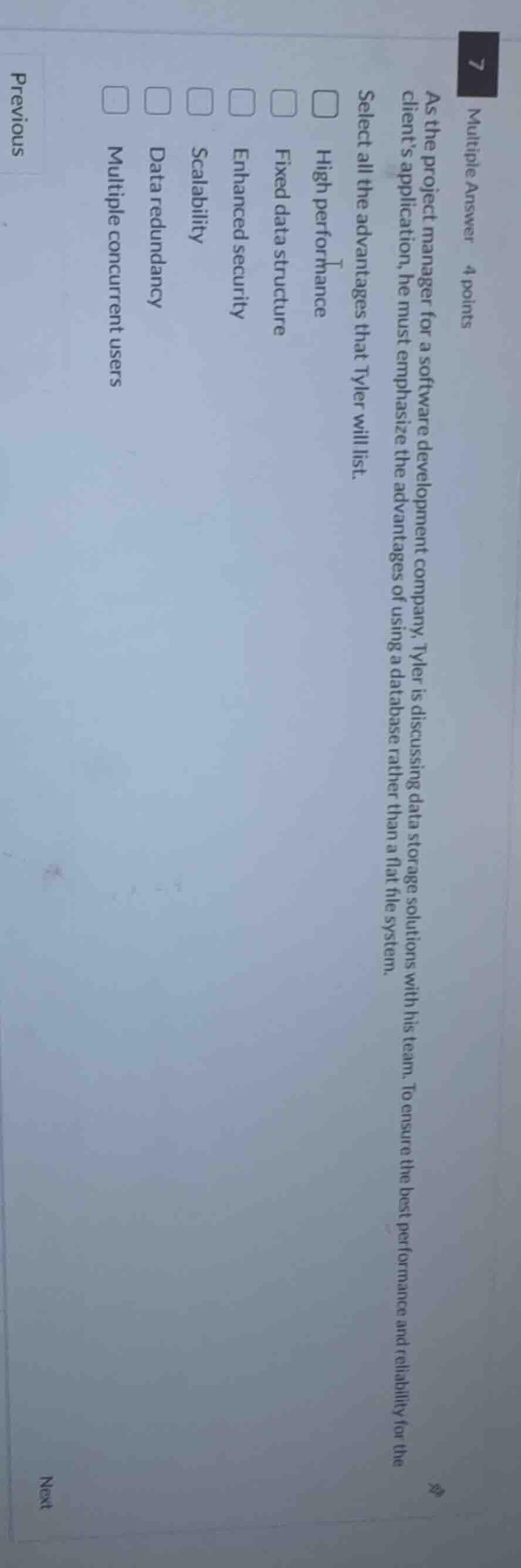
multiple answer 4 points as the project manager for a software development company, tyler is discussing data storage solutions with his team. to ensure the best performance and reliability for the client’s application, he must emphasize the advantages of using a database rather than a flat file system. select all the advantages that tyler will list. high performance fixed data structure enhanced security scalability data redundancy multiple concurrent users
Brief Explanations
- High performance: Databases are optimized for data retrieval and manipulation, offering better performance than flat - file systems, especially with large datasets.
- Enhanced security: Databases have built - in security mechanisms like user authentication, access control, and encryption to protect data, which flat - file systems lack.
- Scalability: Databases can handle increasing amounts of data and more users over time. They can be scaled vertically (adding more resources to a single server) or horizontally (adding more servers), while flat - file systems struggle with scalability.
- Multiple concurrent users: Databases support concurrent access by multiple users without data integrity issues. They use techniques like locking and transaction management to ensure that multiple users can access and modify data simultaneously, which is difficult to achieve with flat - file systems.
- Fixed data structure is not an advantage. Databases have flexible data structures (e.g., in relational databases, you can add/modify tables and columns relatively easily), while flat - file systems may have a more rigid structure, but "fixed" is not an advantage of databases.
- Data redundancy is not an advantage. Databases aim to reduce data redundancy through normalization, while flat - file systems often have more redundant data.

Snap & solve any problem in the app
Get step-by-step solutions on Sovi AI
Photo-based solutions with guided steps
Explore more problems and detailed explanations
A. High performance
B. Enhanced security
C. Scalability
F. Multiple concurrent users