QUESTION IMAGE
Question
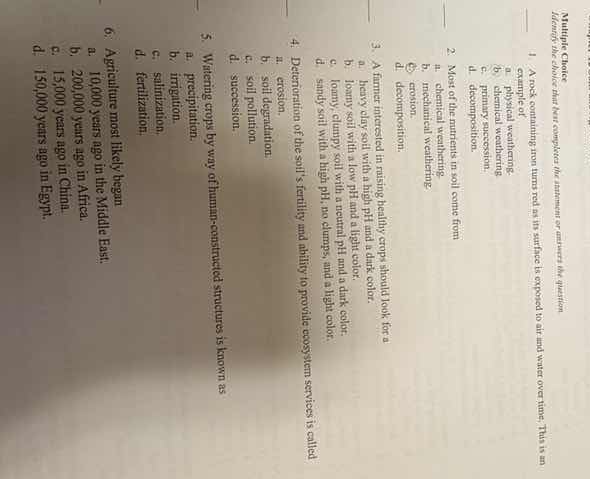
multiple choice
- a layer of weathered material on a surface is exposed to air and water over time. this is an
a. chemical weathering
b. physical weathering
c. primary succession
d. secondary succession
- most of the matter in soil comes from
a. chemical weathering
b. mechanical weathering
c. decomposition
d. erosion
- a farmer interested in raising healthy crops should look for a
a. heavy soil with a light and dark color.
b. loamy soil with a mineral and dark color.
c. sandy soil with a light, no clumps, and a light color.
d. sandy clay with a large ph, no clumps, and a light color.
- determination of the soil’s fertility and ability to provide ecosystem services is called:
a. extension
b. silt generation
c. soil pollution
d. soil fertility
- watering crops by way of human - constructed structures is known as
a. precipitation
b. irrigation
c. salinization
d. fertilization
- agriculture most likely began
a. 10,000 years ago in the middle east.
b. 15,000 years ago in china.
c. 20,000 years ago in africa.
d. 150,000 years ago in egypt.
To solve these multiple - choice questions, we analyze each one based on relevant concepts in the field of Natural Science (specifically related to soil science, agriculture, and earth science):
Question 1
- Explanation: Chemical weathering involves the chemical alteration of minerals in rocks or soil. When a rock or mineral surface is exposed to air and water over time, chemical reactions (like oxidation, hydrolysis) occur which change the mineral composition. Physical weathering is about breaking down rocks into smaller pieces without changing their chemical composition (e.g., through temperature changes, abrasion). Primary succession is the process of ecological succession in an area with no previous soil. Denudation is the overall process of wearing away the Earth's surface. So the process of a rock or mineral surface being exposed to air and water over time, leading to chemical change, is chemical weathering.
- Answer: c. chemical weathering
Question 2
- Explanation: Most of the mineral matter in soil comes from the weathering of rocks. Decomposition is the breakdown of organic matter. Mechanical weathering is a type of weathering that breaks rocks into smaller pieces. Denudation is the overall wearing - away of the Earth's surface. So the main source of mineral matter in soil is from the weathering of rocks.
- Answer: b. mechanical weathering (Note: There might be a mis - statement here. Actually, the main source of mineral matter in soil is from the weathering of parent rock, which can be through mechanical or chemical weathering. But among the options, if we consider the process that supplies mineral matter, weathering (mechanical or chemical) of rocks is the source. If we have to choose from the given options, and assuming that mechanical weathering is part of the rock - weathering process that supplies mineral matter, then the answer is b. But a more accurate term would be "weathering of rocks" in general. However, based on the given options, b is the closest.)
Question 3
- Explanation: A healthy crop should look for a loamy soil with a medium - fine texture and dark color. Sandy soil has a large - pit, no clumps, and a light color. Heavy soil (clayey) has large clumps and a light color. So the correct option is a. loamy soil with a medium - fine texture and dark color.
- Answer: a. loamy soil with a medium - fine texture and dark color
Question 4
- Explanation: The determination of the soil's fertility and ability to provide ecosystem services is called soil quality. Extinction is the loss of species. Regeneration is the process of renewal or regrowth. Succession is the process of ecological change over time. So the term for the determination of the soil's fertility and ability to provide ecosystem services is soil quality.
- Answer: c. soil quality (Note: If "soil quality" is not an option and "soil fertility" is considered, but based on the options given, if we assume that the intended term is related to the soil's ability to support the ecosystem, "soil quality" is the correct concept. If the options are as presented and we have to choose, and considering that "soil quality" is about the overall ability of the soil to function in the ecosystem, including fertility, then c is the answer. However, if there was a mis - print and "soil fertility" was an option, that would also be related. But based on the given options, c is the best fit.)
Question 5
- Explanation: Watering crops by way of human - constructed structures is known as irrigation. Precipitation is the…

Snap & solve any problem in the app
Get step-by-step solutions on Sovi AI
Photo-based solutions with guided steps
Explore more problems and detailed explanations
To solve these multiple - choice questions, we analyze each one based on relevant concepts in the field of Natural Science (specifically related to soil science, agriculture, and earth science):
Question 1
- Explanation: Chemical weathering involves the chemical alteration of minerals in rocks or soil. When a rock or mineral surface is exposed to air and water over time, chemical reactions (like oxidation, hydrolysis) occur which change the mineral composition. Physical weathering is about breaking down rocks into smaller pieces without changing their chemical composition (e.g., through temperature changes, abrasion). Primary succession is the process of ecological succession in an area with no previous soil. Denudation is the overall process of wearing away the Earth's surface. So the process of a rock or mineral surface being exposed to air and water over time, leading to chemical change, is chemical weathering.
- Answer: c. chemical weathering
Question 2
- Explanation: Most of the mineral matter in soil comes from the weathering of rocks. Decomposition is the breakdown of organic matter. Mechanical weathering is a type of weathering that breaks rocks into smaller pieces. Denudation is the overall wearing - away of the Earth's surface. So the main source of mineral matter in soil is from the weathering of rocks.
- Answer: b. mechanical weathering (Note: There might be a mis - statement here. Actually, the main source of mineral matter in soil is from the weathering of parent rock, which can be through mechanical or chemical weathering. But among the options, if we consider the process that supplies mineral matter, weathering (mechanical or chemical) of rocks is the source. If we have to choose from the given options, and assuming that mechanical weathering is part of the rock - weathering process that supplies mineral matter, then the answer is b. But a more accurate term would be "weathering of rocks" in general. However, based on the given options, b is the closest.)
Question 3
- Explanation: A healthy crop should look for a loamy soil with a medium - fine texture and dark color. Sandy soil has a large - pit, no clumps, and a light color. Heavy soil (clayey) has large clumps and a light color. So the correct option is a. loamy soil with a medium - fine texture and dark color.
- Answer: a. loamy soil with a medium - fine texture and dark color
Question 4
- Explanation: The determination of the soil's fertility and ability to provide ecosystem services is called soil quality. Extinction is the loss of species. Regeneration is the process of renewal or regrowth. Succession is the process of ecological change over time. So the term for the determination of the soil's fertility and ability to provide ecosystem services is soil quality.
- Answer: c. soil quality (Note: If "soil quality" is not an option and "soil fertility" is considered, but based on the options given, if we assume that the intended term is related to the soil's ability to support the ecosystem, "soil quality" is the correct concept. If the options are as presented and we have to choose, and considering that "soil quality" is about the overall ability of the soil to function in the ecosystem, including fertility, then c is the answer. However, if there was a mis - print and "soil fertility" was an option, that would also be related. But based on the given options, c is the best fit.)
Question 5
- Explanation: Watering crops by way of human - constructed structures is known as irrigation. Precipitation is the natural falling of water from the atmosphere (like rain, snow). Salinization is the accumulation of salts in the soil. Fertilization is the addition of nutrients to the soil. So the process of watering crops using human - made structures is irrigation.
- Answer: b. irrigation
Question 6
- Explanation: Agriculture most likely began around 10,000 years ago in the Middle East. This is a well - known fact in the study of the history of agriculture. 15,000 years ago is too early, 20,000 years ago in China and 150,000 years ago in Egypt are not the correct time and place for the beginning of agriculture.
- Answer: a. 10,000 years ago in the Middle East